
Call Us Now:
+92 300 9842234
Side Info Heading
Side Info Text
Gallery Heading
Follow Us

What Is a Multilingual SEO Agency?
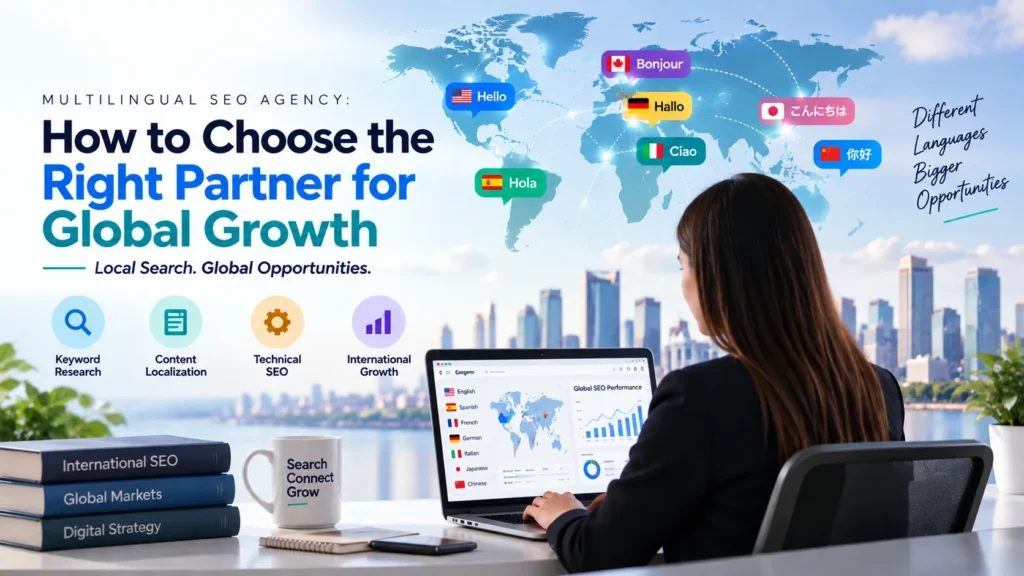
A multilingual SEO agency helps a website rank for searches in two or more languages. It combines standard SEO with language and market research. The goal is to create pages that make sense to both local users and search engines. This is different from basic translation.
For example, imagine that a US software company ranks for an English keyword. The company wants to enter Spain. It translates the keyword and its main landing page into Spanish. The translation may be correct. Yet people in Spain may use a different phrase when looking for that service. As a result, the new page may target a term with little search demand.
A good agency researches the Spanish market first. It checks the words people use, the intent behind those searches, and the pages that already rank. In simple terms, multilingual SEO focuses on how people search, not only on how they speak.
Why Is Multilingual SEO Different From Regular SEO?
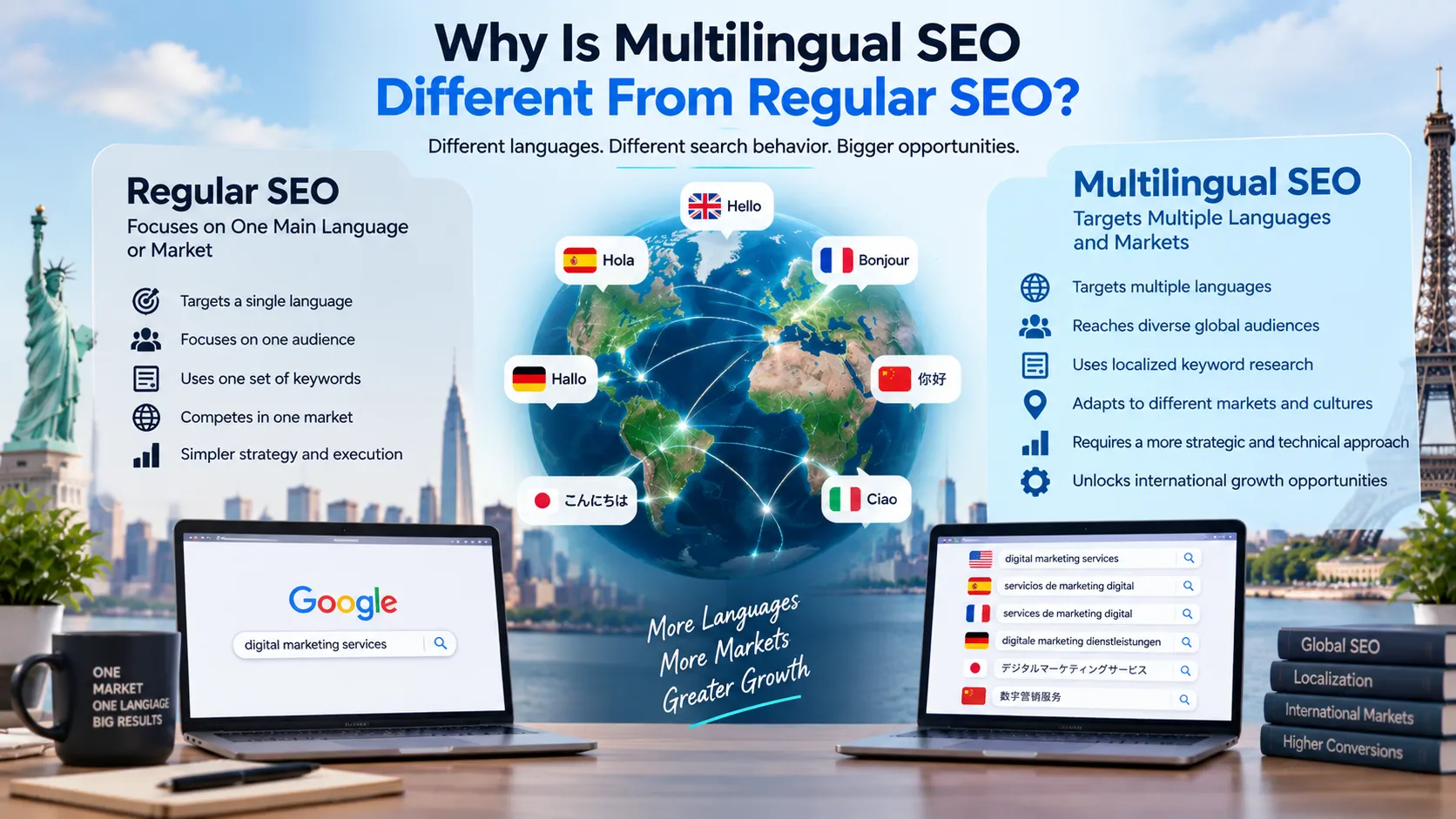
Regular SEO often focuses on one main language or market. Multilingual SEO has to account for several search environments. Each market may have its own competitors. Users may also use different terms and expect different types of content. Even countries that share a language can differ.
For example, search terms used in the United States may differ from those used in the United Kingdom. Spanish searches can also vary between Spain, Mexico, and other Spanish-speaking markets. Search intent can change too.
A keyword may be used for research in one country but have stronger buying intent in another. That affects the type of page you should create. For this reason, copying one SEO strategy across every country is rarely the best approach.
How Does Multilingual Keyword Research Work?
Multilingual keyword research finds the terms that real users search for in each target market. The process should start with local search data. It should not start with a translated English keyword list.
Suppose a US company wants to sell a service in France. Its main English keyword may have a direct French translation. But French customers may use another phrase far more often. The agency should research both options.
It should check search demand, keyword meaning, local competitors, related queries, and search intent. It should also review the pages that already appear in search results. This process helps answer three basic questions:
- What do people call this product or service in the target market?
- What do they expect to find when they search for it?
The answers can shape page titles, headings, copy, FAQs, and calls to action.
What Is the Difference Between Translation and SEO Localization?
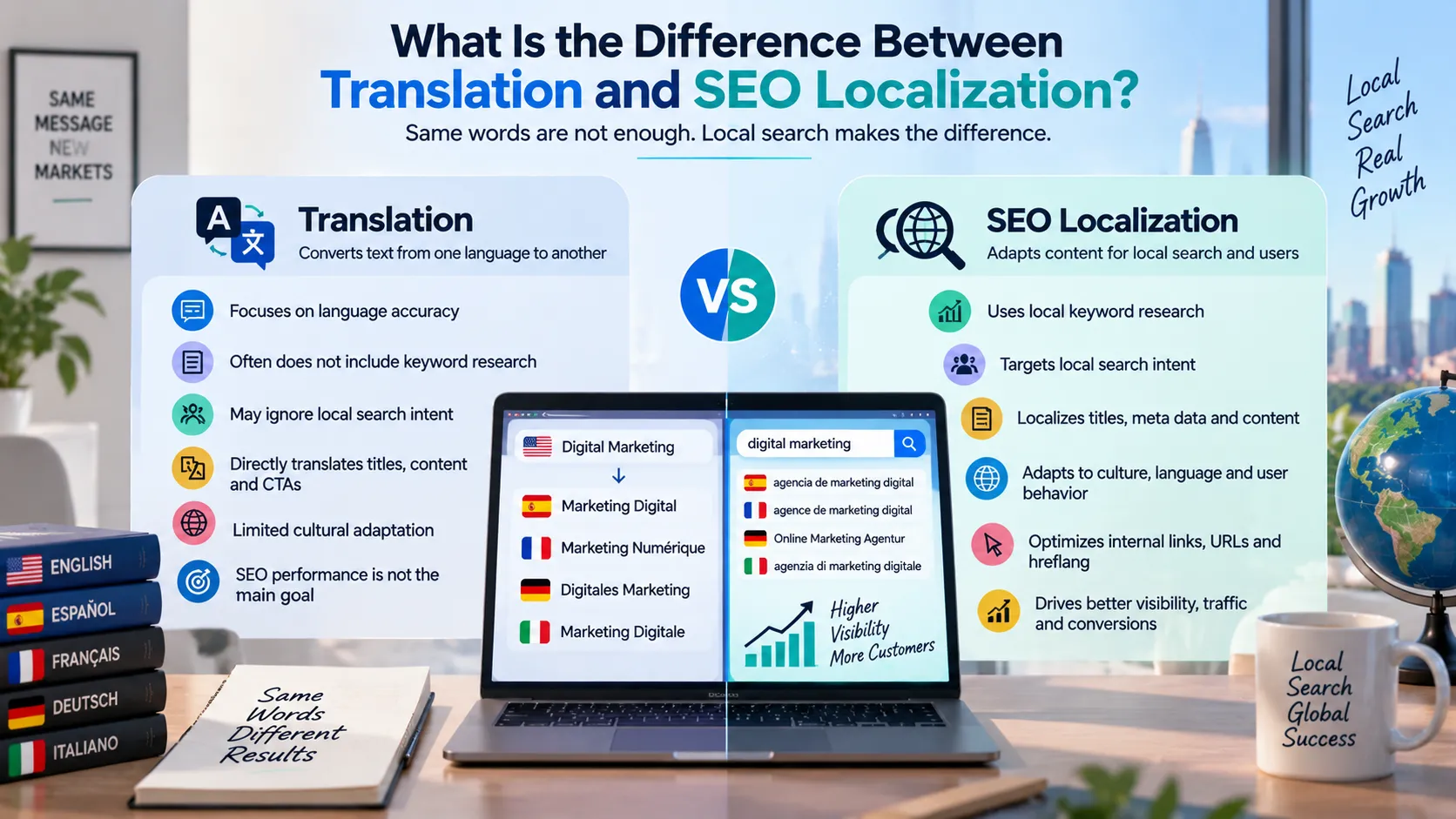
Translation and SEO localization have different goals. Translation transfers meaning from one language to another. SEO localization adapts a page to the language, search behavior, and needs of a local audience. Here is the difference:
Area | Basic Translation | SEO Localization |
Main goal | Preserve meaning | Match local search needs |
Keyword research | Often not included | Done for the target market |
Search intent | May stay unchanged | Reviewed for local users |
Titles and metadata | Usually translated | Written around local searches |
Terminology | Based on source text | Based on natural local usage |
Cultural context | Limited changes | Adapted where needed |
Calls to action | Often translated | Adjusted for the market |
SEO focus | Secondary | Core part of the process |
Translation still matters. Poor language can damage trust. But correct grammar does not mean a page is ready to rank. Search demand and user intent must also be considered.
Why Is Hreflang Important for Multilingual SEO?
Hreflang helps search engines understand alternate language or regional versions of a page. It is a signal rather than a direct ranking boost. For example, a company may have one English page for US visitors and another for UK visitors. The pages may offer similar services but use different prices, spelling, or regional details.
Hreflang can help search engines understand which version is meant for each audience. It can be implemented in HTML, HTTP headers, or XML sitemaps. The setup needs care. Wrong language codes, missing return links, or conflicts with canonical tags can create problems.
A technical audit should therefore check hreflang together with canonicals, redirects, XML sitemaps, internal links, crawl access, and indexing. Hreflang does not guarantee higher rankings. Its main purpose is to help search engines understand language and regional page relationships.
Which URL Structure Is Best for a Multilingual Website?
There is no single URL structure that works best for every business. The three common choices are subdirectories, subdomains, and country-code domains.
Structure | Example | Main Benefit | Main Challenge |
Subdirectory | example.com/es/ | Keeps languages under one domain | Needs clear site structure |
Subdomain | es.example.com | Creates separate market sections | Can add management work |
Country-code domain | example.es | Gives users a clear country focus | Requires more domains and resources |
Subdirectories are often easier to manage because the content stays under one main domain. Country-code domains can make sense when a company has a strong presence in a specific country. However, each domain needs its own maintenance and SEO effort.
Subdomains offer another way to separate markets. They can be useful for some technical or business setups. The right choice depends on the current website, target countries, resources, branding, and long-term plans. It is better to make this decision early. Changing a large international site later can create extra work and migration risk.
What Should a Top Multilingual SEO Agency Provide?
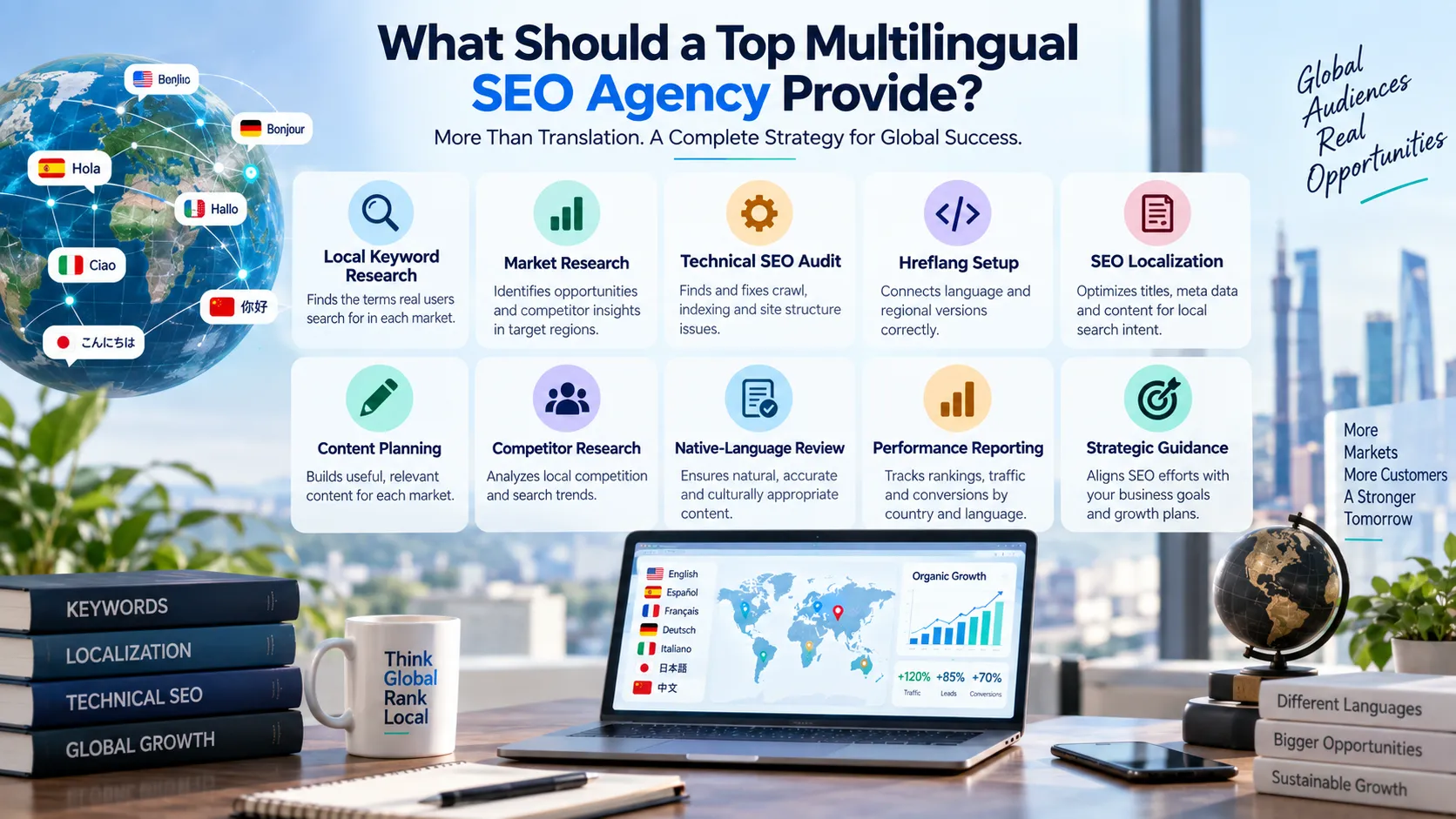
A top multilingual SEO agency should provide more than translation and basic on-page SEO. Its work should connect search data, local language knowledge, technical SEO, and business goals.
Service | Why It Matters |
Local keyword research | Finds terms real users search for |
Market research | Shows where useful demand exists |
Technical SEO audit | Finds crawl and indexing problems |
Hreflang setup | Connects language and regional pages |
SEO localization | Adapts content to local search intent |
Content planning | Builds topics around market needs |
Competitor research | Shows what works in local results |
Native-language review | Helps improve natural wording |
Reporting | Tracks results by country and language |
Not every company needs all these services. A US business adding Spanish pages may need a simple plan. An online store operating across ten countries may need a much larger program. The agency should build its scope around the business. It should not sell the same package to every client.
How Should You Choose Which Markets to Target?
One of the biggest mistakes in international SEO is trying to enter too many markets at once. A better approach is to rank each market by its value and difficulty. A simple framework can help.
Factor | Question to Ask |
Search demand | Are people searching for what we sell? |
Business value | Can this market produce useful leads or sales? |
Competition | Can we compete with current search results? |
Localization cost | How much new content and review will we need? |
Operational readiness | Can we serve customers in this market well? |
This framework can stop a company from investing in a language only because it has a large number of speakers. A market can have high search demand but still be a poor choice. The business may not be able to ship there, provide support, accept local payments, or compete on price. SEO should support a real business opportunity.
How Can Multilingual SEO Help US Businesses?
US companies do not need to expand overseas to benefit from multilingual search. The United States has audiences that search in many languages. For some businesses, this creates a domestic SEO opportunity.
A company may decide to build Spanish pages, for example. But it should first confirm that its customers use Spanish when searching for its services. International growth creates another use case.
A US SaaS company may create localized pages for European markets. An e-commerce store may target product searches in several countries. A B2B company may publish local service and solution pages.
The right approach depends on demand. Do not select languages based only on population size. Look at search behavior, business value, and your ability to serve the market.
What Are the Main Benefits of a Multilingual SEO Agency?
International SEO can involve several teams. SEO specialists, developers, writers, translators, editors, and local experts may all play a role. A specialist agency can bring these tasks into one process. The main benefits can include:
- Better local keyword targeting, more natural content, stronger technical setup, and clearer market-level reporting.
- Lower risk of errors caused by poor translation, wrong hreflang, weak site structure, or a rushed international launch.
This does not mean an agency can guarantee rankings. Its value comes from better research, execution, and quality control. It can also help a business avoid costly mistakes.
What Are the Drawbacks of Multilingual SEO?
Multilingual SEO needs time and resources. Every new market can require keyword research, content, technical setup, language review, reporting, and updates. The work also continues after launch.
Imagine that a company changes the price or features on its English product page. If it forgets to update its French and German pages, customers may see old information. Quality control becomes harder as the website grows.
For this reason, it is often better to launch a few strong markets first. The company can learn from the results before adding more.
How Do You Choose the Best Multilingual SEO Agency?
The best multilingual SEO agency is not simply the one with the largest client list. It should fit your target markets and business model. Start by checking its experience with the countries and languages you want to target. Then ask how it performs keyword research.
A strong process should include research inside each market. Be careful if an agency only translates an English keyword list. Ask who writes and reviews the content. Native or highly fluent reviewers can help with natural wording and local terms. Technical knowledge also matters.
The agency should be able to explain hreflang, canonical tags, indexing, redirects, sitemaps, crawling, and international URL structures in clear language. Finally, ask how it measures results. Rankings matter, but they do not tell the whole story. Traffic that never produces a lead or sale may have little business value.
What Metrics Should You Track?
Multilingual SEO should be measured by market whenever possible. Do not place all international traffic into one report. A website could gain traffic in one country while losing valuable leads in another. A single global number may hide that problem.
Useful metrics include organic clicks, impressions, search visibility, qualified visits, leads, sales, and organic revenue. The right metric depends on the company.
An online store may focus on sales and revenue. A B2B company may track qualified leads. A publisher may care more about organic readership. Good reporting links SEO activity to business results.
Should You Use AI for Multilingual SEO Content?
AI can make multilingual workflows faster. It can help with research, outlines, topic ideas, content briefs, and early drafts. But AI output still needs review. A sentence can be grammatically correct and still sound strange to a local reader. AI can also choose the wrong regional term or miss the intent behind a keyword.
AI-generated translations should be checked for local terms, spelling, cultural context, facts, and search intent. This is even more important for legal, medical, financial, and other sensitive content. The goal is not to avoid AI. The goal is to use it where it helps and add human review where accuracy matters.
How Can Multilingual Content Perform Better in AI Search?
People now discover information through both traditional search and AI-powered search tools. This makes clear content even more important.
Pages should give direct answers to common questions. Headings should describe what each section covers. Definitions should be simple. Important claims should have enough context to make sense on their own.
This structure helps readers scan a page. It can also make information easier for search and AI systems to understand and retrieve. The same standards should apply to every language version. Do not fill localized pages with repeated keywords. Focus on useful facts, clear explanations, and the questions real users ask.
Is Multilingual Link Building Different?
Yes. Link opportunities often change from one market to another. Each country has its own publishers, trade sites, business groups, directories, and online communities. A US outreach list may not work for a campaign in France or Germany.
Relevant local links can help a business build awareness in the target market. They may also send useful referral traffic. This does not mean every link must come from the same country. Strong and relevant international websites can still be useful. The focus should be quality and relevance. Avoid bulk link packages or low-quality sites created only to sell backlinks.
What Multilingual SEO Mistakes Should You Avoid?
Many problems happen when a company tries to scale too fast. Watch for these common mistakes:
- Translating keywords word for word, publishing unreviewed machine translations, using the wrong hreflang setup, or launching too many languages at the same time.
- Ignoring local competitors, copying the same search intent across countries, leaving old translated pages online, or judging every market through one combined report.
A smaller set of useful, well-researched pages is often a better starting point than hundreds of weak translations.
How Much Does a Multilingual SEO Agency Cost?
There is no standard price for multilingual SEO. Cost depends on the number of markets, website size, competition, technical needs, and amount of content. A small website adding one language needs less work than an e-commerce site with thousands of product and category pages.
Language can also affect cost. Some projects need specialist writers or reviewers with knowledge of a specific industry. When comparing agencies, look at the scope rather than the monthly fee alone.
Check what the proposal includes. Research, technical work, content, localization, quality checks, and reporting should be clear. This makes different offers easier to compare.
When Should You Hire a Multilingual SEO Agency?
Specialist help makes sense when search is important to your expansion plan, but your team lacks international SEO skills. It can also help when a multilingual website already exists but does not perform well.
You may find that pages are indexed but get few clicks. Google may show the wrong country version. Localized pages may also rank far below the original English content. These problems do not always come from writing.
The cause could be poor keyword research, technical errors, weak local authority, wrong search intent, or site structure. An audit can help find the real issue before more money is spent on content.
What Is the Best Way to Start Multilingual SEO?
Start with research. Do not translate the whole website on day one. Choose markets with clear search demand and real business value. Next, check the website’s technical setup. Make sure search engines can crawl and index the right pages. Then focus on high-value pages first. These may be service pages, product categories, product pages, or useful guides.
Research the target market before localizing each page. Review the final copy for language quality and search intent. After launch, track each market on its own. Use those results to decide where to improve and where to expand next.



Boutique SEO Agency: A Practical Guide for Growing Your Business
Jump To Boutique SEO Agency: A Practical Guide for Growing

SEO Agency for Ecommerce: How to Choose the Right SEO Partner in the USA
Jump To SEO Agency for Ecommerce: How to Choose the

Multilingual SEO Agency: How to Choose the Right Partner for Global Growth
Jump To Multilingual SEO Agency: How to Choose the Right

B2B Social Media Marketing Agency for US Businesses
Jump To B2B Social Media Marketing Agency for US Businesses