Call Us Now:
+92 300 9842234
Side Info Heading
Side Info Text
Gallery Heading
Follow Us

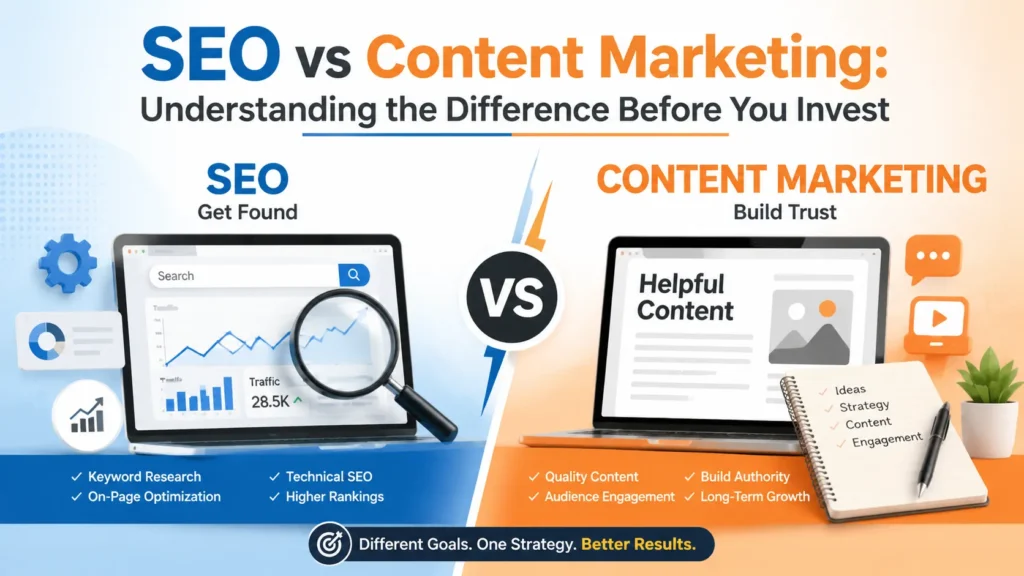
If you’re looking to grow your website and attract more customers, you’ve probably heard the debate about SEO vs Content Marketing. While many see them as separate strategies, they work best together. SEO helps your website rank higher in search results, while content marketing builds trust by delivering valuable information to your audience.
At Tekcurio, we’ve found that combining SEO with high-quality content creates sustainable growth, stronger brand authority, and better long-term results. In this guide, you’ll learn the key differences between SEO and content marketing and why using both together is the smartest strategy for success.
What Is SEO?
Search Engine Optimization, commonly known as SEO, is the practice of improving a website so it becomes easier for search engines to understand, evaluate, and recommend to users.
When someone searches for a product, service, or question on Google, hundreds or even thousands of pages may be relevant. SEO helps your website stand out by demonstrating that your content is valuable, technically sound, and closely aligned with what users are looking for.
Contrary to popular belief, SEO is no longer just about adding keywords to a page. Modern optimization involves improving every aspect of the user experience, from website speed and mobile usability to content quality and internal linking.
Think of SEO as building the roads that lead people to your business. Without those roads, even the most useful website can remain invisible. Today, SEO generally includes three major areas.
On-Page SEO
On-page SEO focuses on everything that appears directly on your website. This includes creating descriptive titles, writing useful headings, improving content quality, optimizing images, and ensuring every page answers a specific search intent.
Technical SEO
Technical SEO ensures search engines can easily crawl, index, and understand your website. It includes factors such as page speed, website security, mobile responsiveness, structured data, XML sitemaps, and clean site architecture.
Off-Page SEO
Off-page SEO refers to activities that strengthen your website’s authority outside your own pages. High-quality backlinks, digital PR, brand mentions, and positive online reputation all contribute to stronger search visibility.
Rather than treating these elements separately, successful businesses view SEO as an ongoing process that improves both search performance and user experience.
What Is Content Marketing?
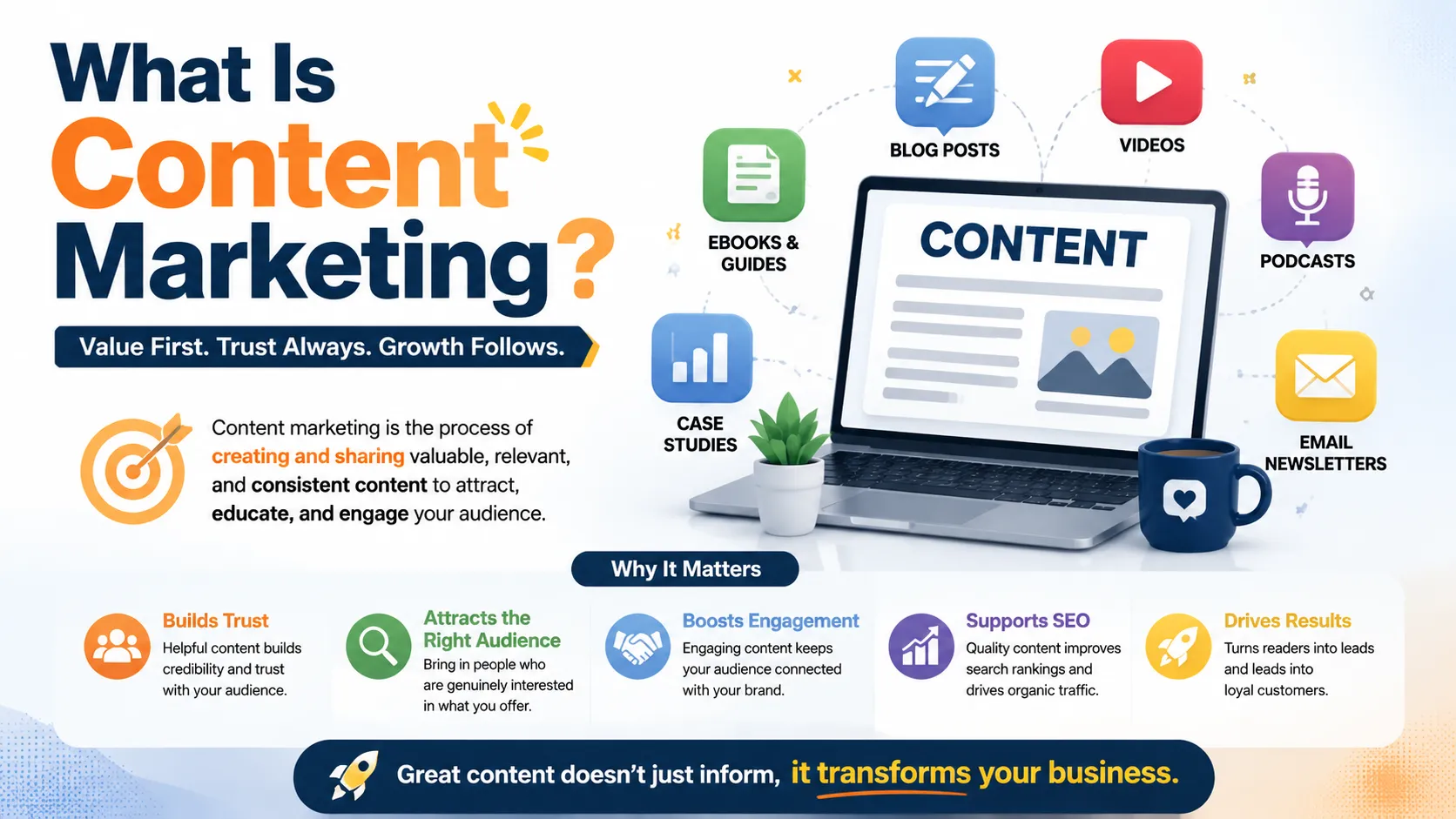
While SEO helps people find your website, content marketing gives them a reason to stay. It involves creating valuable, relevant, and trustworthy content that educates, solves problems, and helps people make informed decisions instead of directly promoting products or services.
Content marketing can include blog posts, case studies, videos, guides, newsletters, and podcasts. Its goal is to build trust by consistently delivering useful information. Today, both readers and search engines value original, experience-driven content, making quality more important than ever.
SEO vs Content Marketing at a Glance
Before exploring the deeper differences, it’s helpful to understand how these two strategies complement one another rather than compete.
Aspect | SEO | Content Marketing |
Primary Purpose | Improve search visibility | Educate, engage, and build trust |
Main Audience | Search engines and users | Primarily human readers |
Focus | Website optimization and discoverability | Valuable information and customer relationships |
Long-Term Goal | Higher organic traffic | Greater authority, loyalty, and conversions |
Works Best When | Supported by quality content | Supported by strong SEO |
The table makes one thing clear: neither strategy replaces the other. SEO creates opportunities for discovery, while content marketing ensures those opportunities lead to meaningful engagement.
Why Do People Often Confuse SEO and Content Marketing?
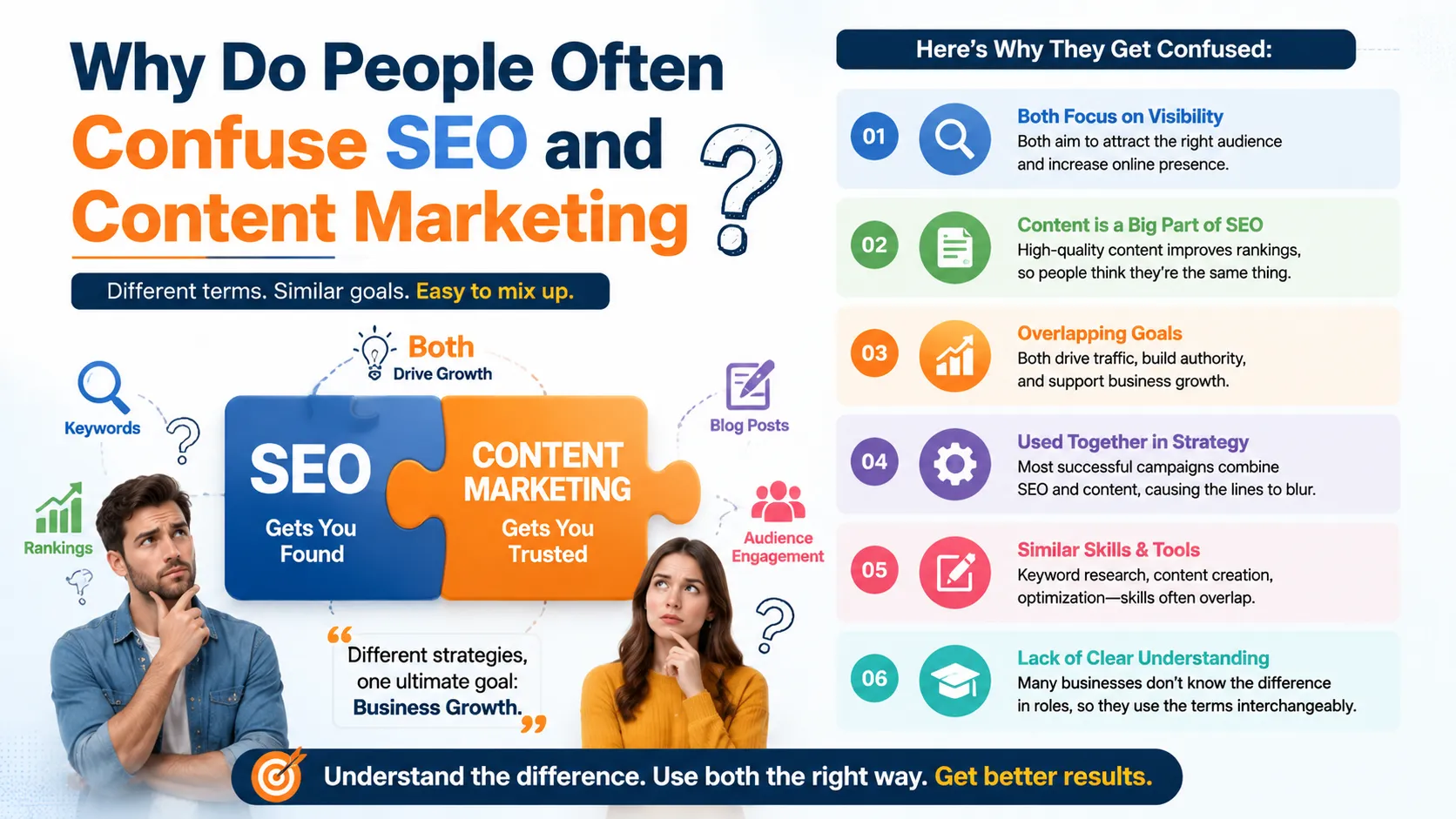
One reason this debate continues is that both strategies frequently overlap during everyday marketing activities. For example, when you publish a blog article targeting a specific keyword, are you doing SEO or content marketing? The answer is both.
The keyword research, page optimization, internal linking, and metadata are all part of SEO. Research, writing, storytelling, examples, and educational value are part of content marketing.
Because they work so closely together, many people mistakenly assume they are identical disciplines. In reality, they solve different problems. SEO helps people discover your content, while content marketing helps them trust what they find.
Understanding that distinction is the first step toward building a digital strategy that delivers lasting results rather than short-term traffic spikes.
The Real Difference Between SEO and Content Marketing
Many articles compare SEO and content marketing as if they are competing marketing channels. In practice, that comparison misses the bigger picture.
Imagine opening a beautiful retail store in the middle of a desert. The interior is well designed, the products are excellent, and customer service is outstanding. Yet almost nobody visits because there are no roads leading to the store.
Now imagine the opposite. There are highways leading to your store, but once people enter, they find empty shelves and leave within seconds. Neither business succeeds.
That is exactly how SEO and content marketing work. SEO creates the path that brings visitors to your website, while content marketing gives those visitors a reason to stay, explore, and eventually become customers. Businesses that understand this relationship tend to build long-term digital assets instead of chasing short-term marketing wins.
What Is the Primary Goal of SEO?
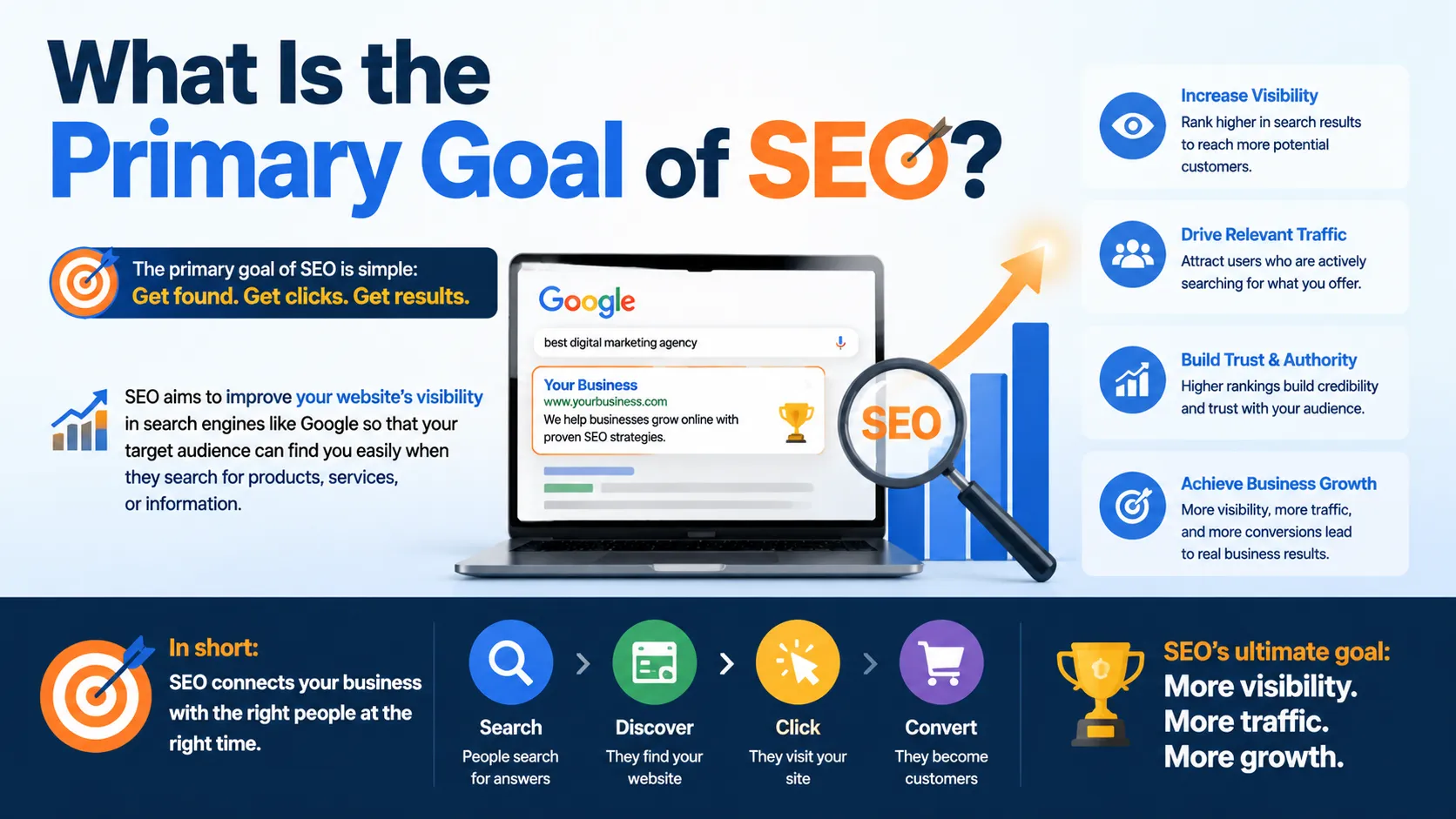
The purpose of SEO is simple: make your website visible when people are actively searching for information. When someone searches for “best CRM software,” “roof repair near me,” or “how to start an LLC,” search engines evaluate millions of pages before deciding which ones deserve to appear first.
SEO improves your chances of becoming one of those recommended pages. However, rankings alone are not the final objective.
Modern SEO aims to attract qualified visitors, people who are genuinely interested in your products, services, or expertise. A page that ranks well but fails to satisfy visitors will rarely maintain its position for long because search engines increasingly measure user satisfaction alongside traditional ranking signals.
What Is the Primary Goal of Content Marketing?
Content marketing begins with a different question. Instead of asking, “How can we rank higher?”, it asks, “How can we genuinely help our audience?” That shift in thinking changes everything.
Rather than producing content simply to target keywords, successful marketers identify the challenges, questions, and concerns their audience experiences every day. They then create resources that provide practical, trustworthy answers.
Over time, readers begin to associate that helpful experience with the brand itself. This trust becomes one of the strongest competitive advantages any business can develop because customers naturally prefer companies that educate before they sell.
SEO Brings Visitors. Content Marketing Builds Relationships.
Traffic is valuable, but attention alone does not grow a business. Imagine two websites ranking for the same keyword. The first website contains outdated information, generic advice, and obvious keyword stuffing. The second provides clear explanations, practical examples, updated statistics, and solutions readers can actually use.
Although both pages may initially attract similar traffic, the second website is far more likely to earn repeat visitors, backlinks, social shares, and customer inquiries. That difference illustrates why content quality has become one of Google’s strongest ranking considerations.
Search engines increasingly reward websites that demonstrate experience, expertise, authority, and trustworthiness because those qualities improve user satisfaction.
Why Modern SEO Depends on Great Content
Years ago, SEO could often produce results through technical adjustments and aggressive keyword optimization. Today’s search environment is completely different. Google’s Helpful Content System, EEAT principles, and AI-powered search experiences all prioritize information that is genuinely useful.
A technically perfect website cannot compensate for weak content. Similarly, publishing dozens of articles with little originality rarely produces sustainable rankings. Modern SEO succeeds when every page answers a real question better than competing pages.
Instead of asking, “How many times should this keyword appear?” experienced marketers now ask, “Will this page completely solve the reader’s problem?” That mindset leads to stronger rankings naturally.
Why Great Content Still Needs SEO
Creating exceptional content does not automatically guarantee visibility. Thousands of high-quality articles remain buried because search engines struggle to understand their relevance.
SEO provides the signals that connect valuable content with the people searching for it. For example, optimization helps search engines understand:
- What the page is about.
- Which questions it answers.
- Who the intended audience is.
- How the page relates to other content on the website.
Without those signals, even outstanding content may never reach its intended audience. In other words, quality creates value, while SEO creates discoverability.
SEO vs Content Marketing: Strengths and Limitations
Every marketing strategy has advantages and challenges. Understanding both helps businesses set realistic expectations.
SEO | Content Marketing |
Builds long-term organic traffic | Builds trust and credibility |
Improves search visibility | Educates potential customers |
Generates qualified visitors | Supports every stage of the buyer journey |
Requires continuous optimization | Requires consistent content creation |
Results often take several months | Audience growth also requires patience |
Depends on quality content | Performs best when supported by SEO |
Rather than asking which strategy is stronger, businesses should ask how each can strengthen the other.
Which Strategy Delivers a Better Return on Investment?
This is one of the most common questions business owners ask. The honest answer is that the return depends on your objectives. If your goal is immediate visibility for a brand-new product launch, paid advertising may outperform both SEO and content marketing in the short term.
However, if your objective is sustainable growth, lower customer acquisition costs, and long-term authority, combining SEO with content marketing usually delivers the strongest return over time. Unlike paid advertising, a well-optimized article can continue attracting qualified visitors months or even years after publication.
Each high-quality piece of content becomes a long-term digital asset that keeps working long after the initial investment. That compounding effect is one of the biggest reasons successful companies continue investing in educational content.
A Real-World Example
Consider two accounting firms targeting small businesses in the United States. The first firm creates a website with only service pages describing bookkeeping and tax preparation. The second firm also offers those services but regularly publishes practical guides such as:
- How to prepare for tax season.
- Common bookkeeping mistakes made by startups.
- Choosing accounting software for a growing business.
- Understanding quarterly tax payments.
Both firms offer similar services. Over time, however, the second firm’s website begins attracting business owners searching for answers to those questions.
Some visitors become newsletter subscribers. Others share the articles with colleagues. Many eventually become paying clients because they already trust the expertise demonstrated through the content. This is how SEO and content marketing create sustainable growth together rather than producing isolated marketing wins.
Common Mistakes Businesses Should Avoid
Many companies struggle not because SEO or content marketing is ineffective, but because they apply them incorrectly. The most common mistakes include:
- Treating keywords as more important than user experience.
- Publishing articles that repeat information already available everywhere else.
- Ignoring search intent and focusing only on search volume.
- Creating content without a clear strategy or topical structure.
- Expecting immediate results from strategies that naturally require consistency and patience.
- Neglecting regular updates, allowing valuable content to become outdated.
Avoiding these mistakes often produces better results than simply increasing the amount of content published.
How AI Is Changing SEO and Content Marketing
The way people search for information is evolving faster than ever. A few years ago, most users typed a short keyword into Google, clicked one of the first results, and explored several websites before making a decision. Today, that journey often looks very different.
People ask complete questions through AI-powered search tools, receive summarized answers, and expect reliable information within seconds. Platforms such as Google AI Overviews, ChatGPT Search, Gemini, and Perplexity are reshaping how content is discovered and consumed.
This shift does not mean SEO is becoming less important. Instead, it means that optimization now extends beyond traditional search rankings. Content must be structured so that both humans and AI systems can easily understand, interpret, and reference it.
For businesses, the opportunity is significant. Websites that publish original, well-organized, and trustworthy information are more likely to be cited in AI-generated responses, increasing both visibility and authority.
Why EEAT Matters More Than Ever
Google continues to emphasize Experience, Expertise, Authoritativeness, and Trustworthiness (EEAT) when evaluating content quality. While EEAT is not a direct ranking factor, it reflects the qualities Google wants to see in pages that answer important questions.
For example, a healthcare article written with clear medical references and practical guidance is more trustworthy than one filled with vague or unsupported claims. Likewise, a software review based on actual product testing is generally more valuable than one copied from other websites.
Businesses can strengthen EEAT by:
- Demonstrating real-world experience instead of repeating common information.
- Explaining concepts accurately and in plain language.
- Keeping content updated as industries change.
- Supporting claims with reliable sources and practical examples.
- Publishing comprehensive resources that fully answer user questions.
When readers trust your content, search engines are more likely to trust it as well.
GEO: Writing for Generative Search
Generative Engine Optimization (GEO) focuses on making content easier for AI search systems to understand and reference. Unlike traditional SEO, GEO is not just about ranking on a search results page. It is about becoming a source that AI platforms consider reliable enough to summarize or cite. A page designed for GEO usually includes:
- Clear definitions at the beginning of important sections.
- Logical headings that answer specific questions.
- Comprehensive topic coverage instead of surface-level explanations.
- Natural language that reflects how people actually ask questions.
- Consistent facts supported by credible information.
Rather than writing for algorithms, GEO encourages writing for clarity. The easier your content is to understand, the easier it becomes for AI systems to interpret.
AEO: Optimizing for Direct Answers
Answer Engine Optimization (AEO) focuses on delivering concise, accurate responses to user questions. Many searches today begin with words such as what, why, how, when, or which. Search engines often highlight content that answers these questions directly before providing additional details. For example:
What is the difference between SEO and content marketing?
SEO improves a website’s visibility in search engines, while content marketing focuses on creating valuable information that attracts, educates, and builds trust with potential customers. Together, they support sustainable online growth.
Providing clear answers like this increases the likelihood of appearing in featured snippets, AI summaries, and voice search results.
AIO: Preparing Content for AI Systems
AI Optimization (AIO) ensures that information is structured in a way that artificial intelligence can easily process. Instead of relying on complicated language or unnecessary jargon, AIO encourages writers to present ideas logically. Good AIO practices include:
- Using descriptive headings.
- Explaining one idea before moving to the next.
- Maintaining a clear content hierarchy.
- Avoiding vague statements and unsupported opinions.
- Writing naturally while staying factual.
These practices improve readability for people while also helping AI systems identify key information more accurately.
Best Practices for Combining SEO and Content Marketing
Businesses that consistently perform well in organic search tend to follow similar principles. Rather than chasing algorithm updates, they focus on delivering genuine value. Some of the most effective practices include:
- Start every piece of content with a clear understanding of user intent rather than simply targeting a keyword.
- Build topical authority by publishing related content that explores a subject from multiple angles.
- Refresh important articles regularly to keep information accurate and relevant.
- Use internal links to guide readers toward additional resources.
- Measure success through meaningful outcomes such as engagement, qualified leads, and conversions instead of rankings alone.
These habits create a stronger foundation than any short-term SEO tactic.
The Future of SEO and Content Marketing
Digital marketing will continue to evolve, but one principle is unlikely to change. Search engines and increasingly AI systems exist to connect people with the most useful information available.
As algorithms become more sophisticated, they will become even better at recognizing originality, expertise, and genuine value. Businesses that rely on shortcuts, repetitive content, or outdated optimization techniques may find it increasingly difficult to compete.
On the other hand, organizations that invest in helpful content, strong technical foundations, and a positive user experience will continue to build authority over time. The future belongs to brands that prioritize people first and optimization second, not because SEO is unimportant, but because modern SEO rewards websites that truly deserve attention.
Frequently Asked Questions
Is SEO better than content marketing?
Neither strategy is better on its own. SEO helps potential customers discover your website, while content marketing gives them valuable reasons to stay, learn, and trust your brand. The strongest results come from combining both.
Does every website need SEO?
If you want people to find your website through search engines, SEO is essential. It improves visibility, accessibility, and long-term organic growth.
Can content marketing increase sales?
Yes. Helpful content builds trust throughout the customer journey, making people more confident when choosing your products or services. Although it may not generate immediate sales, it often leads to higher-quality conversions over time.
How long does it take to see results?
Content marketing and SEO are long-term strategies. While some improvements may appear within a few weeks, meaningful organic growth usually develops over several months through consistent effort.
Should small businesses invest in both?
Absolutely. Even with a limited budget, combining basic SEO with high-quality educational content often produces better long-term results than focusing on only one approach.
Conclusion
The debate around SEO vs Content Marketing isn’t about choosing one over the other; it’s about using both together. SEO helps people discover your website, while content marketing builds trust, answers questions, and turns visitors into loyal customers. Combined, they create a stronger strategy for sustainable online growth.
At Tekcurio, we help businesses across the USA grow with data-driven SEO and high-quality content marketing strategies that improve rankings, increase organic traffic, and generate qualified leads. As search engines and AI platforms continue to evolve, businesses that prioritize helpful, user-focused content will stay ahead of the competition.
If you’re ready to strengthen your online presence and achieve long-term digital growth, book an appointment with Tekcurio today and let our experts create a customized SEO and content marketing strategy for your business.

Restaurant SEO Agency: How to Grow Restaurant Visibility, Traffic, and Reservations in Los Angeles
Jump To Restaurant SEO Agency: How to Grow Restaurant Visibility,
SEO Agency Los Angeles: How to Choose the Right SEO Partner for Business Growth
Jump To SEO Agency Los Angeles: How to Choose the
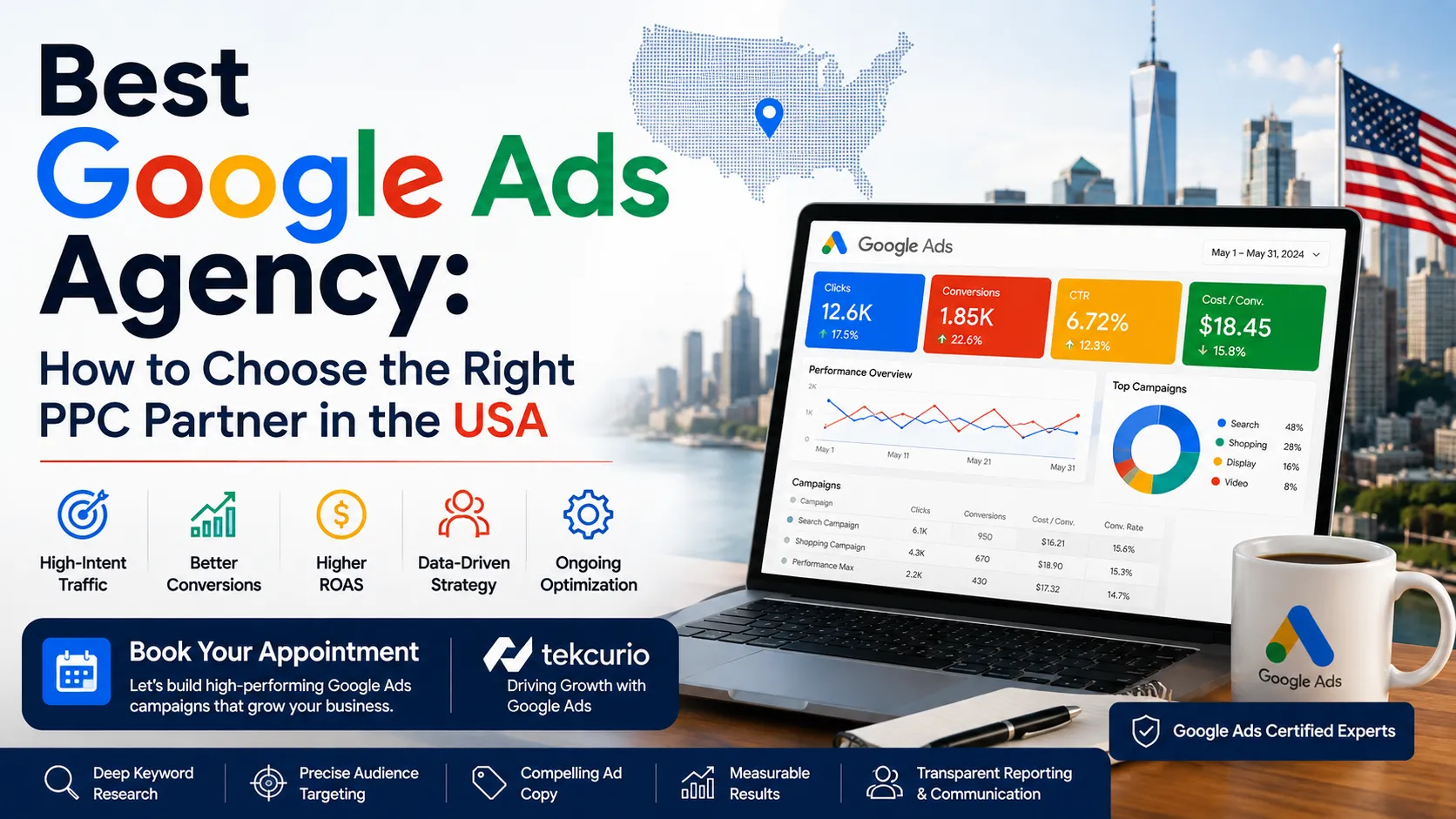
Best Google Ads Agency: How to Choose the Right PPC Partner in the USA
Jump To Best Google Ads Agency: How to Choose the

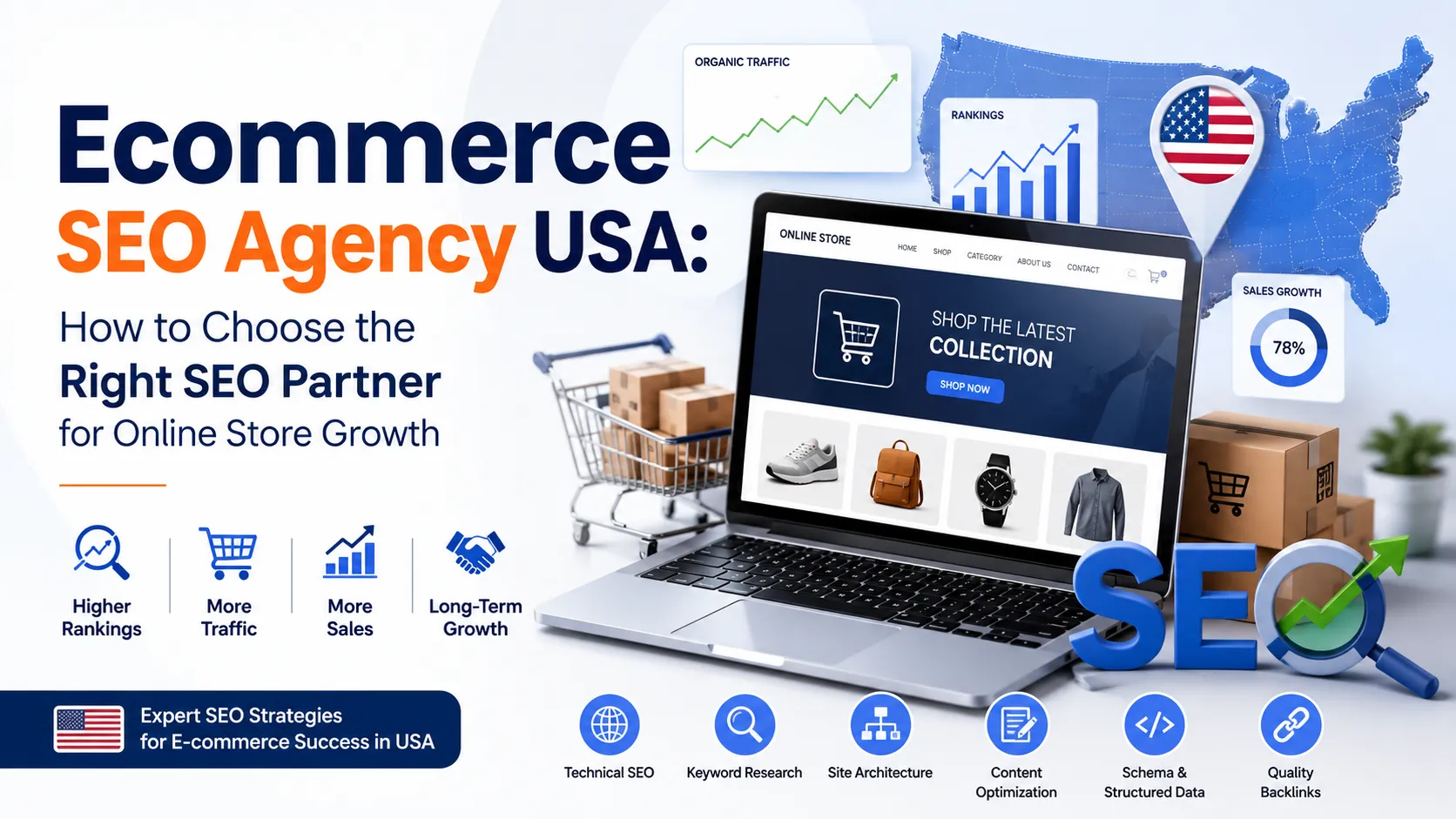
Ecommerce SEO Agency USA: How to Choose the Right SEO Partner for Online Store Growth
Jump To Ecommerce SEO Agency USA: How to Choose the