

SEO vs PPC: Which Digital Marketing Strategy Delivers Better Results in 2026?
Jump To
SEO vs PPC: Which Digital Marketing Strategy Delivers Better Results in 2026?
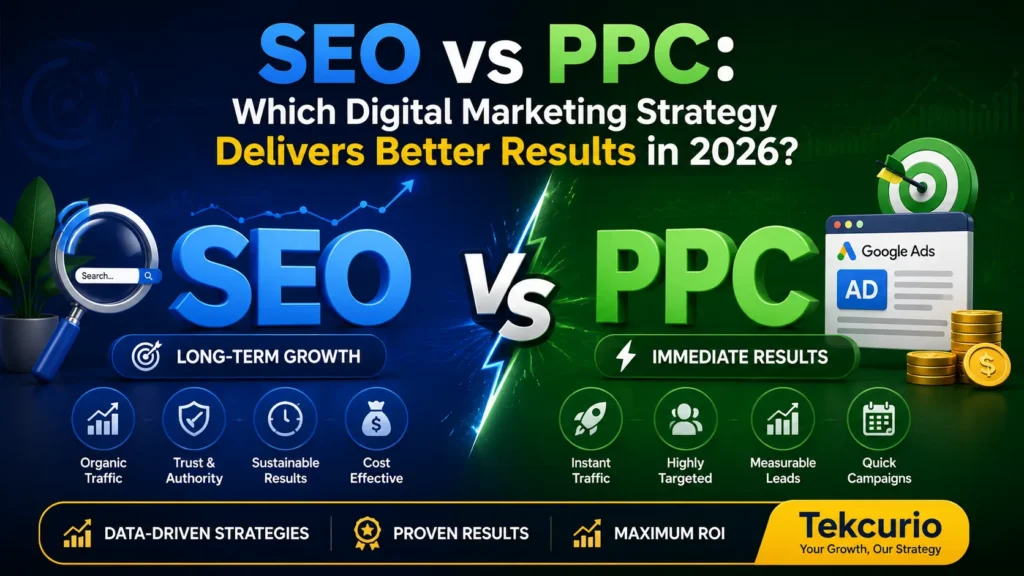
Choosing between SEO vs PPC is one of the most important digital marketing decisions for any business. While SEO focuses on sustainable organic growth, PPC helps generate immediate traffic and leads through paid campaigns. The right choice depends on your objectives, budget, and how quickly you need results.
In 2026, search is no longer limited to traditional Google rankings. AI-powered search experiences, Google AI Overviews, and conversational platforms have changed how people discover businesses online. That means companies need a strategy that goes beyond simply ranking or running ads.
This guide compares SEO vs PPC while also exploring SEO vs AEO, AEO vs GEO, SEO vs GEO, and SEO vs LLM to help you understand the future of search.
If you’re looking for a partner to maximize both organic and paid performance, Tekcurio combines SEO, PPC, and AI-focused optimization to help businesses achieve measurable, long-term growth through proven strategies and real-world results.
Quick Answer
The choice between SEO vs PPC depends on your business goals, budget, and timeline. SEO helps build long-term organic visibility, while PPC delivers immediate traffic through paid advertising. For most businesses, a combination of both strategies delivers the best results.
If you’re looking for expert guidance, Tekcurio helps businesses create the right mix of SEO and PPC strategies based on their goals, backed by proven client results and data-driven marketing.
What Is SEO?
Search Engine Optimization (SEO) is the process of improving a website so it appears naturally in search engine results without paying for each visitor. Instead of buying clicks, SEO helps search engines understand your content, your expertise, and the value your website provides to users.
Modern SEO goes far beyond inserting keywords into a page. Search engines now evaluate whether your content genuinely answers questions, demonstrates expertise, and provides a trustworthy experience. They also consider page speed, mobile usability, website structure, topical authority, and user engagement.
Think of SEO as building a valuable digital asset. Every well-optimized page has the potential to attract visitors for months or even years after it is published. Although results usually take time, the long-term return can be significant because organic traffic continues without a direct advertising cost for every click.
A local law firm publishing detailed legal guides, a software company creating educational resources, or an online retailer optimizing product pages are all examples of businesses using SEO to build sustainable visibility.
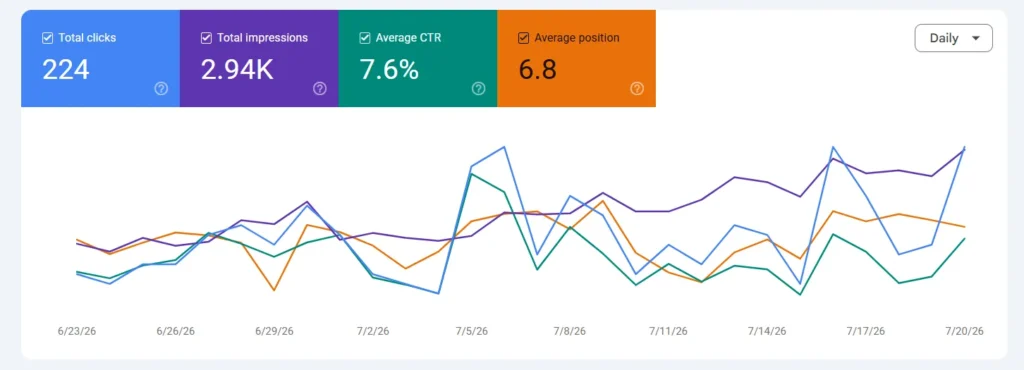
Tekcurio SEO Proven Results: Real Growth Backed by Data
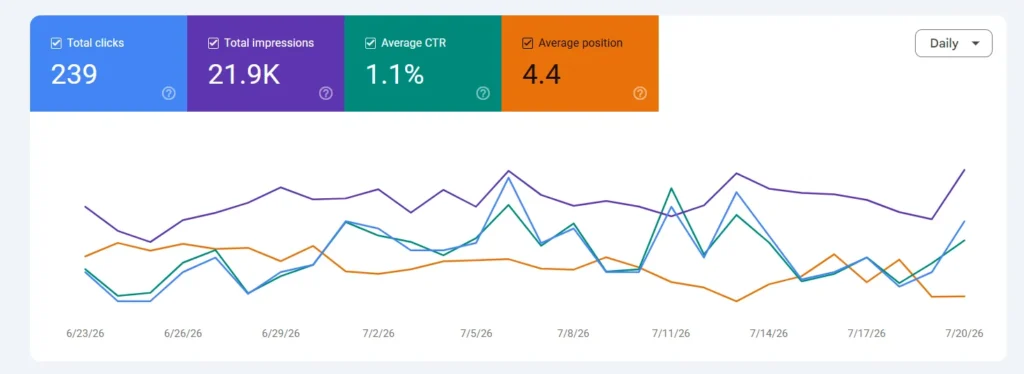
At Tekcurio, we believe that successful SEO should be measured by real business outcomes, not just rankings. Our data-driven SEO strategies have helped businesses improve organic visibility, increase qualified traffic, and achieve consistent growth across competitive search results.
The Google Search Console performance snapshots below showcase real improvements in clicks, impressions, click-through rates (CTR), and keyword rankings, demonstrating our commitment to delivering measurable and sustainable SEO success.
See the real performance results achieved through Tekcurio’s proven SEO strategies below.
What Is PPC?
Pay-Per-Click (PPC) is an online advertising model where businesses pay only when someone clicks on their advertisement. The most common example is Google Ads, although PPC campaigns also run across Bing, YouTube, LinkedIn, Meta platforms, Amazon, and other advertising networks.
Unlike SEO, PPC can place a business in front of potential customers almost immediately. A campaign launched today can begin generating impressions, clicks, and leads within hours if it is properly configured.
The speed of PPC makes it particularly useful for:
- Launching new products or services
- Promoting seasonal offers
- Testing new markets
- Generating leads quickly
- Supporting limited-time campaigns
However, paid advertising comes with an important trade-off. Once the advertising budget stops, the traffic generally stops as well. PPC provides speed and control, but it requires continuous investment to maintain visibility.
SEO vs PPC: Understanding the Fundamental Difference
At first glance, SEO and PPC seem to solve the same problem; they both help businesses appear in search results. The difference lies in how that visibility is earned.
SEO is based on building authority over time. Every optimized page, helpful article, and technical improvement strengthens your website’s ability to earn organic rankings. Results usually take patience, but they often become more cost-effective in the long run.
PPC works differently. Instead of waiting to earn visibility, you purchase placement through advertising platforms. This allows businesses to target specific audiences, keywords, locations, and demographics almost instantly. The benefit is speed, but the investment continues for as long as the campaign runs.
Rather than viewing them as competitors, many successful companies treat SEO and PPC as complementary strategies. PPC creates immediate opportunities while SEO builds lasting visibility that reduces dependence on paid advertising over time.
SEO vs PPC Comparison
Factor | SEO | PPC |
Visibility | Organic search results | Paid advertisements |
Time to Results | Usually several months | Often within hours or days |
Cost Model | Investment in optimization and content | Pay for every qualified click |
Long-Term Value | Continues after ranking is established | Stops when advertising budget ends |
Best For | Sustainable growth and authority | Fast leads, launches, and promotions |
Why the SEO vs PPC Debate Matters More Than Ever
A few years ago, businesses mainly focused on ranking higher in Google Search. Today, users discover information through many different experiences. Google AI Overviews summarize answers before users even visit websites.
AI assistants recommend businesses during conversations. Voice search continues to grow, and generative search systems increasingly influence buying decisions. As a result, choosing between SEO and PPC is no longer just about traffic. It is about building visibility across multiple discovery channels.
A business relying only on paid advertising may generate immediate sales but miss the long-term trust that comes from authoritative organic content. On the other hand, a company focusing only on SEO may struggle to capture high-intent customers during important campaigns or product launches.
The strongest digital strategies in 2026 recognize that search behaviour has evolved. Success comes from understanding how different marketing channels work together rather than treating them as isolated tactics.
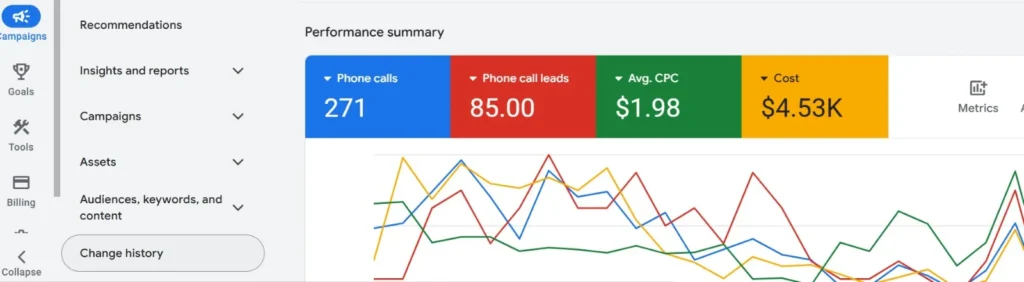
Tekcurio Google Ads Proven Results: Driving More Leads with High-Performance PPC Campaigns
At Tekcurio, we create data-driven Google Ads (PPC) campaigns that focus on generating qualified leads, increasing phone calls, and maximizing return on ad spend (ROAS). Instead of simply driving traffic, our PPC experts continuously optimize targeting, bidding, keywords, and ad performance to deliver measurable business results.
The Google Ads performance snapshot below highlights real campaign success, including increased phone calls, lead generation, cost efficiency, and overall campaign performance achieved through Tekcurio’s proven PPC strategies.
Explore the real Google Ads results delivered by Tekcurio’s PPC experts below.
How Search Has Changed Beyond Traditional SEO
Search engines no longer evaluate websites using keywords alone. They attempt to understand topics, context, expertise, and user intent before deciding which content deserves visibility.
This shift has introduced several new concepts that marketers frequently encounter, including SEO vs AEO, AEO vs GEO, SEO vs GEO, and SEO vs LLM. While these terms sound similar, they represent different ways of optimizing content for modern search experiences.
Traditional SEO remains the foundation because search engines still need high-quality, well-structured websites. However, businesses now also need content that AI systems can interpret, summarize, and confidently reference when answering user questions.
Instead of replacing SEO, these newer approaches expand it. They encourage publishers to create content that is not only easy for search engines to rank but also easy for AI systems to understand, verify, and cite.
In the next section, we’ll explore how these modern optimization approaches differ, why they matter, and whether businesses should invest in them alongside traditional SEO.
SEO vs AEO: How Search Optimization Is Evolving
If SEO helps your website rank in search results, Answer Engine Optimization (AEO) focuses on helping your content become the answer itself.
Search behaviour has changed dramatically over the last few years. People no longer search only through Google’s traditional blue links. They ask complete questions in Google AI Overviews, ChatGPT, Gemini, Microsoft Copilot, and voice assistants. Instead of clicking through several websites, users often expect an immediate, trustworthy answer.
This shift doesn’t mean SEO is becoming obsolete. It means the definition of successful optimization has expanded. SEO still helps search engines discover, understand, and rank your pages. AEO builds on that foundation by making information easier for answer engines to extract, summarize, and present confidently.
For example, imagine someone searches:
“Should a small business invest in SEO or PPC?”
A traditional SEO strategy aims to rank the page. An AEO strategy aims to make a specific section of that page clear enough that an AI system can quote or summarize it directly. Businesses that understand this difference are already creating content that performs well in both traditional search and AI-powered search experiences.
What Is AEO?
Answer Engine Optimization is the practice of organizing content so answer engines can quickly identify accurate, concise, and trustworthy information. Rather than focusing only on ranking positions, AEO focuses on answer quality. A well-optimized AEO article typically includes:
- Clear definitions
- Direct answers near the beginning of important sections
- Logical heading hierarchy
- Easy-to-follow explanations
- Supporting evidence and context
- Natural language that matches real user questions
These characteristics make it easier for AI systems to understand the relationship between questions and answers.
SEO vs AEO: The Key Difference
Although SEO and AEO often work together, they are designed for different objectives.
Feature | SEO | AEO |
Primary Goal | Rank web pages | Provide direct answers |
Focus | Organic visibility | Answer visibility |
Target | Search engines | AI systems and answer engines |
Success Metric | Rankings and organic traffic | Citations, summaries, featured answers |
Content Style | Comprehensive topic coverage | Clear, structured explanations |
Neither approach replaces the other. A website with excellent SEO but poor content structure may rank well but receive fewer AI citations. Likewise, a page written perfectly for answer engines still requires strong SEO fundamentals to earn authority and visibility. The most successful publishers combine both approaches rather than choosing one over the other.
AEO vs GEO: Are They the Same?
One of the biggest misconceptions in digital marketing today is assuming that AEO vs GEO describes two identical strategies. They are closely related, but they solve different problems. AEO is primarily concerned with helping answer engines understand and present accurate responses.
Generative Engine Optimization (GEO) goes a step further. Its purpose is to improve the likelihood that AI-powered search systems reference your brand, website, expertise, or original content when generating complete responses.
Think of it this way. AEO improves the answer. GEO improves your visibility inside AI-generated answers. This distinction becomes increasingly important as conversational AI becomes a major source of product research, service discovery, and purchasing decisions.
What Is GEO?
Generative Engine Optimization is the process of creating content that large AI-powered search systems can confidently understand, verify, and reference. Unlike traditional search engines that return a list of links, generative engines often synthesize information from multiple trusted sources before presenting a response.
That changes how content earns visibility. Instead of competing only for rankings, publishers increasingly compete to become reliable sources that AI systems trust enough to cite. High-quality GEO content usually demonstrates several characteristics.
It explains topics comprehensively without unnecessary complexity. It uses clear language and logical structure. It presents factual information consistently. It establishes topical expertise rather than covering isolated keywords. Most importantly, it contributes useful information instead of repeating what already exists.
SEO vs GEO: Understanding the Difference
Traditional SEO focuses on helping search engines rank individual pages. GEO focuses on helping AI systems recognize valuable knowledge across an entire topic. Imagine two websites discussing the same subject. The first repeats information already available across hundreds of blogs.
The second provides original research, practical frameworks, real examples, and expert observations. Both websites may rank reasonably well. However, the second website has a much stronger chance of becoming a trusted reference for AI-generated responses because it offers information gain instead of duplication.
This illustrates one of the biggest shifts happening in digital publishing today. Creating content that simply ranks is no longer enough. Creating content worth referencing has become equally important.
SEO vs LLM: Why Large Language Models Matter
Another term becoming increasingly common is SEO vs LLM. Large Language Models (LLMs) such as ChatGPT, Gemini, Claude, and Microsoft Copilot don’t rank pages the same way traditional search engines do.
Instead, they interpret relationships between topics, entities, facts, and trusted sources before generating natural-language responses. This changes what “optimization” actually means.
Rather than writing exclusively for algorithms, publishers now need content that helps AI understand context. For example, an article explaining SEO should naturally connect related concepts such as:
- search intent
- crawling
- indexing
- structured data
- topical authority
- user experience
- semantic relevance
When these relationships are explained clearly, AI systems gain stronger confidence in the overall topic. That confidence increases the likelihood that your content will be referenced during conversational search experiences.
Why Traditional Keyword Optimization Is No Longer Enough
There was a time when repeating the target keyword several times throughout an article could improve rankings. Modern search no longer works that way. Today’s algorithms evaluate whether a page genuinely satisfies user intent. AI systems go even further by evaluating context, relationships between concepts, factual consistency, and overall usefulness.
For example, an article targeting SEO vs PPC should naturally discuss related topics like paid advertising, organic search, search intent, conversion tracking, AI search, user behaviour, content marketing, and attribution.
If those supporting concepts are missing, the article feels incomplete, not only to readers but also to modern search systems. This is why semantic coverage has become one of the strongest indicators of content quality.
Should Businesses Replace SEO With AEO or GEO?
The short answer is no. Businesses should think of SEO, AEO, and GEO as different layers of the same visibility strategy rather than competing alternatives. SEO builds discoverability. AEO improves answer quality. GEO increases the chances of being referenced by AI-powered search systems.
Removing SEO from the equation weakens the entire foundation because search engines still determine much of the authority that AI systems rely upon. Instead of replacing traditional optimization, businesses should evolve it.
Companies investing in high-quality content, technical SEO, topical authority, structured information, and genuinely helpful resources are usually better positioned for both traditional search and emerging AI-driven experiences. The future belongs to businesses that create content people trust and AI systems can confidently understand.
Which Is Better: SEO or PPC?
There is no universal winner in the SEO vs PPC debate because both strategies solve different business problems. The better choice depends on what you’re trying to achieve, how quickly you need results, and how much you’re prepared to invest over time.
Businesses often make the mistake of looking for a single “best” strategy. In reality, the smartest decision is based on timing, objectives, and available resources.
If your goal is to build long-term visibility and reduce customer acquisition costs over the years, SEO usually delivers stronger value. If you need qualified traffic immediately, for example, after launching a new service or running a seasonal promotion, PPC can generate results much faster.
The important question isn’t whether SEO is better than PPC. The real question is which strategy aligns with your current stage of growth.
When SEO Is the Better Investment
SEO rewards businesses that are willing to invest in sustainable growth rather than immediate wins. A company publishing useful content, improving its website experience, and building topical authority gradually becomes more visible in search results. Over time, every optimized page can continue attracting visitors without requiring payment for each click.
SEO is often the better choice when:
- You want to build long-term brand authority.
- Your business relies on consistent organic traffic.
- You’re willing to wait several months for stronger returns.
- You want to reduce dependence on paid advertising over time.
Although SEO requires patience, it often becomes one of the most cost-effective digital marketing investments because the value of high-quality content continues long after it has been published.
When PPC Makes More Sense
PPC is designed for situations where speed matters. A new business entering a competitive market may not have the authority needed to rank organically. Running paid campaigns allows it to appear in front of potential customers immediately while its long-term SEO strategy develops.
PPC also performs exceptionally well for limited-time promotions, product launches, event registrations, and highly competitive commercial keywords where organic rankings may take significant time to achieve. Another advantage is control.
Advertisers can decide exactly which audience sees their ads, when they appear, where they appear, and how much budget is allocated to each campaign. This level of flexibility makes PPC a valuable testing tool before investing heavily in long-term SEO campaigns.
Real Business Scenarios
The difference between SEO and PPC becomes much easier to understand when viewed through practical examples. A local accounting firm wants to become the first choice for businesses searching throughout the year.
Investing in educational content, local SEO, and service pages makes sense because potential clients continue searching for accounting services every month.
Now consider an online electronics retailer launching a three-day Black Friday sale. Waiting six months for organic rankings would mean missing the opportunity. Running targeted PPC campaigns allows the retailer to capture buyers while demand is at its highest.
A software startup launching a new SaaS platform may use PPC during its first few months to generate trial users while simultaneously investing in SEO resources that attract long-term organic traffic. Each strategy solves a different problem. The strongest marketing plans recognize when to use one, when to use the other, and when both should work together.
Why the Smartest Businesses Combine SEO and PPC
One of the biggest misconceptions in digital marketing is that SEO and PPC compete against each other. In reality, they often produce better results together.
Paid advertising generates immediate visibility while SEO builds lasting authority. Insights gathered from PPC campaigns such as high-converting keywords, customer messaging, and audience behaviour can improve SEO content. Likewise, successful SEO pages often reveal valuable keywords worth targeting through paid campaigns.
Businesses that combine both strategies also gain greater visibility across search results. A user may first notice the paid advertisement and later encounter the same brand in organic listings, increasing familiarity and trust. Rather than asking which channel deserves the entire budget, experienced marketers focus on how each channel strengthens the other.
Common Mistakes Businesses Make
Many companies fail to achieve meaningful results not because SEO or PPC doesn’t work, but because they approach both strategies with unrealistic expectations.
Some expect SEO to generate leads within a few weeks, even though building authority naturally requires time. Others continue increasing advertising budgets without improving their website, resulting in expensive clicks that fail to convert.
Another common mistake is treating content as a collection of isolated keywords instead of building topical expertise. Search engines and AI systems increasingly reward websites that demonstrate depth, consistency, and genuine value across an entire subject.
Perhaps the most costly mistake is relying entirely on one channel. Businesses that depend only on paid traffic become vulnerable to rising advertising costs, while those relying solely on SEO may struggle during highly competitive campaigns or product launches. A balanced strategy usually provides greater stability.
Best Practices for SEO and PPC Success in 2026
Digital marketing continues to evolve, but certain principles consistently separate successful campaigns from average ones.
- Build content around user intent instead of individual keywords.
- Use PPC data to identify high-converting search queries.
- Continuously improve website speed, usability, and mobile experience.
- Publish original content that offers insights instead of repeating competitors.
- Measure conversions, not just clicks or rankings.
- Create content that is easy for both people and AI systems to understand.
Businesses following these practices are better positioned not only in traditional search results but also in AI-powered search experiences.
The Future of Search: Beyond SEO and PPC
Search is entering a new phase where visibility is no longer limited to ranking first in Google. People increasingly discover information through AI assistants, conversational search, Google AI Overviews, and intelligent recommendation systems. These platforms don’t simply list websites; they evaluate, summarize, and recommend trusted sources.
This is why discussions around SEO vs AEO, AEO vs GEO, SEO vs GEO, and SEO vs LLM have become increasingly important. The future doesn’t belong to businesses chasing algorithms. It belongs to businesses that consistently publish accurate, well-structured, experience-driven content capable of answering real questions better than anyone else.
Whether someone finds your brand through Google Search, ChatGPT, Gemini, or another AI-powered platform, the underlying requirement remains remarkably similar: publish content that deserves to be trusted.
Comprehensive Comparison: SEO vs PPC vs AEO vs GEO vs LLM Optimization
Comparison Factor | SEO | PPC | AEO | GEO | LLM Optimization |
Primary Goal | Improve organic search rankings | Generate immediate paid traffic | Provide direct answers to user questions | Increase visibility in AI-generated search results | Help AI models understand and reference your content |
Traffic Source | Organic search engines | Paid advertisements | Search engines, voice assistants, and answer engines | AI-powered search experiences | Large Language Models like ChatGPT, Gemini, Claude, and Copilot |
Cost | Requires ongoing investment in content and optimization but no cost per click | Pay for every click or impression | Usually built into content creation efforts | Built through high-quality AI-friendly content | Focuses on content optimization rather than paid advertising |
Time to See Results | Medium to long term | Immediate | Medium term | Medium to long term | Medium to long term |
Long-Term Value | Excellent, as rankings can generate traffic for years | Limited to the duration of the advertising budget | Strong when content consistently answers user questions | High as AI search adoption continues to grow | High because AI-powered search continues expanding |
Best For | Building sustainable organic visibility | Product launches, promotions, and fast lead generation | Winning featured answers and AI-generated responses | Increasing brand mentions in generative search | Improving discoverability across AI assistants and conversational search |
Performance Measurement | Organic traffic, keyword rankings, conversions | Click-through rate, cost per click, conversions, ROAS | Featured snippets, AI answers, and answer visibility | AI citations, brand mentions, and AI visibility | AI references, knowledge retrieval, and conversational visibility |
Content Focus | Comprehensive topic coverage and search intent | High-converting landing pages and advertisements | Clear, concise, question-and-answer content | Authoritative, trustworthy, and original information | Context-rich, entity-based, and semantically connected content |
Main Platforms | Google, Bing, Yahoo, DuckDuckGo | Google Ads, Microsoft Ads, Meta Ads, LinkedIn Ads | Google AI Overviews, voice assistants, answer engines | Google AI Mode, Perplexity AI, AI-powered search engines | ChatGPT, Gemini, Claude, Copilot, and other LLM-powered platforms |
Ideal Business Objective | Long-term growth and authority | Immediate leads and sales | Becoming the preferred answer for user queries | Being cited by AI search systems | Remaining visible in conversational AI and future search experiences |
Frequently Asked Questions
Is SEO better than PPC for small businesses?
For many small businesses, SEO offers stronger long-term value because it continues generating organic traffic after rankings improve. However, PPC can be extremely useful when immediate leads or quick market visibility are required. Combining both strategies often delivers the best balance between short-term growth and long-term sustainability.
Can SEO and PPC work together?
Yes. In fact, many successful businesses use both simultaneously. PPC provides immediate traffic and valuable keyword insights, while SEO builds lasting authority and reduces dependence on paid advertising over time.
Does AI search reduce the importance of SEO?
No. AI-powered search experiences still rely heavily on trustworthy, well-structured, and authoritative content. Traditional SEO remains the foundation, while AEO and GEO help content become more discoverable and reference-worthy within AI-generated responses.
Which delivers a better return on investment?
The answer depends on your objectives. PPC often produces faster results, making it valuable for campaigns that require immediate visibility. SEO generally provides a stronger long-term return because organic traffic can continue long after content is published.
Conclusion
The SEO vs PPC debate is no longer about choosing one over the other. In 2026, businesses achieve the best results by combining long-term SEO growth with the immediate impact of PPC while adapting to emerging strategies like SEO vs AEO, AEO vs GEO, SEO vs GEO, and SEO vs LLM.
The most successful brands focus on creating valuable content, building authority, and staying visible across both traditional search engines and AI-powered search platforms.
At Tekcurio, we are experts in both SEO and PPC, helping businesses develop data-driven strategies that drive sustainable growth, generate qualified leads, and deliver measurable results. Whether you’re looking to improve organic rankings, launch high-performing PPC campaigns, or prepare your business for the future of AI search, our team is here to help.
Book an appointment with Tekcurio today and discover how our SEO and PPC experts can create a customized digital marketing strategy that delivers real business growth.

Daniel William
SEO Agency for Ecommerce: How to Choose the Right SEO Partner in the USA
September 16, 2026
No Comments
Read More »
Multilingual SEO Agency: How to Choose the Right Partner for Global Growth
September 14, 2026
No Comments
Read More »

Latest Posts
Boutique SEO Agency: A Practical Guide for Growing Your Business
September 18, 2026
No Comments
Jump To Boutique SEO Agency: A Practical Guide for Growing
SEO Agency for Ecommerce: How to Choose the Right SEO Partner in the USA
September 16, 2026
No Comments
Jump To SEO Agency for Ecommerce: How to Choose the
Multilingual SEO Agency: How to Choose the Right Partner for Global Growth
September 14, 2026
No Comments
Jump To Multilingual SEO Agency: How to Choose the Right

B2B Social Media Marketing Agency for US Businesses
September 11, 2026
No Comments
Jump To B2B Social Media Marketing Agency for US Businesses


Where We Provide Our Service
Our Services
Company
- Blogs
- About
- Contact
- Privacy Policy
- Terms and Conditions
Get In Touch
- 021 35392234
- +1 (323) 435-2603
- +92 300 9842234
- contact@tekcurio.com
- Plot# 31-C, Commercial Street, EXT, 15 Phase II Ext. Rd, Phase 2 Commercial Area Defence Housing Authority, Karachi, 75500
- 5887 W 77th Pl, Los Angeles, CA 90045
Tekcurio Digital Marketing Agency © All Rights Reserved | Design & Developed By Tekcurio.com
How can i help you