
Call Us Now:
+92 300 9842234
Side Info Heading
Side Info Text
Gallery Heading
Follow Us


What Is Off-Page SEO?
Off-page SEO means improving your website’s reputation through actions outside your site. A backlink is the best-known example. It happens when another website links to one of your pages. Yet off-page SEO can include much more. Common off-page SEO types include:
- Link building
- Digital PR
- Customer reviews
- Local citations
- Brand mentions
- Expert contributions
- Business partnerships
- Community activity
- Content promotion
- Industry coverage
These signals can help people discover your brand across the web. Bing says organic links can signal that others see your content as useful and trustworthy. It also states that link quality matters more than raw link volume.
Why Is Off-Page SEO Important?
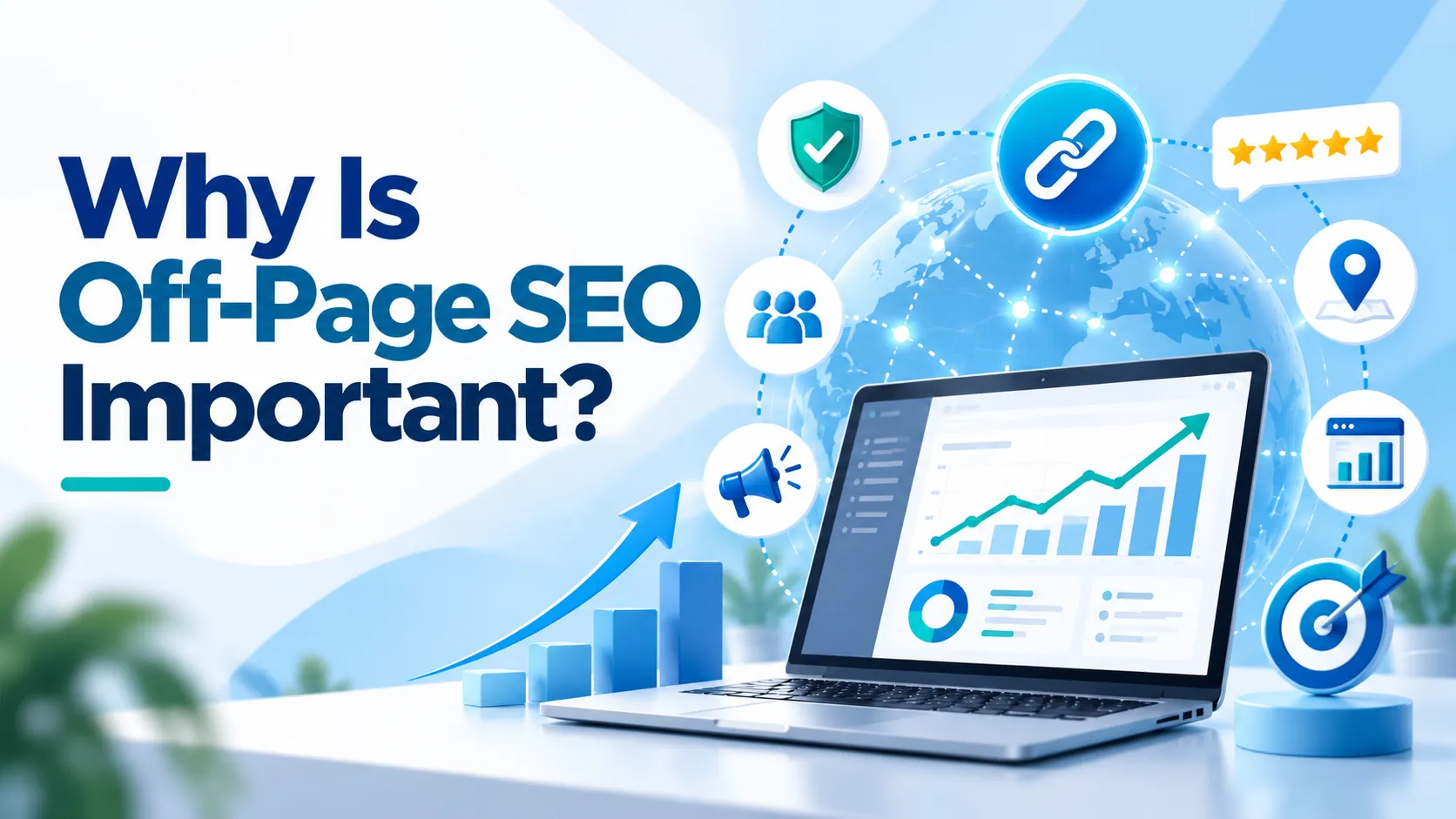
You can publish a great website and still struggle to get attention. Why? Because strong content needs discovery and trust. Off-page SEO can help build both.
A useful mention on an industry website may send new visitors to your page. A local news story may introduce your company to a new audience. Customer reviews may help a buyer feel more confident before contacting you. Good off-page SEO can support:
- Brand awareness. More people can discover your company outside your own website.
- Referral traffic. Links can bring visitors from other sites.
- Business trust. Reviews, press coverage, and expert mentions can add credibility.
- Local visibility. Reviews and references can be useful for businesses that serve a set area.
- Long-term relationships. Partnerships with publishers, businesses, and experts can lead to new opportunities.
Google says local search results are mainly based on relevance, distance, and prominence. Its current guidance says prominence can include information such as links to a business and the number of reviews it has.
Off-Page SEO and On-Page SEO: What Is the Difference?
On-page and off-page SEO solve different problems. On-page SEO helps search engines and readers understand your website. Off-page SEO builds your reputation beyond your site.
SEO Area | On-Page SEO | Off-Page SEO |
Main location | Your website | Other websites and platforms |
Content | Direct focus | Promotes or supports content |
Titles and headings | Yes | No |
Internal links | Yes | No |
Backlinks | No | Yes |
Digital PR | No | Yes |
Reviews | Limited | Yes |
Local citations | Limited | Yes |
Brand mentions | Limited | Yes |
Main purpose | Improve page relevance | Build trust and visibility |
For example, a Texas HVAC company may publish a guide about lowering summer cooling costs. The company can improve the page with clear headings, useful content, images, and internal links. That is on-page SEO.
It may then share original data from the guide with local journalists or home improvement websites. If those sites reference the study, that becomes off-page SEO. Both sides work better together.
What Are the Main Types of Off-Page SEO?
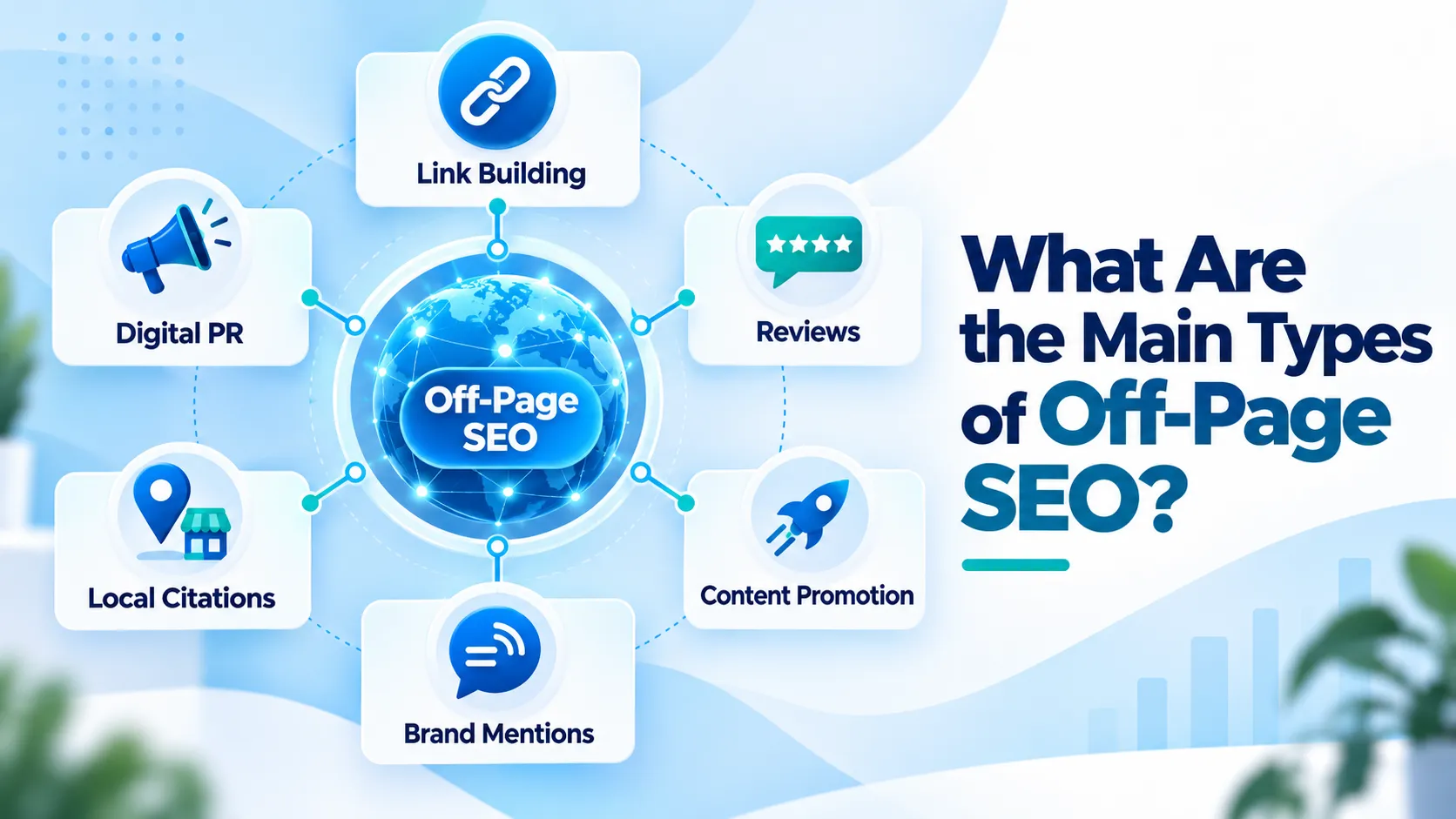
There is no single tactic that fits every business. A local dentist may focus on reviews and local references. A software company may gain more value from industry reports and digital PR. Here are the main areas to understand.
Link Building
Link building means earning links from other websites. The best links usually have a clear reason to exist. For example, a finance blog may link to a useful calculator. A news site may cite original survey data. A trade publication may reference an expert guide.
These links help the reader. They were not added only for SEO. Google lists several forms of manipulative link building as link spam. These include buying links for ranking purposes, excessive link exchanges, automated link creation, and low-quality links made mainly to affect search results.
Digital PR
Digital PR means creating stories or information that publishers may want to cover. Useful PR assets may include: original research, new data, surveys, expert comments, market reports, and useful case studies.
For example, a U.S. roofing company could study how repair costs changed after major weather events. A local publication may use the data in a story. A home improvement site may cite the report. The main aim is not to “buy a backlink.” It is to create something worth discussing.
Local Citations
A local citation is a reference to your business on another website or platform. It may contain your business name, phone number, address, website, or service information. Local citations matter most for businesses that serve a local market.
A dental office in Chicago, for example, may appear on trusted health directories, local business groups, or professional associations. Focus on useful and trusted platforms. Do not create hundreds of weak listings just to increase your link count.
Customer Reviews
Reviews can shape how people see a local business. They can also affect local visibility. Google says positive reviews and ratings can help a business’s local ranking. It also allows businesses to ask customers for genuine reviews.
However, businesses should not offer rewards in exchange for reviews. Ask real customers to share honest feedback. Never buy fake reviews.
Brand Mentions
A brand mention happens when another website discusses your company, product, employee, research, or service. Some mentions include links. Some do not.
An unlinked mention can still help people discover your brand. It may also lead to branded searches, referral visits, or future relationships. It is safer not to claim that every unlinked mention is a direct Google ranking factor. Think of brand mentions as part of your wider online reputation.
The 5 Signals of a Strong Off-Page SEO Strategy
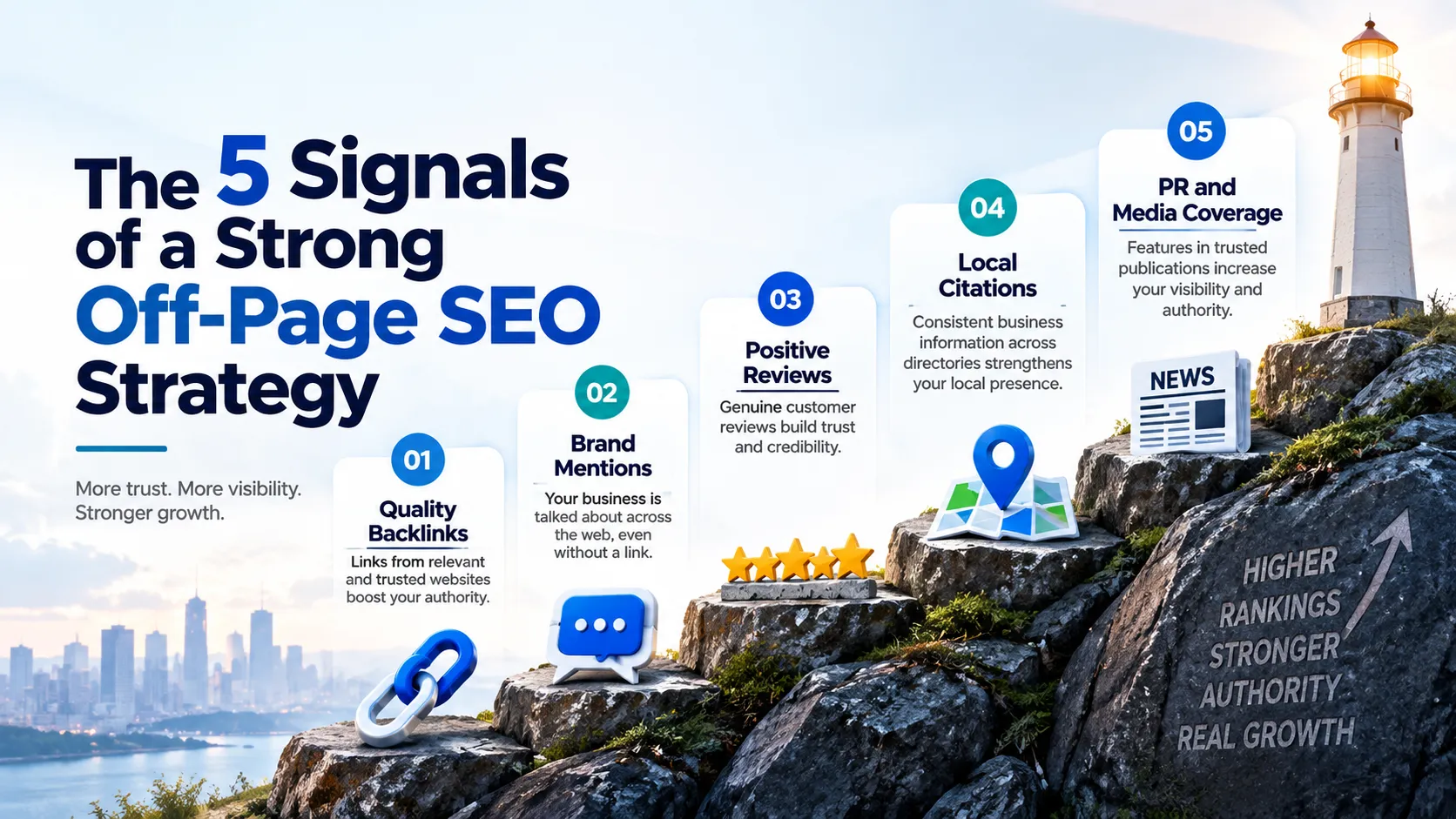
Before you chase a link or mention, use this simple framework.
1. Relevance
Ask whether the website serves your industry or audience. A link from a respected construction publication makes sense for a building company. A link from an unrelated gaming site may not.
2. Editorial Value
Why is the website mentioning you? The strongest references exist because your page, research, quote, or tool adds value to the article. A link should make sense even if SEO did not exist.
3. Reputation
Look at the website itself. Does it publish useful content? Does it have real authors, clear ownership, and an active audience? Avoid judging a site by one SEO score alone.
4. Audience
Can the source reach people who may care about your business? A smaller niche publication with the right readers may be more useful than a large but unrelated website.
5. Business Value
Ask what the activity may produce beyond a backlink. It could lead to referral traffic, new customers, media relationships, branded searches, partnerships, or industry recognition. This framework keeps off-page SEO focused on real value rather than link counts.
What Are the Best Off-Page SEO Techniques?
Good off-page SEO techniques give people a reason to notice your business.
Create Content Worth Citing
Basic blog posts may struggle to earn links. Unique resources have a better chance. You could create original research, calculators, templates, data studies, market reports, maps, case studies, or detailed guides.
For example, a marketing agency could study average ad costs across several U.S. industries. That data gives other writers something useful to reference.
Build Publisher Relationships
Do not send the same outreach email to hundreds of websites. Study the publisher first. Look at the topics it covers. Find the right writer. Then offer something useful. You may have data, expert insight, a new angle, or a helpful resource. A short and relevant pitch is better than a long sales email.
Reclaim Useful Brand Mentions
Sometimes a website mentions your company without linking to the source. You can contact the publisher when a link would help its readers. For example, a journalist may mention your research but forget to link to the full study. A polite message can make sense in that case.
Contribute Expert Knowledge
Industry publications often need useful expert insight. A financial adviser may comment on a savings trend. A cybersecurity company may explain a new threat. A real estate expert may discuss local housing data.
The aim should be to share real knowledge. Do not turn every expert contribution into an anchor-text link campaign.
Promote Your Best Assets
Publishing content is only the first step. Share strong resources with relevant communities, newsletters, publishers, customers, and social audiences. Promotion can help the right people discover your work.
Example: Which Backlink Opportunity Makes More Sense?
Imagine you have two possible opportunities.
- Website A has a high third-party authority score. It is not related to your industry. It publishes many paid posts and links to hundreds of unrelated companies.
- Website B has a smaller audience. It covers your exact industry. A real editor wants to cite your research inside a useful article.
Do not judge the choice by a single SEO metric. Instead, ask: Does the site match your topic? Is the link useful to readers? Does the publication have a real audience? Is the placement editorial? Could it send useful traffic?
In many cases, those questions are more useful than comparing two authority scores. Third-party SEO metrics can help with research, but they are not Google’s own ranking scores.
What Off-Page SEO Practices Should You Avoid?
Off-page SEO becomes risky when the main aim is to manufacture ranking signals. Avoid large backlink packages that promise thousands of links. Be careful with automated forum links, spam comments, unrelated directories, link farms, and large-scale link exchanges.
Paid promotion is not automatically bad. Businesses pay for advertising and sponsorships every day. The problem starts when paid links are used to manipulate search rankings. Google’s spam policies explain that paid links created for ranking purposes can count as link spam. Focus on audience value first.
Which Off-Page SEO Tools Can You Use?
You do not need a large tool stack. A few tools can cover most tasks.
Google Search Console
The Links report in Google Search Console shows pages and websites that link to your site. You can review your top linked pages and common linking sites. Google notes that the report is not a full list of every backlink. It provides a sample that can help you understand your link profile.
Bing Webmaster Tools
Bing Webmaster Tools includes backlink data such as referring domains, pages, and anchor text. Its backlink report also states that the data is a representative set, not a complete backlink profile.
Ahrefs, Semrush, Moz, and Similar Tools
Third-party off-page SEO tools can help you find: competitor backlinks, lost links, new links, content gaps, referring domains, and outreach ideas. Use these metrics as research aids. Do not treat them as direct Google scores.
Brand Monitoring Tools
Monitoring tools can help find news coverage and brand mentions. They may also help you spot mentions that do not include a link. Google Alerts is a simple place to start.
How Should You Measure Off-Page SEO?
Do not measure success only by backlink count. A campaign that earns 100 poor links may create less value than one industry feature that sends real customers.
Track outcomes such as referring domains, relevant links, referral traffic, media coverage, reviews, branded searches, qualified leads, and conversions. Also check which pages earn links on their own. That can show you what people in your market value most.
Off-Page SEO Checklist
Use this off-page SEO checklist when planning a campaign:
- Review your current backlinks and referring domains.
- Find pages that already earn links.
- Study relevant competitors and publishers.
- Create useful assets that deserve references.
- Build relationships with industry writers.
- Find relevant unlinked brand mentions.
- Keep local business details accurate.
- Ask real customers for honest reviews.
- Monitor new links and media mentions.
- Track referral traffic and business results.
- Avoid automated backlink packages.
- Avoid links created only to manipulate rankings.
You do not need to complete every task at once. Start with the activities that match your business model.
Does Social Media Help Off-Page SEO?
Social media can support off-page SEO, but it is not a simple ranking shortcut. Its main value is distribution. A good post can put your research or guide in front of journalists, creators, customers, and experts. One of those people may later cite your page or mention your brand. So the useful path often looks like this:
Content → promotion → discovery → mention or link
Do not assume that likes or shares alone will improve Google rankings. Use social media to help useful content reach more people.
How Does Off-Page SEO Support EEAT and AI Search?
Off-page activity can make it easier for people and search systems to find information about a business or expert across the web. For example, an AI search system may encounter: independent news coverage, expert biographies, research reports, trusted citations, customer reviews, company information, and industry references.
These sources can provide more context about who created the information and where it came from. Suppose a cybersecurity expert publishes original research on a company website. If respected technology publications cite that research, the expert now has independent references outside the company site.
That creates a clearer web presence. The same idea applies to businesses. Consistent company details, trusted reviews, relevant press coverage, useful research, and quality citations make the brand easier to understand across different sources.
This does not mean there is an “AI backlink formula.” AI Search systems use their own methods to find and present information. No business can guarantee a citation. The practical goal is to publish clear information and earn real references that other people find useful.
How Long Does Off-Page SEO Take?
There is no fixed timeline. A digital PR campaign may gain attention in a few days, while strong publisher relationships can take months to build. A new local business may also need time to earn genuine reviews and local mentions.
Results depend on your market, website, brand, competition, content, and current reputation. At Tekcurio, the focus is on steady off-page growth instead of chasing a fixed number of backlinks each month.
A better question is: Are more relevant people finding, trusting, and referencing your business? If the answer is yes, your off-page SEO is moving in the right direction. This is a stronger sign of long-term progress than backlink volume alone.
Best Social Media Marketing Agency in Pakistan: A Complete Guide for 2026
SUMMARIZE THIS POST WITH ChatGPT GoogleAI Perplexity Claude Jump To
SEO Services in Pakistan: A Complete Guide to Growing Your Business Online
SUMMARIZE THIS POST WITH ChatGPT GoogleAI Perplexity Claude Jump To

Website Development Services in Pakistan: Build a Website That Grows Your Business
Jump To Website Development Services in Pakistan: Build a Website
Marketing and Advertising Company in Pakistan: How to Choose the Right Agency for Business Growth
Jump To Marketing and Advertising Company in Pakistan: How to