
Call Us Now:
+92 300 9842234
Side Info Heading
Side Info Text
Gallery Heading
Follow Us


What Is a Meta Advertising Agency?
A Meta advertising agency is a company that manages advertising on Meta platforms. Most agencies focus on Facebook and Instagram ads. Some also manage Reels campaigns, lead forms, remarketing, and creative production.
A good agency does more than launch ads. It first learns how the business makes money. It looks at the offer, customer, sales process, and ad budget. It then builds campaigns around a clear goal.
That goal may be online sales, leads, calls, bookings, or website actions. The campaign structure should match that goal. For example, an online store may care about purchases and revenue. A local roofing company may care about qualified calls. A law firm may focus on consultation requests. The same Meta strategy will not fit all three businesses.
What Does a Meta Ads Agency Do?
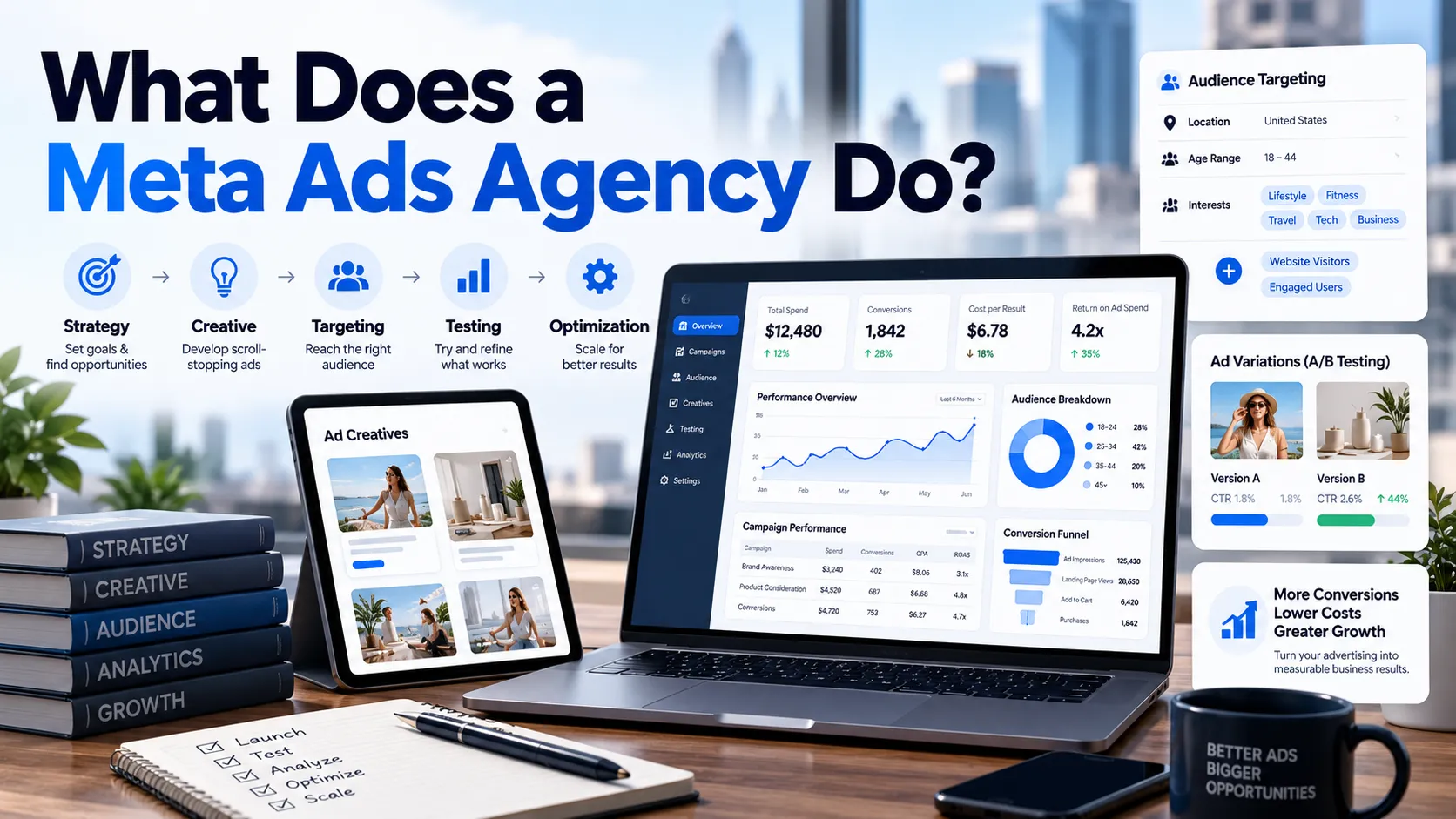
A Meta Ads agency usually manages several parts of paid advertising. First, it builds the campaign plan. The agency decides what it wants the ads to achieve. It also reviews the audience, budget, offer, and customer journey. Next comes creative work.
The agency may create images, short videos, Reels, carousels, ad copy, and calls to action. It may also test different offers or messages. Then it tracks results. Good reporting goes beyond clicks and impressions. It should show whether the campaign is helping the business get real leads or sales.
Meta also offers automated placement options. Its current Reels guidance says Advantage+ placements can distribute eligible ads across Facebook, Instagram, Messenger, Audience Network, and Reels. An agency should still review whether the setup fits the campaign goal. Automation is a tool. It is not a complete strategy.
Meta Advertising Agency vs Facebook Marketing Agency
These names often overlap. There is no fixed rule for how every agency uses them. Still, there are some common differences.
Area | Meta Advertising Agency | Facebook Marketing Agency |
Facebook ads | Usually included | Usually included |
Instagram ads | Usually included | May be included |
Reels ads | Often included | Depends on service |
Paid media | Usually a core service | May be one service |
Organic content | Sometimes included | Often included |
Creative testing | Often included | Varies |
Conversion tracking | Common | Varies |
Wider Meta campaigns | Usually covered | May focus on Facebook |
A Facebook marketing agency may also manage organic posts and community activity. A Meta agency often puts more focus on paid media across Facebook and Instagram. Do not choose an agency based only on its title. Ask what the service actually includes.
How Does a Meta Ads Agency Account Work?
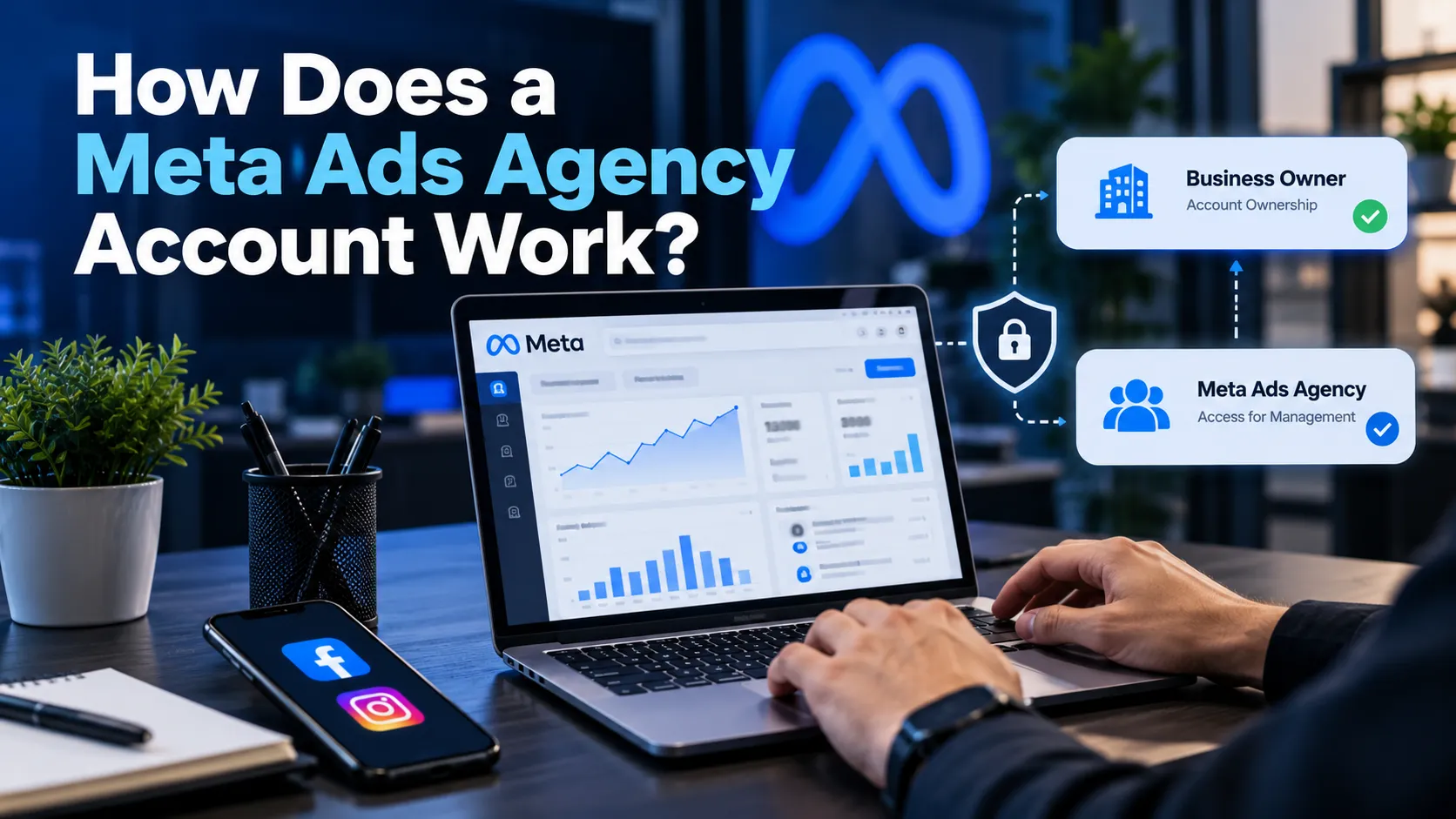
The phrase Meta Ads agency account can confuse. Some businesses think the agency should own the ad account. That can create problems later. In most cases, the business should keep control of its main assets. The agency should get the access needed to do its work.
Meta allows Page owners to give trusted people different levels of access. Task access can include working with ads and insights through Meta business tools. This makes account access an important question before you sign a contract.
Before Hiring, Confirm Asset Ownership
Ask who controls each important asset:
- Facebook Page, Instagram account, business portfolio, ad account, tracking setup, customer audiences, product catalogs when used, and original creative files.
- Confirm how access will be removed if the agency relationship ends. Also make sure your company keeps the login and ownership details it needs.
Not every business will use every asset above. The main point is simple. Your company should know what it owns and what the agency can access. Changing agencies should not force you to rebuild your whole advertising system.
What Is Meta Creative Hub?
Meta Creative Hub is linked with the creative planning side of Meta advertising. Advertisers have used Creative Hub workflows to build and review ad mockups before launch.
This can make client review easier. For example, a marketing team may want to see how a proposed ad looks before it spends money. That helps the team catch weak copy, poor layouts, or missing creative versions.
Meta changes its tools and interface over time. For that reason, always check the current Meta Business interface before writing internal instructions around a specific button or workflow. Creative Hub should not be treated as a campaign reporting tool. Its main value is creative planning and preview work.
What Is CreativeX?
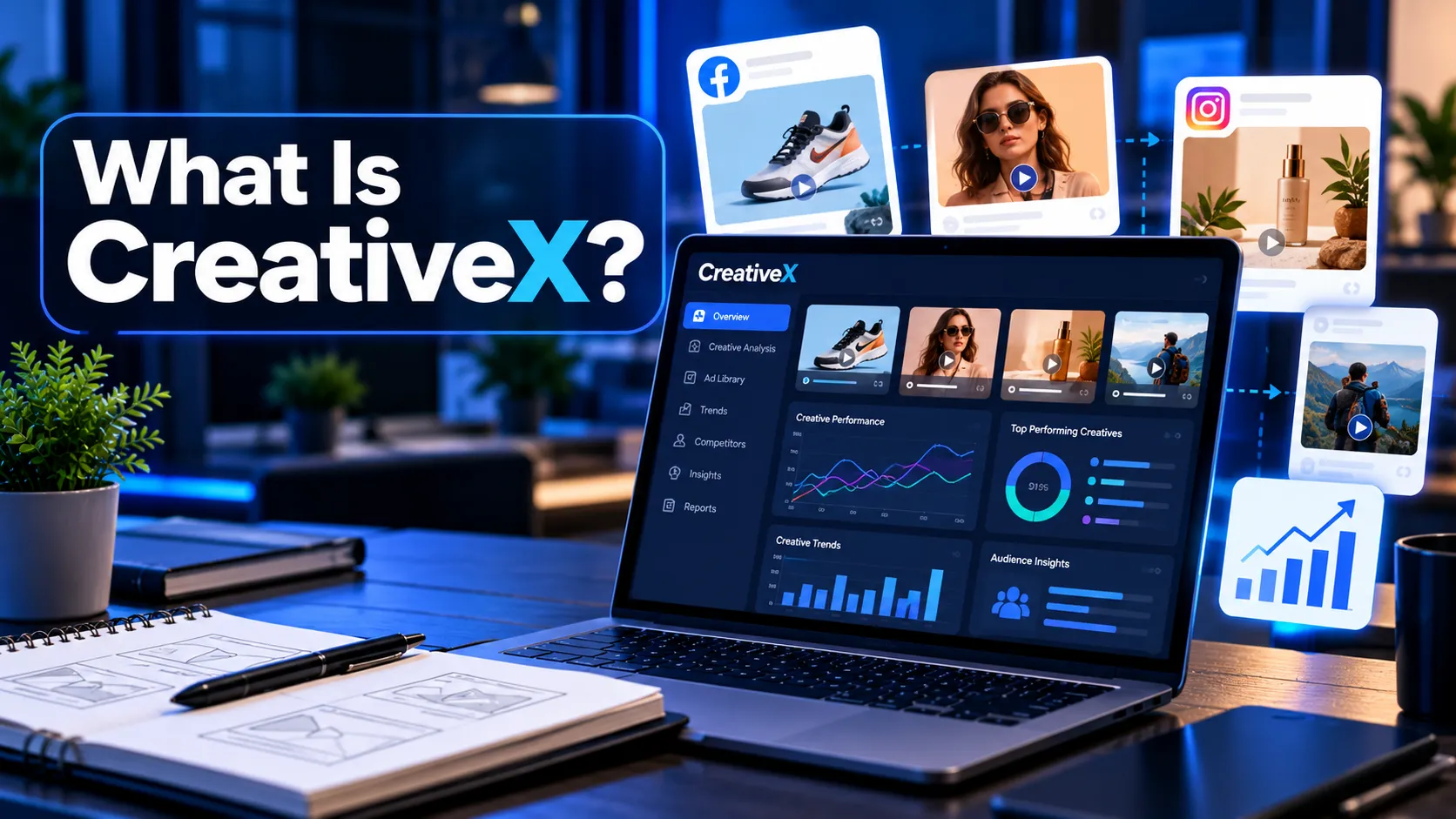
CreativeX is not the same product as Meta Creative Hub. This matters because people also search terms such as Creative X Meta and Creative X agency.
CreativeX describes itself as a platform that brings creative, content, and media measurement together. Its integrations include Facebook and Instagram, along with other advertising platforms. Large brands may use a system like this to study creative quality at scale.
A small business does not need CreativeX simply to run Meta ads. Meta Creative Hub and CreativeX solve different problems. Creative Hub relates to Meta creative workflows. CreativeX is a separate creative measurement platform.
Why Does Creative Testing Matter?
An advertiser can have good targeting and still get weak results. The ad itself must win attention. That is why creative testing matters. Instead of changing everything at once, test clear ideas. A simple framework is:
Creative Part | Question to Ask |
Hook | Does the first moment get attention? |
Problem | Does the customer recognize the issue? |
Proof | Is there a reason to trust the message? |
Offer | Is the value easy to understand? |
CTA | Is the next step clear? |
For a home fitness brand, one ad could show the product in use. Another could start with a customer problem. A third could focus on a feature or use case. The point is not to produce endless ads.
The point is to learn which message brings better business results. Meta also recommends testing in its Reels advertising guidance and supports A/B testing for campaign learning.
How Can an Agency Research Competitor Ads?
The Meta Ad Library is useful for competitor research. Meta says the library lets people search ads that are currently running across its platforms. Users can search by keyword or advertiser. An agency can use it to study creative styles and offers. It can also look for common messages in a market. But there is an important limit.
An ad appearing in the library does not prove that the ad is profitable. You cannot see a competitor’s true cost per sale from the standard Ad Library. You also do not know its margins or lead quality. Use competitor ads for research. Do not copy them blindly.
A Practical 5-Layer Meta Ads Audit
A useful account review should go deeper than CTR and impressions. This five-layer framework keeps the review focused.
Layer | Main Question |
Tracking | Can we trust the conversion data? |
Offer | Is there a clear reason to respond? |
Creative | Does the ad earn attention and explain value? |
Conversion | Does the page or lead process turn interest into action? |
Economics | Can the business afford the cost of getting a customer? |
This framework also helps find the real problem. For example, an ad may get many clicks. But the landing page may fail to turn those clicks into leads. In that case, changing the audience may not solve the issue. The weak point is lower in the funnel.
Which Meta Ads Metrics Matter Most?
The best metric depends on the campaign goal. An ecommerce brand may watch purchases and revenue. A local service company may care more about qualified leads and booked jobs. A useful formula is:
Cost per booked appointment = Ad spend ÷ Booked appointments
Another is:
Cost per customer = Ad spend ÷ New customers
These measures move closer to business value. Cost per lead alone can be misleading. Consider an example. Campaign A spends $1,800 and produces 100 leads. Its cost per lead is $18. But only 10 leads are qualified. The cost per qualified opportunity is now $180.
Campaign B also spends $1,800. It produces 72 leads at $25 each. If 18 are qualified, the cost per qualified opportunity is $100. Campaign B has the higher lead cost. Yet it may be the better campaign. This is an illustrative example, not a claimed client result.
How Much Does a Meta Advertising Agency Cost?
There is no single price for Meta Ads management in the USA. Agency fees depend on the work involved. A simple account with a few campaigns may need less work than a national ecommerce account. Creative production can also change the price.
Agencies often use a flat monthly fee, a percentage of ad spend, or a mix of both. Some charge a setup fee as well. Others include landing page work or creative production in a larger package.
When comparing quotes, do not look only at the monthly fee. Ask what is included. A lower fee may exclude video creative, tracking work, or landing page support. A higher fee may include those services. The useful question is not only, “What does the agency cost?” Ask, “What work am I paying for?”
What Happens in the First Month?
The first month should not be random. It should build a base for later decisions.
Period | Main Focus |
Week 1 | Account audit, tracking, goals, and access |
Week 2 | Creative setup and first campaign launch |
Week 3 | Early data review and lead-quality checks |
Week 4 | Creative, budget, and campaign decisions |
This timeline can change. A large account may need more setup time. A small account may move faster. The agency should also avoid making major changes every few hours. Early data is useful only when the team gives it enough time to show a pattern.
How Do You Choose the Best Meta Ads Agency?
People searching for the Best Meta Ads agency often want one clear winner. In practice, the right fit depends on the business. A local lead generation company may need different skills from a large online store. Ask how the agency connects ad performance with real sales. Also ask who creates the ads.
Some agencies manage media but expect the client to supply every video and image. Others have their own creative team. Find out how often you will get reports.
Ask who will work on the account each week. You should also understand how the agency reacts when results fall. Strong agencies should be able to explain what they are testing and why.
Meta Ads Agency Red Flags
Watch for signs that may create problems later:
- Be careful with guaranteed ROAS, guaranteed sales, unclear asset ownership, reports based only on impressions, weak tracking explanations, or a strategy that depends on one ad for months.
- Also ask how the agency checks lead quality. Cheap leads have little value when they do not match the target customer.
No agency can control every factor. Pricing, competitors, demand, sales follow-up, and the website can all affect results. A trustworthy agency should explain those limits.
Can a Small Business Use a Meta Advertising Agency?
Yes. But an agency is not the first fix for every business. Paid ads work better when the business already has a clear offer and a working sales process. The website should also make it easy for customers to act. If leads are ignored for days, more ad spend may not help.
If the offer is unclear, more traffic may only create more weak traffic. Advertising often makes existing strengths and problems easier to see. That is why a good Meta agency may ask about margins and sales before increasing the budget.
Is a Meta Advertising Agency Worth It?
An agency may be useful when your team lacks time or paid media skills. It can also help when you need stronger creative testing or better tracking. But outsourcing only makes sense when the agency brings useful expertise.
For businesses that need support in these areas, Tekcurio offers Meta advertising and performance marketing services. The focus is on testing, tracking, creative improvement, and using campaign data to support better marketing decisions.
A strong agency relationship should produce clear answers. What are we testing? What did we learn? Which ads bring useful customers? Where are people dropping out? What should change next? Those questions matter more than a large impressions number.


Best Google Ads Agency in Pakistan: How to Choose the Right PPC Partner
Jump To Best Google Ads Agency in Pakistan: How to

Creative Design Agency: How to Choose the Right Partner for Your Brand
Jump To Creative Design Agency: How to Choose the Right

Best Marketing Agency in Los Angeles: How to Choose the Right Partner
Jump To Best Marketing Agency in Los Angeles: How to
B2B Social Media Agency: How to Choose the Right Partner for Growth
Jump To B2B Social Media Agency: How to Choose the