

Call Us Now:
+92 300 9842234
Side Info Heading
Side Info Text
Gallery Heading
Follow Us


What Does a Google Ads Agency for Small Business Do?
A Google Ads agency for small business manages paid advertising campaigns with the goal of producing measurable business outcomes. Depending on the company, an agency may manage:
- Google Search campaigns
- Performance Max campaigns
- Local advertising strategies
- Local Services Ads where available
- Keyword and search intent research
- Ad copy and assets
- Geographic targeting
- Conversion tracking
- Landing page recommendations
- Smart Bidding
- Search term analysis
- Negative keyword management
- Budget allocation
- Performance reporting
The important distinction is that professional management should not stop at campaign setup.
For example, a Los Angeles appliance repair company may receive many searches for refrigerator repair, dishwasher repair, and washer repair. But if its campaign also attracts people searching for appliance manuals, replacement parts, DIY instructions, or locations outside its service area, some of that traffic may have little business value.
An experienced manager looks at what happens after the click and adjusts the campaign accordingly.
Why Can Google Ads Be Valuable for Small Businesses in Los Angeles?
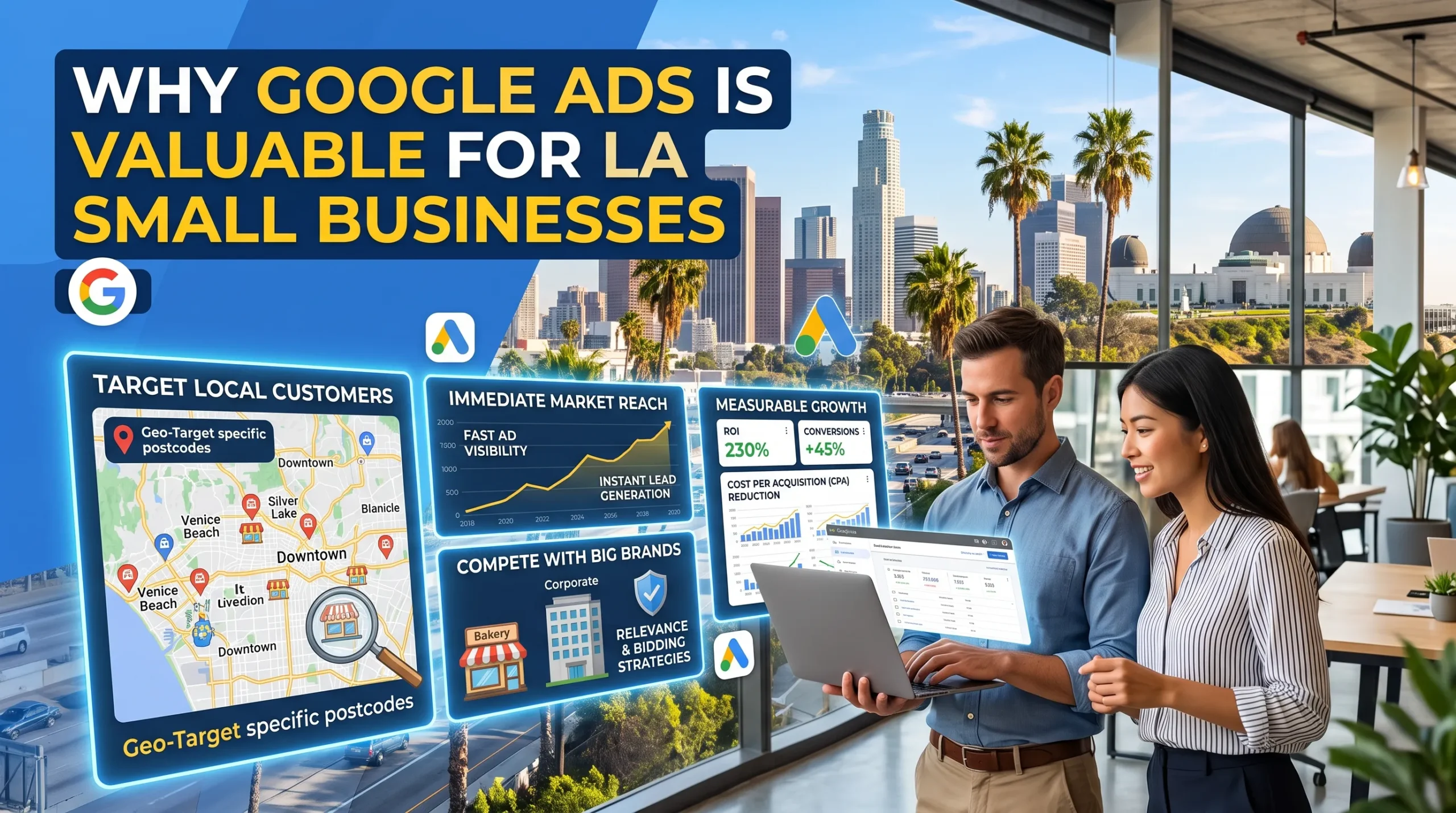
Google Ads can be especially useful when customers already have a clear reason to search for a product or service. Someone searching for “how to repair a leaking faucet” may be researching a DIY solution. Someone searching for “emergency plumber near me” is showing a much stronger service intent.
That distinction matters in Los Angeles because businesses often compete for expensive, high-intent searches within specific geographic areas.
A local business does not necessarily need to advertise to everyone in Los Angeles. A company may serve only certain neighborhoods, cities, or a defined service radius. Targeting the entire market without considering operational coverage can create unnecessary spending.
Los Angeles Requires More Than Adding the City Name
Simply mentioning Los Angeles in an advertisement does not create a local strategy. A better campaign considers:
- Which parts of Los Angeles the business actually serves
- Whether the business serves LA city, LA County, or selected surrounding communities
- Which services are most profitable
- Which searches indicate immediate buying intent
- Whether mobile users are important
- Whether calls or forms produce better leads
- Whether certain service areas produce better customers
- Whether different services require different landing pages
For example, a company serving only West Los Angeles should not automatically spend the same amount trying to reach every possible search across the wider metropolitan area.
How Does Google Ads Work for a Small Business?
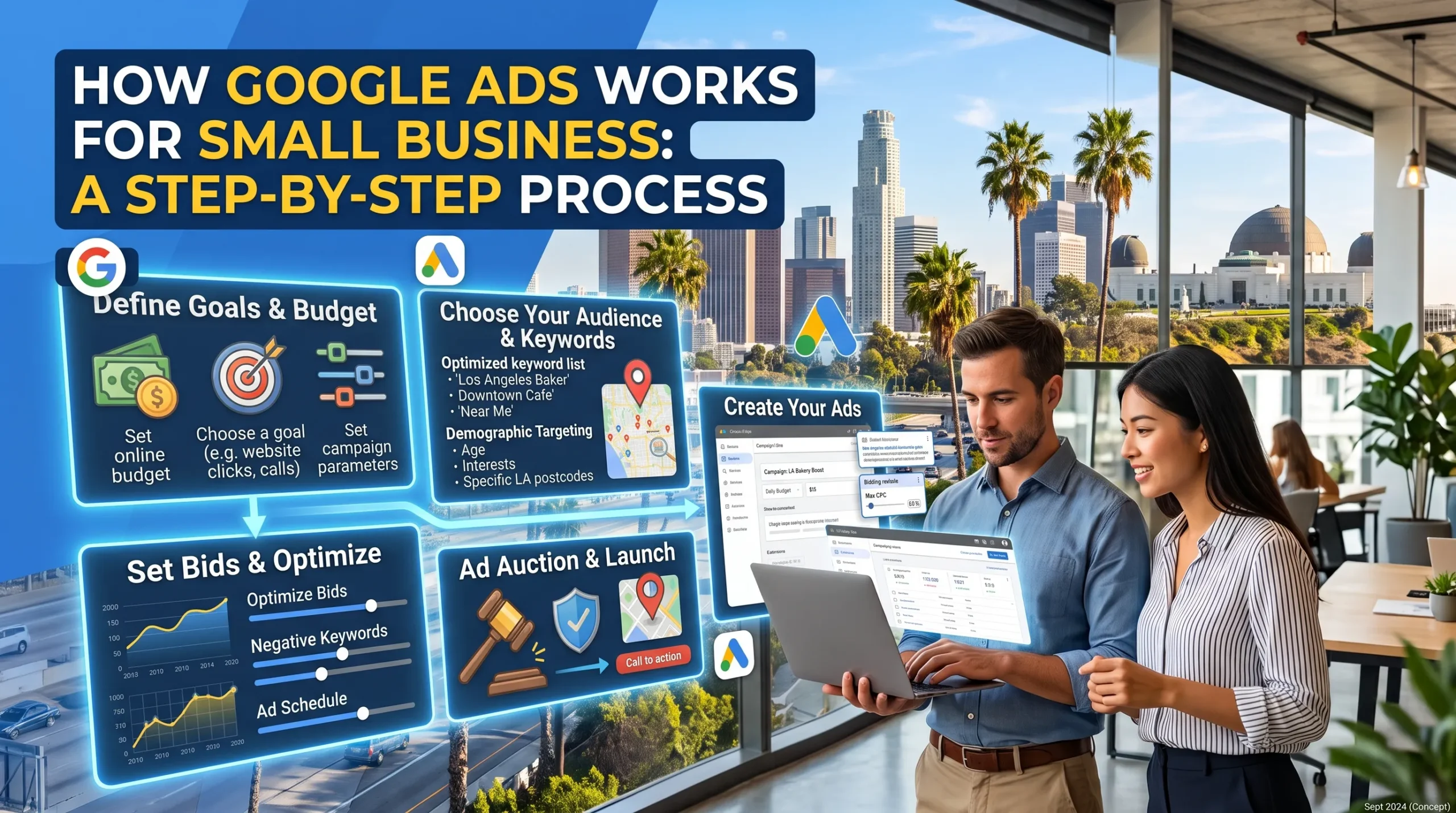
The basic process is straightforward, but effective management requires careful decisions at every stage.
1. Define the Business Goal
Start with the result the company actually wants. That might be:
- More phone calls
- More qualified leads
- More appointments
- More purchases
- More quote requests
- More revenue
The advertising objective should match the business objective.
2. Identify High Intent Searches
Not every keyword with high search volume deserves advertising budget. A professional campaign considers the reason behind the search. Commercial and transactional searches can be particularly valuable for businesses selling services or products.
3. Build the Campaign Around Relevant Intent
Campaigns should be structured so that advertisements, keywords, landing pages, locations, and conversion goals make sense together. A person searching for “emergency HVAC repair” should not be sent to a generic page that barely mentions HVAC services.
4. Track Meaningful Conversions
Conversion tracking tells Google and the advertiser which actions matter. Google explains that conversion goals can include actions such as purchases, contacts, and lead form submissions. These goals can also influence bidding optimization. For a local service business, useful conversion signals can include calls, forms, appointment requests, and qualified leads.
5. Optimize With Real Data
Once sufficient data is available, campaign managers can evaluate search terms, locations, devices, ads, landing pages, conversion rates, and lead quality.
Google’s Smart Bidding uses AI to optimize bids toward conversions or conversion value at auction time. Current Smart Bidding strategies include Maximize Conversions, Target CPA, Maximize Conversion Value, and Target ROAS. Automation is useful, but it does not remove the need for good conversion data and sensible campaign goals.
Which Google Ads Campaign Type Is Right for a Small Business?
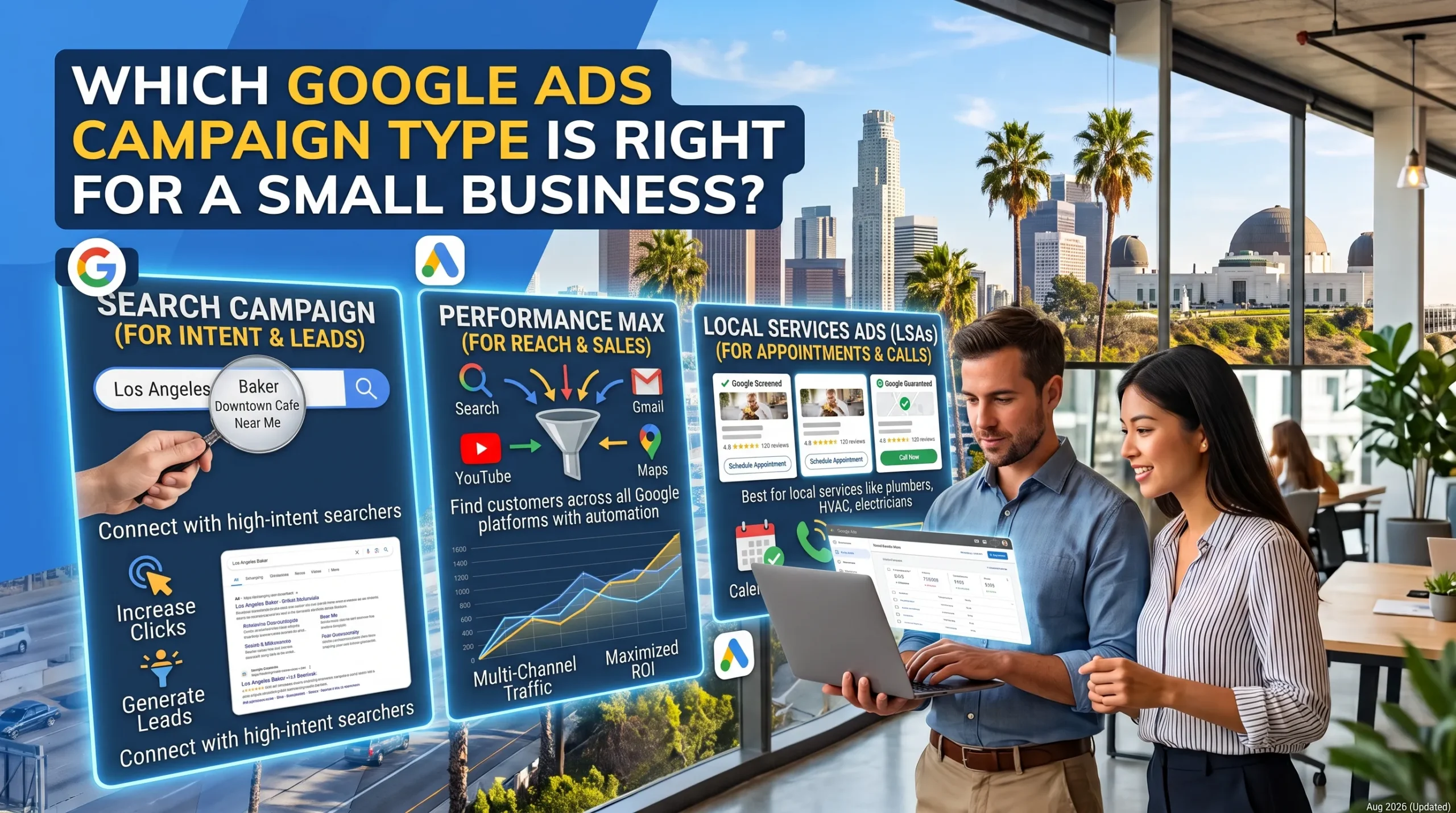
There is no single campaign type that is best for every company.
Business situation | Potential priority | Why it may fit |
Local service with high-intent searches | Google Search Ads | Captures people actively looking for a service |
Eligible local service provider | Local Services / pay-per-lead setup | Designed around local service leads |
Ecommerce business | Shopping or Performance Max | Can support product-focused advertising |
Appointment-based business | Search + conversion tracking | Focuses on inquiries and bookings |
Very limited budget | Narrow high-intent Search targeting | Helps reduce unnecessary traffic |
Multiple services | Separate service-focused campaigns | Makes intent and performance easier to evaluate |
Wider product or service demand | Performance Max or broader campaigns | Can expand reach across eligible Google surfaces |
The right choice depends on eligibility, budget, conversion volume, business model, and customer journey.
Google Search Ads vs. Local Services Ads vs. Performance Max
Small businesses often confuse these advertising options because all of them can help generate customers through Google. Traditional Search Ads allow advertisers to build campaigns around search intent and provide substantial control over keywords, ads, targeting, budgets, and conversion goals.
Local Services Ads are designed around eligible local service providers and lead generation. Performance Max is a broader Google Ads campaign type that can use Google’s automation across eligible Google inventory. For a small business, the important question is not “Which product is newest?” It is:
Which advertising approach best matches how my customers search and how my business makes money?
What Are Local Services Ads?
Local Services Ads, commonly called LSAs, are designed to help eligible local service providers connect with customers searching for services.
The format is different from traditional keyword-based Search campaigns. Local Services campaigns are built around the business’s services and service areas, and eligible advertisers can receive leads through calls and messages.
For a local service company, this can be valuable because the customer is already searching for a nearby provider. However, eligibility and availability vary by business category and location.
What Are Google Local Services?
Google Local Services is the advertising environment associated with Local Services Ads and eligible local service providers. A business profile can present information such as services, service areas, business details, and customer reviews. Verification and screening requirements can also apply depending on the business and market.
For an agency, managing this type of advertising means paying attention not only to advertising settings but also to lead quality, service areas, profile information, responsiveness, and eligibility.
What Happened to Google Guaranteed Ads in 2026?
Many business owners still search for Google Guaranteed Ads, but Google’s current terminology has changed.
Google is moving toward a single Google Verified badge for eligible Local Services advertisers. Google’s current documentation says eligible existing advertisers who have completed the required verification can automatically receive the new badge, while new advertisers must complete the applicable screening and verification process.
Google also states that the Money Back Guarantee associated with the former Google Guarantee badge is being discontinued. So if you see an agency promising to get your business “Google Guaranteed,” ask exactly what current Google program and verification status it means. The more accurate 2026 terminology is generally Google Verified, where applicable.
What Changed With Local Services Ads in 2026?
This is one of the most important current developments for local service businesses. Starting August 1, 2026, Google began transitioning Local Services Ads toward Performance Max campaigns with pay-per-lead goals for selected advertisers. Google says the transition brings Local Services into Google Ads while preserving important aspects of the local lead experience.
Google’s announcement says that businesses in the transition will continue to pay for valid leads rather than clicks, while their ads can continue appearing on Google Search and Google Maps. The campaigns remain focused on services and service areas rather than traditional keyword management.
For a Los Angeles business, this means older articles about “Google Guaranteed Ads” and standalone Local Services Ads may no longer describe the complete current process. An agency should be able to explain which version of the platform applies to your account rather than relying on outdated terminology.
What Experienced Google Ads Managers Look for That Business Owners Often Miss
This is where professional management can make a meaningful difference. A campaign can look successful inside Google Ads and still produce poor business results. For example, suppose an account reports a low cost per lead. That sounds positive. But imagine that many of those leads are:
- Outside the service area
- Looking for a service the company does not provide
- Duplicate inquiries
- Spam submissions
- Low-intent requests
- Customers who never receive a response
The dashboard may show conversions, but the business may not be generating profitable customers. For local lead generation, the more useful question is often:
How many qualified leads became real customers, and what did it cost to acquire them?
That is a much stronger business metric than clicks alone.
How Should a Small Business Measure Google Ads ROI?
Cost per click and click-through rate are useful diagnostic metrics, but they should not be the final definition of success. A local business should ideally track the journey:
Ad → Click → Lead → Qualified Lead → Customer → Revenue
Consider a simple example. Suppose a business can afford to spend $600 to acquire one customer and normally closes 20% of qualified leads. A simplified target calculation would be:
$600 × 20% = $120 target cost per qualified lead
This is only an example, not a universal benchmark. Real targets depend on margins, customer lifetime value, sales performance, refunds, repeat business, and operating costs. The point is that advertising targets should come from business economics rather than arbitrary industry averages.
Why Conversion Tracking Matters So Much
Google’s automated bidding depends on conversion information. Google recommends measuring valuable conversion actions and providing a strong foundation of conversion data before changing bidding strategies.
That means a business should distinguish between meaningful and weak conversion signals. For example, a purchase is usually more commercially meaningful for an ecommerce store than a simple page view.
For a service company, a qualified phone call may be more valuable than someone who merely opens a contact page. If an account optimizes toward the wrong actions, automated bidding can receive misleading signals.
How Much Should a Small Business Spend on Google Ads?
There is no universal monthly Google Ads budget. The right amount depends on:
- Customer value
- Profit margin
- Competition
- Search demand
- Conversion rate
- Lead-to-customer rate
- Geographic coverage
- Available cash flow
- Sales capacity
A $1,000 monthly budget may be meaningful for one business and too small for another. Rather than asking only, “How much does Google Ads cost?” ask:
How much can my business profitably spend to acquire a customer?
An experienced agency should be willing to discuss this question before recommending a campaign budget.
What Services Should a Google Ads Agency Provide?
A complete small business Google Ads service may include:
Campaign Strategy
The agency should determine which campaign types, services, locations, and customer actions deserve budget.
Keyword and Search Intent Research
Research should focus on commercial value, not simply high search volume.
Ad Creation
Ads should clearly communicate the service, value proposition, location, and next step.
Geographic Targeting
Campaigns should reflect where the business can actually serve customers.
Conversion Tracking
Important customer actions should be tracked accurately so campaign decisions are based on useful information.
Search Term and Traffic Review
Search behavior can reveal irrelevant traffic as well as new opportunities.
Landing Page Recommendations
The page after the click should match the advertisement and make it easy for visitors to take the intended action.
Bid and Budget Management
Google’s automated bidding tools can optimize toward conversions or conversion value, but the selected goal should match the business objective.
Reporting and Analysis
Reports should explain what happened, why it happened, and what will be changed next.
How to Choose a Google Ads Agency Near Me in Los Angeles
Searching for a Google Ads agency near me is a useful starting point, but proximity alone should not determine your choice. When comparing agencies, ask:
- How will you define a qualified lead?
- How will phone calls be tracked?
- Who owns my Google Ads account?
- How will you control wasted geographic traffic?
- How often will search terms be reviewed?
- What will be included in monthly reporting?
- How do you handle poor-quality leads?
- What campaign types do you recommend and why?
- How do you evaluate profitability?
- What happens if the campaign does not perform as expected?
A trustworthy agency should be comfortable explaining its process without promising guaranteed revenue.
How Important Are Google Ads Agency Reviews?
When researching Google Ads agency reviews, look for detailed experiences rather than star ratings alone. A useful review may explain:
- What the agency actually managed
- Whether communication was reliable
- Whether reporting was understandable
- Whether leads were relevant
- Whether the agency respected the agreed budget
- Whether problems were explained honestly
- Whether the relationship lasted beyond the initial campaign
A five-star rating with no meaningful detail tells you less than a detailed review describing what the agency actually did.
Common Google Ads Mistakes Small Businesses Make
Small businesses often lose money through avoidable campaign mistakes. The most important ones include:
- Tracking clicks instead of meaningful conversions
- Targeting locations the company cannot serve
- Using broad keywords without reviewing search behavior
- Sending every advertisement to the homepage
- Ignoring irrelevant searches
- Failing to distinguish qualified leads from spam
- Changing campaigns too frequently
- Choosing a bidding strategy without reliable conversion data
- Measuring lead volume without measuring lead quality
- Ignoring slow or ineffective landing pages
- Failing to follow up with leads quickly
One of the biggest mistakes is treating Google Ads as the entire sales process. A campaign can generate excellent leads, but if calls are missed or inquiries are not followed up, the advertising investment can still underperform.
What Should a Google Ads Agency Report Each Month?
A useful report should help a business owner make decisions. Depending on the campaign, it may include:
- Advertising spend
- Impressions
- Clicks
- Click-through rate
- Cost per click
- Conversions
- Conversion rate
- Cost per conversion
- Qualified leads
- Phone calls
- Lead quality
- Revenue or conversion value
- Geographic performance
- Campaign performance
- Search term insights
- Recommended next actions
The report should answer three questions:
What happened?
Why did it happen?
What are we changing next?
That is more useful than sending a spreadsheet filled with metrics without explaining their business meaning.
Is a Google Ads Agency Worth It for a Small Business?
A Google Ads agency can be worth the investment when the business has enough customer value and demand to support paid acquisition and the agency has a clear process for measuring performance. However, hiring an agency does not automatically make a campaign profitable. Results can also depend on:
- Pricing
- Competition
- Website quality
- Customer demand
- Reviews
- Sales follow-up
- Availability
- Service quality
- Geographic coverage
The strongest setup is usually:
Relevant traffic + accurate tracking + strong landing experience + good sales follow-up
An agency can improve the advertising system, but it cannot fix every weakness in the underlying business.
Quick Checklist for Choosing a Los Angeles Google Ads Agency
Before hiring an agency, make sure you can answer these questions:
- Does the agency understand your industry?
- Does it understand your actual Los Angeles service area?
- Will you retain access and ownership of your Google Ads account?
- Are calls and forms tracked?
- Does the agency measure qualified leads?
- Does it explain campaign recommendations clearly?
- Does it review search terms and geographic performance?
- Does it provide useful monthly reporting?
- Does it avoid unrealistic guarantees?
- Does it understand current Google Ads and Local Services changes?
If the answer is yes to most of these questions, you are starting from a much stronger position.


Best Web Development Agency in Pakistan: How to Choose the Right Partner
SUMMARIZE THIS POST WITH ChatGPT GoogleAI Perplexity Claude Jump To

Graphic Design Services in Pakistan: A Complete Guide for Businesses
SUMMARIZE THIS POST WITH ChatGPT GoogleAI Perplexity Claude Jump To

Best Social Media Marketing Agency in Pakistan: A Complete Guide for 2026
SUMMARIZE THIS POST WITH ChatGPT GoogleAI Perplexity Claude Jump To
SEO Services in Pakistan: A Complete Guide to Growing Your Business Online
SUMMARIZE THIS POST WITH ChatGPT GoogleAI Perplexity Claude Jump To