


Call Us Now:
+92 300 9842234
Side Info Heading
Side Info Text
Gallery Heading
Follow Us

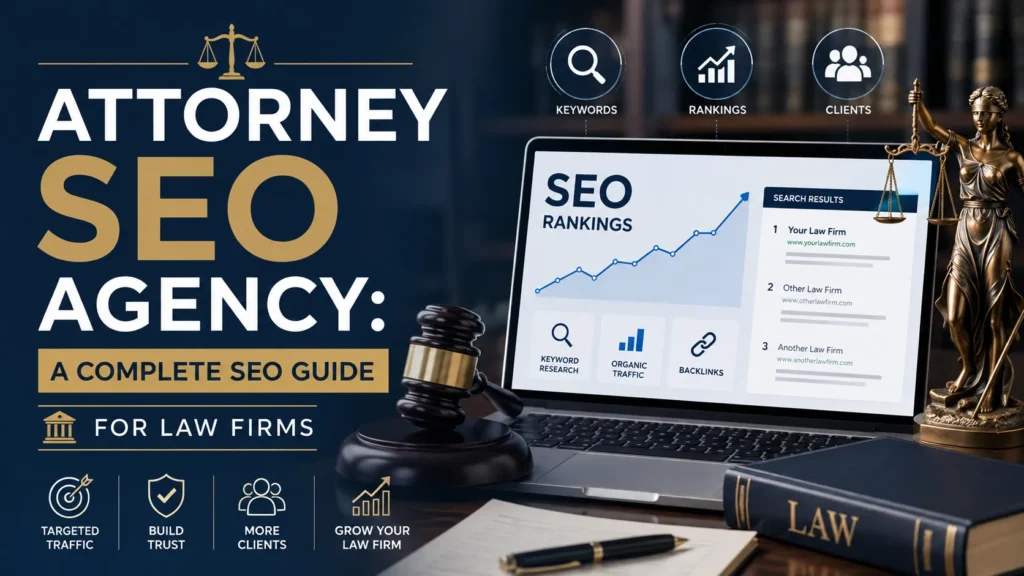
What Is Attorney SEO?
Attorney SEO is the process of optimizing a lawyer or law firm’s online presence so potential clients can find relevant services through search engines.
The work can include technical SEO, keyword research, practice area pages, legal content, local SEO, internal linking, authority building, conversion optimization, and performance measurement. The basic objective is simple:
Help the right people find the right law firm when they are searching for legal help or legal information.
That distinction matters. A page that attracts thousands of visitors searching for general legal definitions may bring less business value than a page attracting a smaller number of people actively looking for an attorney. Attorney SEO therefore focuses on relevance, intent, trust, and visibility, not traffic alone.
Why Do Law Firms Need Specialized SEO?

Legal services are different from many ordinary consumer purchases. A potential client may be dealing with an accident, a criminal charge, a divorce, an immigration matter, a financial dispute, or another serious problem. They need information they can trust before deciding whether to contact a firm.
That creates several SEO challenges. A law firm’s website needs to make clear:
- Which legal services the firm provides
- Which locations it serves
- Who the attorneys are
- What experience and qualifications they have
- What questions the firm can help answer
- How a potential client can make contact
Search visibility without credibility is not enough. Likewise, a highly credible firm can miss opportunities if its website is difficult to find or does not clearly explain its services. A specialized SEO strategy brings both sides together.
How Is Attorney SEO Different From General SEO?
The technical principles are similar. Search engines still need to crawl, understand, and index a website. The difference is the context. Attorney SEO has to account for legal search intent, local competition, professional credibility, sensitive information, accurate claims, and the user’s need for reliable information. A useful way to think about the difference is:
General SEO helps a website become visible. Attorney SEO connects that visibility with legal relevance, local intent, professional trust, and client acquisition.
For example, a general SEO campaign may focus heavily on increasing organic traffic. For a law firm, a better question is:
Are the people finding the website actually looking for the legal services this firm provides?
That question changes the entire strategy.
What Does an Attorney SEO Agency Actually Do?
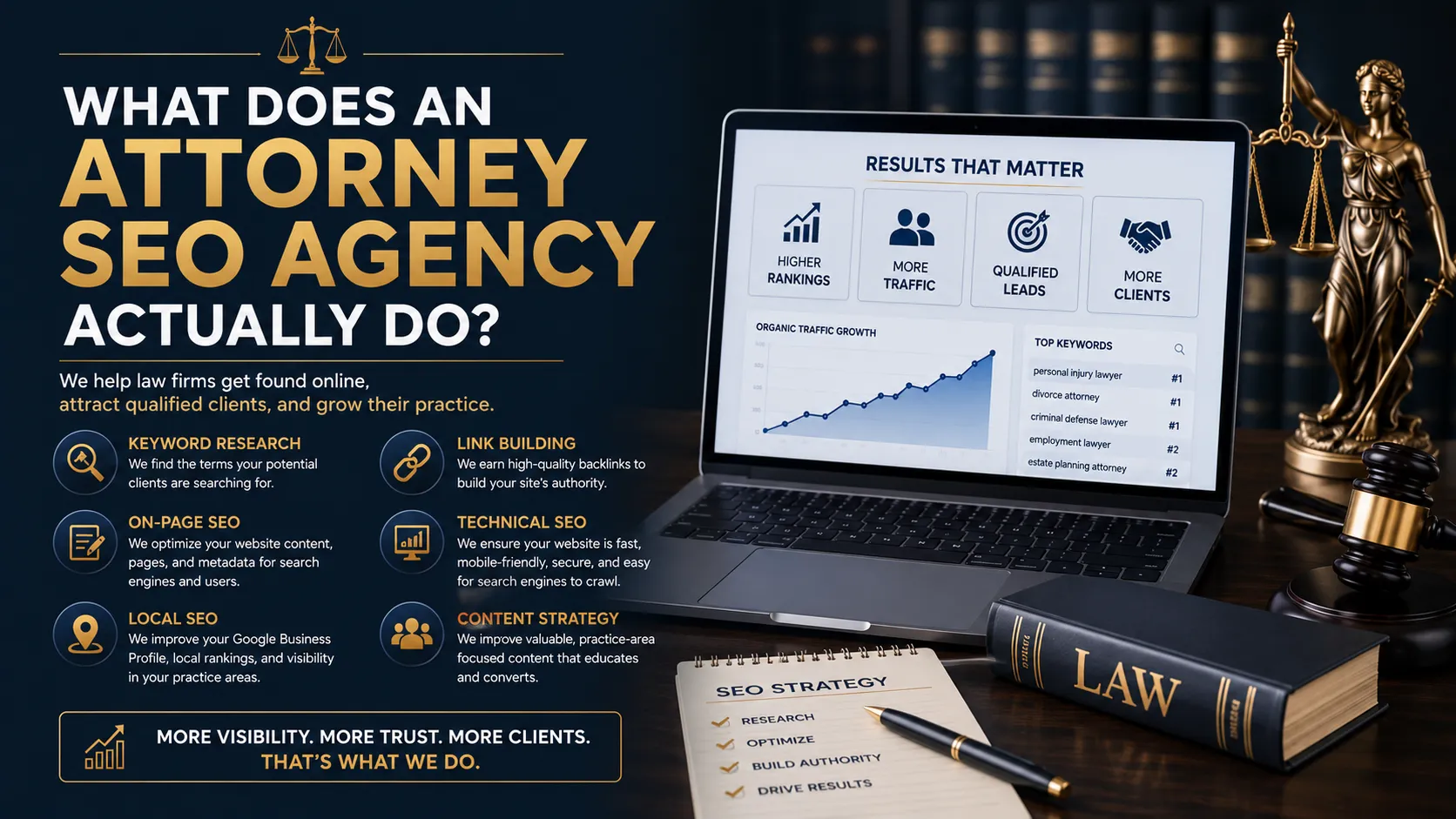
A specialized agency should begin with the law firm’s business rather than a generic SEO package. The work normally falls into several connected areas.
1. SEO and Website Audit
An audit establishes the starting point. The agency should review technical health, existing rankings, website architecture, practice area pages, content quality, internal links, local visibility, backlinks, indexation, and conversion paths.
For example, a firm may have 40 legal articles but weak pages for its most important services. Publishing another article may not solve that problem. The better move could be to improve the core service pages, reorganize related content, and strengthen internal links between informational and commercial pages. That is a strategy decision, not simply a content decision.
2. Keyword Research Based on Search Intent
Keyword research should answer more than how many times a phrase is searched.
The agency should ask:
What does the person actually want?
Consider these searches:
“What is comparative negligence?”
This is mainly informational.
“How does a personal injury claim work?”
This is also informational, but the searcher may be moving closer to professional help.
“Personal injury attorney in Chicago.”
This has much stronger commercial and local intent.
Each search deserves a different type of page. The goal is to map search intent to the most useful destination instead of forcing every keyword onto one page.
3. Practice Area SEO
The firm’s main legal services should have clear pages. Depending on the firm, that could include:
- Personal injury
- Criminal defense
- Family law
- Immigration
- Employment law
- Estate planning
- Business law
- Bankruptcy
- Real estate law
- Medical malpractice
The structure should reflect the firm’s real services. Creating pages for legal services the firm does not offer only to capture search traffic is not a sound SEO strategy.
4. Technical SEO
Technical SEO makes it easier for search engines to access and interpret the website. An attorney SEO agency may review:
- Crawlability
- Indexability
- Canonical URLs
- XML sitemaps
- Robots.txt
- Page speed
- Mobile usability
- Redirects
- Broken links
- Duplicate pages
- Internal links
- HTTPS
- Structured data
Technical SEO is not always visible to visitors, but technical problems can limit the value of otherwise good content.
5. Legal Content Strategy
A law firm does not need a blog post simply because a keyword tool found a phrase. Content should solve a real information need. For example, a personal injury practice could build a topic cluster around:
Core service: Personal Injury Attorney
Supporting topics:
- What should I do after a car accident?
- What evidence can support a personal injury claim?
- How does a personal injury case work?
- What is comparative negligence?
- How long can a personal injury claim take?
- When should I contact an attorney?
These pages can support one another through internal links. The result is a website that covers a subject in depth rather than a collection of disconnected articles.
The 5-Layer Attorney SEO Framework
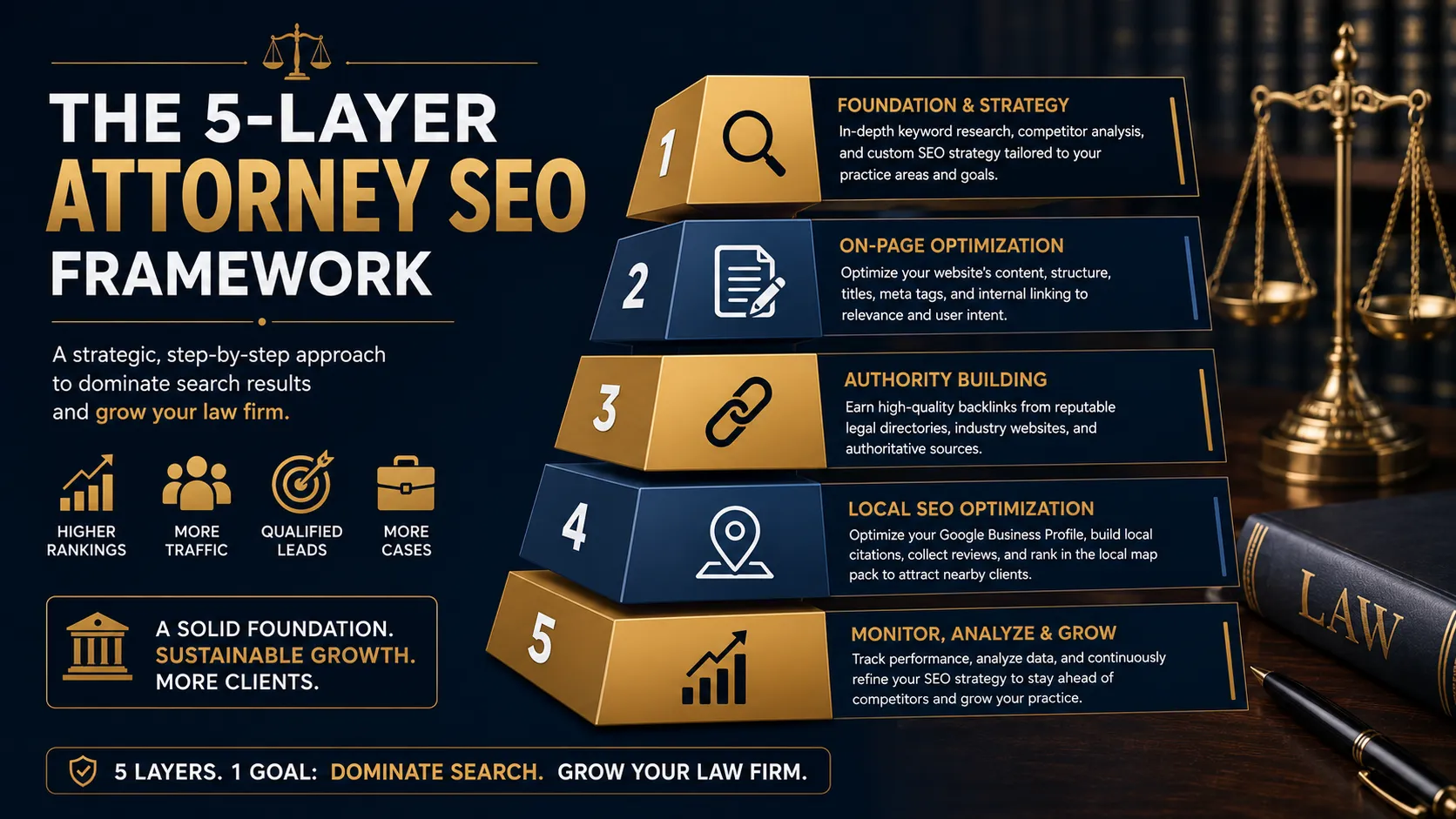
A practical way to assess a law firm’s SEO is to look at five connected layers.
SEO Layer | Main Question | Examples of Work |
Technical Foundation | Can search engines access and interpret the website? | Crawlability, indexation, canonicals, speed |
Practice Relevance | Does the site clearly explain its legal services? | Practice pages, keyword mapping, topic clusters |
Local Authority | Can people find the firm in its service area? | Local SEO, Business Profile, citations |
Trust & Expertise | Why should visitors trust the firm and its information? | Attorney profiles, sources, editorial process |
Conversion | Can qualified visitors easily take the next step? | Calls, forms, consultation CTAs |
These layers should work together. A technically perfect website can still fail to attract relevant searches. A strong content library can still struggle if important pages are not connected. A firm may rank locally but lose potential clients if its website does not clearly explain its services. And high traffic means little if the visitors never become qualified inquiries.
How Does Local SEO Help Law Firms?
Many legal searches have a location component. People often search for attorneys by city, county, state, or proximity. That makes local SEO especially useful for firms serving defined geographic markets. Local SEO may include:
- Google Business Profile optimization
- Accurate business information
- Relevant location pages
- Local citations
- Genuine reviews
- Relevant local links
- Service area information
- Location-focused content
The important word is genuine. A firm should not claim an office in a location where it does not actually operate. Likewise, an SEO agency should not create dozens of location pages that provide little information beyond a changed city name. Local SEO works best when the website reflects the firm’s real geographic presence.
How Should an Attorney SEO Agency Near Chicago Approach Local SEO?
The search for an attorney SEO agency near Chicago has clear commercial and geographic intent. A firm searching for an SEO partner in or around Chicago may value knowledge of the local market, competitive landscape, and search behavior. But proximity alone does not make an agency a good choice. A strong agency should be able to explain:
- Which legal searches are worth targeting
- How competitors are attracting organic visibility
- Which practice areas have the strongest opportunities
- How local pages will be differentiated
- How Google Business Profile work fits the wider strategy
- How results will be measured
The same principle applies whether the target market is Chicago, Los Angeles, Dallas, New York, or another U.S. city. Local SEO should reflect real market relevance, not just a location keyword.
Should Law Firms Create Neighborhood SEO Pages?
Sometimes. A neighborhood page can make sense when the law firm genuinely serves that community and the page provides useful local information. For example, a firm serving Chicago may have legitimate reasons to explain how it serves clients in neighborhoods such as Pilsen.
But a page should not exist simply because someone searched for attorney SEO agency near Pilsen Chicago. If the only difference between a Pilsen page and 20 other neighborhood pages is the neighborhood name, the pages may provide little additional value. A useful neighborhood page should have a real purpose. It may explain:
- The firm’s actual service area
- Office or meeting options
- Relevant legal services
- Local accessibility information
- Communities the firm serves
- Genuine local experience
The rule is simple: Create a location page because users need it, not because a keyword tool suggested it.
What Should an Attorney SEO Agency Los Angeles Strategy Include?
A search such as Attorney SEO agency Los Angeles represents another competitive local market. Los Angeles has law firms covering many practice areas, so there is no single SEO formula for every firm.
A personal injury attorney needs a different content and keyword strategy from an immigration attorney. A business law firm may need a different approach. A local campaign can combine:
- Practice area optimization
- Local search strategy
- Google Business Profile optimization
- Attorney and firm information
- Useful legal content
- Relevant local authority
- Internal linking
- Conversion optimization
The city name is only one part of the strategy. The real work is matching the firm’s services with the searches made by people in its target market.
How Does E-E-A-T Apply to Attorney SEO?
E-E-A-T stands for Experience, Expertise, Authoritativeness, and Trustworthiness. For law firms, these concepts are particularly useful because visitors want to know whether the information and the people behind it are credible.
Experience
Experience can be shown through genuine professional history, relevant work, publications, speaking activities, professional involvement, and other verifiable information. Never invent experience.
Expertise
Attorney profiles should clearly identify qualifications and areas of practice. Legal content should also be written or reviewed through a credible editorial process.
Authoritativeness
Authority can come from legitimate professional credentials, reputable publications, relevant organizations, trustworthy links, and independent mentions.
Trustworthiness
Trust includes accurate business information, realistic claims, transparent authorship, reliable sources, and clear contact information. For legal websites, trust should be visible rather than assumed.
Should Legal Articles Have an Author and Reviewer?
When a genuine editorial review process exists, identifying the author and reviewer can help readers understand who is responsible for the information. A page may show:
Written by: [Real Author]
Reviewed by: [Real Reviewer, if applicable]
Last updated: [Actual Date]
The people listed should have genuinely contributed to the content. Do not add an attorney’s name simply to make an article look authoritative. The same applies to awards, case results, client testimonials, and professional credentials. A real credential is valuable. A manufactured credential can damage trust.
How Can Law Firms Build Topical Authority?
Topical authority is not created by publishing the largest number of articles. It comes from covering an important subject thoroughly and logically. For example, a family law firm could build a topic cluster around divorce. The central service page might explain the firm’s divorce services. Supporting pages could cover:
- Divorce process
- Property division
- Child custody
- Child support
- Mediation
- Common divorce questions
- Preparing documents for a consultation
Each page should have its own purpose. Internal links can then connect related information. This gives search engines and users clearer context about the firm’s expertise. Depth with purpose is more useful than volume without direction.
How Can an Attorney SEO Agency Improve AI Search Visibility?
AI search has changed how people ask questions. Instead of typing a short keyword, a person may ask: “What should I look for when choosing a personal injury attorney in Chicago?” Or: “What questions should I ask a lawyer before hiring them?”
This creates opportunities for firms that publish clear and well-supported information. AI search optimization should focus on making information easy to identify, understand, verify, and connect to the correct entity.
Six Practical Principles for AI Search
- Make the firm easy to identify.
Clearly describe the firm, attorneys, practice areas, locations, and professional credentials.
- Answer questions directly.
Start important sections with a clear answer before adding detail.
- Support important claims.
Use reliable sources when discussing laws, statistics, regulations, or other factual matters.
- Build topical depth.
Connect related pages instead of publishing isolated articles.
- Keep important information consistent.
Business details, attorney names, practice areas, and locations should be accurate across major sources.
- Build independent authority.
Relevant mentions, citations, publications, professional organizations, and reputable websites can provide context beyond the firm’s own website.
The objective is not to trick an AI system into mentioning the firm. The objective is to publish information that deserves to be found and referenced.
What Is the Difference Between SEO, AEO, GEO, and AIO?
These terms overlap, but they describe different search optimization goals.
- SEO focuses on improving visibility in search engines.
- AEO, or Answer Engine Optimization, focuses on providing clear answers to questions and conversational searches.
- GEO, or Generative Engine Optimization, focuses on making useful information easier for generative search systems to discover, interpret, and potentially reference.
- AIO, when used to describe AI search optimization, focuses on making website information suitable for AI-driven discovery and retrieval.
These should not become four separate content strategies. A well-researched page can support all four. For example, a page can target a search query, answer the question directly, provide supporting evidence, explain the firm’s expertise, and connect to related pages. That is better than creating separate pages simply because four marketing terms exist.
What Are Google AI Overviews and AI Mode?
AI Overviews and AI Mode are different search experiences. An AI Overview can provide an AI-generated summary within Google Search for some queries. AI Mode is designed around a more conversational search experience where users can explore a topic through follow-up questions.
Law firms should not build their entire SEO strategy around one specific Google feature. Search features change. A more durable approach is to create information that is:
- Clear
- Accurate
- Well structured
- Relevant
- Easy to verify
- Supported by credible sources
- Connected to a clearly identifiable organization and experts
That foundation can support traditional search and newer AI-driven experiences.
Can Attorney SEO Help Generate Qualified Leads?
Yes, but SEO should not be treated as a guaranteed lead machine. Its value comes from attracting people who are actively searching for relevant information or legal services and then giving them a clear path to contact the firm. For example, a visitor searching for a general legal definition may not be ready to hire an attorney.
A visitor searching for a specific attorney in a specific city may have much stronger commercial intent. That difference should influence both keyword strategy and conversion design. A good SEO campaign therefore measures lead quality, not just traffic.
How Should Law Firms Measure SEO ROI?
Rankings are useful, but they are not the final business metric. A law firm should look at whether organic search is contributing to meaningful actions. Useful measurements include:
- Organic traffic
- Non-branded search visibility
- Local search visibility
- Organic phone calls
- Contact form submissions
- Consultation requests
- Qualified leads
- Conversion rate
- Cost per qualified lead
- Practice area performance
- Organic assisted conversions
Consider two hypothetical pages. Page A receives 5,000 visits and generates three inquiries. Page B receives 800 visits and generates 15 relevant inquiries. Page B may be far more valuable to the law firm. This is why business intent should guide SEO reporting.
What Should an Attorney SEO Report Include?
A monthly report should help a law firm understand what happened and what comes next.
Visibility
Which important search terms and pages changed?
Traffic
Which pages attracted organic visitors?
Leads
How many calls, forms, or consultation requests came from organic search where tracking allows?
Local Performance
How is the firm’s visibility changing in its target locations?
Work Completed
What technical, content, local, and authority work was completed?
Next Priorities
What will the agency improve next, and why? A report that only shows a list of ranking positions does not tell the full story. The firm should understand how SEO activity connects to business outcomes.
How Much Does Attorney SEO Cost?
There is no universal price for attorney SEO. A solo attorney targeting one local practice area may need a very different campaign from a large firm operating across several locations. Pricing can depend on:
- Website size
- Number of practice areas
- Target locations
- Competition
- Technical SEO requirements
- Content requirements
- Local SEO work
- Authority building
- Reporting and strategy
- Existing website strength
Instead of comparing agencies only by monthly price, compare the scope of work. Ask what the agency will actually improve. A low monthly fee can be expensive if the agency does little meaningful work. A higher fee can also be poor value if it is not tied to a clear strategy.
How Long Does Attorney SEO Take?
There is no fixed SEO timeline. A technical problem can sometimes be corrected quickly. Building visibility for a highly competitive practice area may take much longer. The timeline can depend on:
- Existing website authority
- Competition
- Target location
- Practice area
- Content quality
- Technical health
- Backlink profile
- Local presence
- Previous SEO work
An honest agency should explain these variables instead of promising a specific ranking date. Be cautious about statements such as:
“We guarantee #1 on Google.”
No SEO company controls Google’s ranking system.
How Do You Choose the Best Attorney SEO Agency?
The best attorney SEO agency is not necessarily the cheapest agency or the one promising the largest number of backlinks. Look for a partner that can explain its strategy clearly. Before signing a contract, ask:
- How will you audit our website?
- How will you map keywords to practice areas?
- How will you identify search intent?
- How will you prevent duplicate location pages?
- Who writes the legal content?
- How is content checked for accuracy?
- What link building methods do you use?
- How do you handle local SEO?
- How will you measure qualified leads?
- What will appear in monthly reports?
- How will the strategy change if results are weak?
- What do you refuse to promise?
A good agency should be comfortable answering these questions.
What Are the Biggest Attorney SEO Red Flags?
Watch carefully for agencies that:
- Guarantee first place on Google
- Promise thousands of backlinks without explaining quality
- Create hundreds of nearly identical city pages
- Use fake authors or reviewers
- Invent case studies
- Copy competitor content
- Publish generic AI content at scale
- Focus only on keyword rankings
- Ignore conversion tracking
- Promise guaranteed AI citations
- Cannot explain what work is included in the monthly fee
SEO involves uncertainty. An agency that acknowledges that uncertainty can still provide a clear plan, measurable work, and useful reporting. An agency that promises complete control over Google or AI search should be treated with caution.
Attorney SEO Audit Checklist
Before launching an SEO campaign, review the website across five areas.
Technical SEO
- Can search engines crawl important pages?
- Are valuable pages indexable?
- Are canonical URLs correct?
- Is the XML sitemap current?
- Are important pages internally linked?
- Does the site work well on mobile?
- Are technical errors monitored?
Content
- Does every important practice area have a useful page?
- Does each page satisfy a clear search intent?
- Are articles genuinely helpful?
- Are important legal claims supported?
- Are similar pages meaningfully different?
- Is outdated content reviewed?
Local SEO
- Is the Google Business Profile accurate?
- Does the firm use its real business information?
- Are service areas represented honestly?
- Are reviews genuine?
- Are important business details consistent?
- Does the website explain where the firm actually serves clients?
E-E-A-T
- Are attorney credentials clear?
- Are authors identifiable?
- Is the editorial process credible?
- Are important claims supported?
- Are awards and case results verifiable?
- Is the firm information accurate?
Conversion
- Is the phone number easy to find?
- Is the contact form simple?
- Are consultation options clear?
- Can visitors quickly find the right practice area?
- Does every important page offer an appropriate next step?
What Should a Strong Attorney SEO Content Plan Look Like?
A strong content plan starts with business priorities. Suppose a firm wants more personal injury clients. The agency should not begin by producing 50 unrelated legal articles. A more logical sequence could be:
- Identify the firm’s highest-value personal injury services.
- Build or improve the main service page.
- Research the questions potential clients ask before contacting an attorney.
- Create supporting content around those questions.
- Connect the supporting articles to the main service page.
- Improve local relevance for the firm’s actual service area.
- Strengthen attorney and firm information.
- Monitor traffic, rankings, inquiries, and lead quality.
This creates a relationship between content and business goals.
Why Internal Linking Matters for Attorney SEO
Internal links help users move between related pages and help search engines understand the relationship between topics. For example:
Personal Injury Attorney
can link to:
Car Accident Claims
which can link to:
Evidence After a Car Accident
and:
When to Contact a Personal Injury Attorney
This creates a logical topic cluster. Internal linking also helps prevent useful content from becoming isolated. The links should be natural and useful to the reader. Adding dozens of links simply to increase keyword signals is not the goal.
What Role Do Backlinks Play in Attorney SEO?
Backlinks can contribute to a website’s authority, but quality matters more than raw volume. A law firm does not need thousands of unrelated links. Relevant opportunities may include:
- Professional organizations
- Reputable legal publications
- Local organizations
- Industry publications
- Community resources
- Genuine digital PR
- Relevant editorial coverage
An agency should be able to explain where links come from and why they are relevant. Avoid packages that promise a huge number of backlinks without explaining their source or quality.
How Can Law Firms Avoid Thin or Duplicate SEO Pages?
Before publishing a new page, ask one question: What does this page provide that another page does not?
If the answer is only: “It targets another city,” that may not be enough. A useful location or practice page needs its own purpose, audience, information, and search intent. This is especially important for firms targeting multiple cities, neighborhoods, or states. Scale should not come at the expense of usefulness.



Best Web Development Agency in Pakistan: How to Choose the Right Partner
SUMMARIZE THIS POST WITH ChatGPT GoogleAI Perplexity Claude Jump To

Graphic Design Services in Pakistan: A Complete Guide for Businesses
SUMMARIZE THIS POST WITH ChatGPT GoogleAI Perplexity Claude Jump To

Best Social Media Marketing Agency in Pakistan: A Complete Guide for 2026
SUMMARIZE THIS POST WITH ChatGPT GoogleAI Perplexity Claude Jump To
SEO Services in Pakistan: A Complete Guide to Growing Your Business Online
SUMMARIZE THIS POST WITH ChatGPT GoogleAI Perplexity Claude Jump To