

Call Us Now:
+92 300 9842234
Side Info Heading
Side Info Text
Gallery Heading
Follow Us

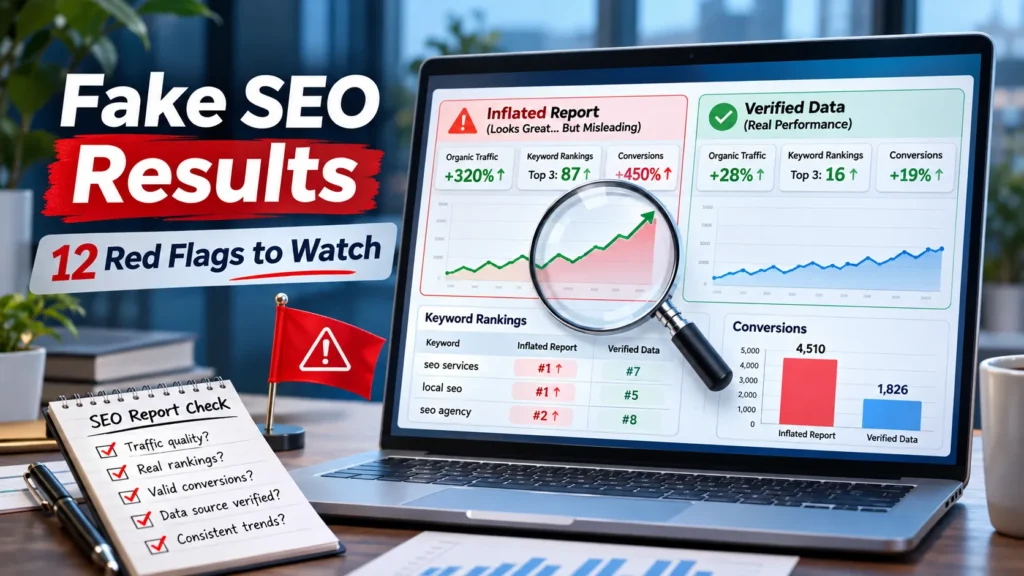
What Are Fake SEO Results?
Fake SEO results refer to inaccurate or misleading claims about a website’s organic search performance. Some reports contain deliberately fabricated numbers. Others use real metrics but present them without enough context to explain what those numbers actually mean. For example, an agency might report:
- A 200% increase in search impressions without showing whether clicks improved.
- First-page rankings for keywords with little commercial relevance.
- Significant traffic growth driven by branded searches.
- Hundreds of conversions that are actually button clicks rather than customer enquiries.
- Improved third-party authority scores without evidence of stronger organic visibility.
These figures may be technically accurate while giving business owners an unrealistic impression of success.
The distinction matters: A misleading report is not automatically proof of dishonesty. Analytics configuration mistakes, seasonal demand, attribution limitations, and poor communication can also explain unexpected numbers.
The goal of an SEO audit is to identify what happened, why it happened, and whether the reported progress supports real business objectives.
Why Do Some SEO Agencies Present Misleading Results?
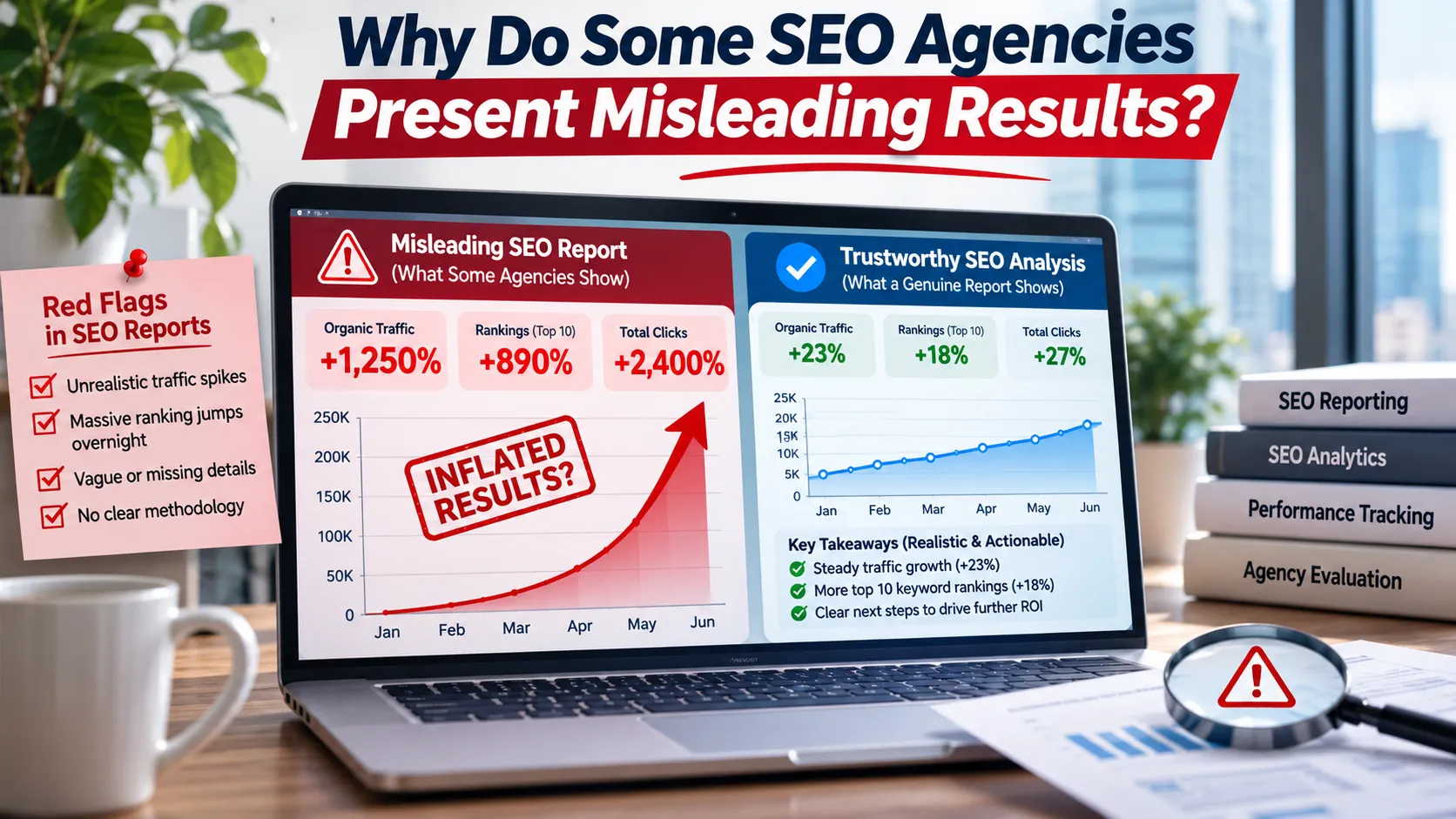
SEO is a long-term marketing strategy. Unlike paid advertising, organic search results cannot be guaranteed within a fixed period. Some agencies feel pressure to demonstrate quick improvements, particularly when clients expect immediate rankings, leads, and revenue.
This can create incentives to emphasize positive-looking indicators instead of meaningful business outcomes. Common reporting problems include:
- Selecting only the highest-performing keywords.
- Excluding pages or periods with declining performance.
- Combining branded and non-branded traffic.
- Presenting third-party SEO scores as official Google metrics.
- Reporting engagement events as sales conversions.
- Failing to explain changes caused by other marketing channels.
A reliable agency should present both positive and negative performance changes and explain their possible causes. That transparency makes it easier to distinguish genuine SEO improvements from misleading SEO metrics.
12 Red Flags That Could Indicate Fake SEO Results
1. Your Agency Reports Rankings for Keywords Nobody Searches
Ranking on Google’s first page sounds impressive. However, ranking for a phrase with little relevant search demand may contribute almost nothing to business growth.
Imagine a Karachi-based digital marketing agency ranking first for an unusually long phrase that almost nobody searches. The ranking itself may be real, but it does not necessarily demonstrate competitive SEO success.
How to verify:
- Open Google Search Console.
- Navigate to Performance > Search results.
- Select the Queries tab.
- Review impressions, clicks, CTR, and average position.
- Compare those queries with the agency’s keyword ranking report.
Evaluate whether the keywords are relevant to your services and capable of attracting prospective customers. Search Console impressions are not identical to total keyword search volume, so use keyword research tools separately when estimating demand.
Key takeaway: A keyword ranking matters when it supports relevant visibility, useful traffic, or conversions, not simply because it appears on page one.
2. Ranking Screenshots Are the Only Proof Provided
Some SEO reports contain screenshots showing a website at position one. Screenshots are easy to misunderstand because search rankings can vary based on location, device, language, and other search conditions. A ranking observed in Karachi may differ from what someone sees in Dubai or London.
How to verify:
Use Search Console’s average position metric for the relevant query, page, country, device, and reporting period. For businesses targeting local customers, also consider consistent geographic rank tracking.
Remember that average position is not a universal, fixed ranking. It reflects an average across the impressions included in the selected report. A screenshot may support a report, but it should never be the only evidence.
3. Organic Traffic Increases Without Relevant Customer Enquiries
Imagine your agency reports that organic traffic increased from 2,000 to 5,000 monthly sessions. That sounds like tremendous growth.
But what if the additional visitors are reading unrelated informational articles, while your service pages receive fewer visits? Your business may gain traffic without attracting more potential customers.
How to verify:
Open GA4 and navigate to Reports > Acquisition > Traffic acquisition. Filter the report to Organic Search, then examine landing pages, engagement, and key events using the relevant reports or explorations.
Ask these questions:
- Which pages attracted the additional sessions?
- Did service and product pages gain relevant visitors?
- Did organic search generate more qualified enquiries?
- Is the growth concentrated in your target market?
Traffic growth should be evaluated alongside visitor intent and business outcomes.
4. Branded Searches Are Presented as New SEO Success
Branded and non-branded searches serve different purposes. A branded search includes your business name, such as “Tekcurio Digital Marketing Agency.” A non-branded search describes a need, such as “SEO agency in Karachi.” Both are valuable, but they represent different types of demand.
If a company launches a major advertising campaign, branded searches may increase because more people are aware of the business. An SEO report that claims all resulting branded search growth was caused by SEO would be overstating attribution.
How to verify:
In Google Search Console, analyze branded and non-branded queries separately. Use query filters to examine common brand spellings and variations. Track both categories over time.
Non-branded search visibility can help evaluate how effectively a website reaches people who may not already know the company. However, non-branded growth can also be influenced by market demand and other marketing activities. It should not be automatically attributed entirely to SEO.
5. Search Impressions Rise While Clicks Decline
An SEO report may celebrate a 150% increase in impressions. But impressions only indicate that a result was displayed in eligible Google Search experiences. They do not mean that someone visited your website. Consider this hypothetical example:
Metric | Previous Period | Current Period |
Impressions | 40,000 | 100,000 |
Clicks | 2,000 | 1,500 |
CTR | 5% | 1.5% |
Impressions increased significantly, but clicks fell by 25%. The additional visibility did not translate into more visits.
How to verify:
Analyze clicks, impressions, CTR, and average position together in Search Console. Segment the data by query, page, country, device, and search appearance where useful.
A declining CTR does not automatically mean your agency failed. Changes in query mix, search features, competition, and user behavior can influence click patterns. The important question is whether visibility is growing for searches that matter to your business.
6. Your SEO Report Uses Misleading Date Comparisons
A common reporting problem involves comparing periods that are not meaningfully comparable. For example, a business might receive more search traffic in November than in a typically quiet month. That increase could reflect normal seasonal demand rather than improved SEO execution.
How to verify:
Compare:
- Month-over-month performance.
- Year-over-year performance for equivalent periods.
- Longer-term trends across several months.
- Major campaign launches, website changes, and known disruptions.
For seasonal businesses, year-over-year comparisons often provide useful additional context. However, no single comparison can completely isolate the impact of SEO.
7. Your Website Receives Suspicious Traffic Spikes
Sudden organic traffic increases sometimes deserve closer investigation. Potential warning signs include unusual geographic distribution, strange landing-page patterns, and very low engagement.
For example, a business targeting Karachi customers might see an unexpected increase in sessions from locations where it offers no services. That alone does not prove the traffic is fraudulent. It may reflect legitimate international interest, reporting changes, or automated activity.
How to verify:
Review GA4 traffic acquisition and geographic reports. Investigate the traffic source, landing pages, engagement patterns, and conversions.
If suspicious traffic continues, review server logs and security monitoring where available. Do not classify every visitor with low engagement as a bot. Engagement metrics alone are not sufficient evidence.
8. Your Agency Reports Conversions That Are Not Real Leads
This is one of the most important SEO reporting red flags. Some websites treat every button click, scroll, or page interaction as a conversion.
Those actions can be useful for measuring engagement, but they do not necessarily represent qualified business leads. Imagine this hypothetical monthly report:
Reported Metric | Number |
Tracked button interactions | 350 |
Completed contact forms | 45 |
Qualified enquiries | 22 |
Confirmed customers | 6 |
An agency claiming that all 350 interactions represent customer leads would be misleading.
How to verify:
Open GA4 and navigate to Admin > Data display > Events. Review which events are marked as key events and what actions trigger them. For lead-generation businesses, relevant events may include:
- Successfully submitted contact forms.
- Verified phone enquiries.
- Completed consultation bookings.
- Qualified leads recorded in the CRM.
A WhatsApp button click indicates an attempt to initiate contact, not necessarily a conversation or qualified lead. Google recommends measuring meaningful business actions through correctly configured events.
The best SEO conversion reports distinguish interactions, leads, qualified opportunities, and customers.
9. Domain Authority Is Presented as a Google Ranking Score
Domain Authority, Domain Rating, and Authority Score are metrics calculated by third-party SEO software providers. They can be useful for competitive analysis, but they are not official Google ranking scores.
An agency might report that a website’s authority score increased from 20 to 35. That change does not necessarily prove that organic rankings, qualified traffic, or sales increased.
How to verify:
Ask which tool produced the score and how it changed. Review the website’s referring domains and acquired backlinks.
Evaluate whether those links come from relevant, legitimate websites. Most importantly, compare these indicators with actual organic search performance. Third-party authority metrics should support SEO analysis rather than replace it.
10. Low-Quality Backlinks Are Reported as Major SEO Achievements
A monthly report boasting 500 new backlinks may look impressive. But backlink quantity alone is a poor indicator of quality. Hundreds of links from irrelevant, automated, or manipulative websites may provide little value and can create SEO risks.
How to verify:
Request a list of acquired links and referring domains.
Review:
- The relevance of the linking website.
- The editorial context surrounding each link.
- Whether the link is live and accessible.
- Whether the linking content provides genuine value.
- Whether paid or sponsored placements use appropriate link attributes.
Be cautious of agencies guaranteeing specific ranking improvements through bulk link packages. A responsible SEO strategy prioritizes relevant content, legitimate digital PR, and sustainable link acquisition.
11. Your Agency Takes Credit for Leads Generated by Other Channels
A business may simultaneously invest in SEO, Google Ads, Meta Ads, email marketing, and offline campaigns. When total leads increase, it is important to understand which channels contributed.
Suppose a business launches a successful paid advertising campaign while its SEO agency is also working on the website. An increase in total website enquiries does not automatically mean SEO caused that growth.
How to verify:
In GA4, review channel-level performance using consistent acquisition and attribution reporting. Compare Organic Search, Paid Search, Organic Social, Direct, and other relevant channels.
Where possible, connect analytics with CRM data. Remember that attribution is imperfect. Customers may interact with several marketing channels before converting. A trustworthy agency should explain these limitations rather than claim ownership of every sale.
12. You Cannot Access Your Own SEO Data
One of the most serious warning signs is when a business receives monthly PDF reports but cannot independently access the underlying data.
Without appropriate access, it becomes difficult to verify performance. Your organization should maintain suitable control over important digital assets, including:
- Google Search Console.
- Google Analytics 4.
- Google Business Profile, where applicable.
- Google Tag Manager.
- Website hosting and domain registration.
An agency may reasonably manage these systems on your behalf, but access arrangements and asset ownership should be clearly defined.
How to verify:
Ask for appropriate access permissions and confirm that the reporting properties belong to the correct website and business. If an agency refuses reasonable verification requests, ask for a written explanation and review your agreement.
How to Verify SEO Results Using Google Search Console
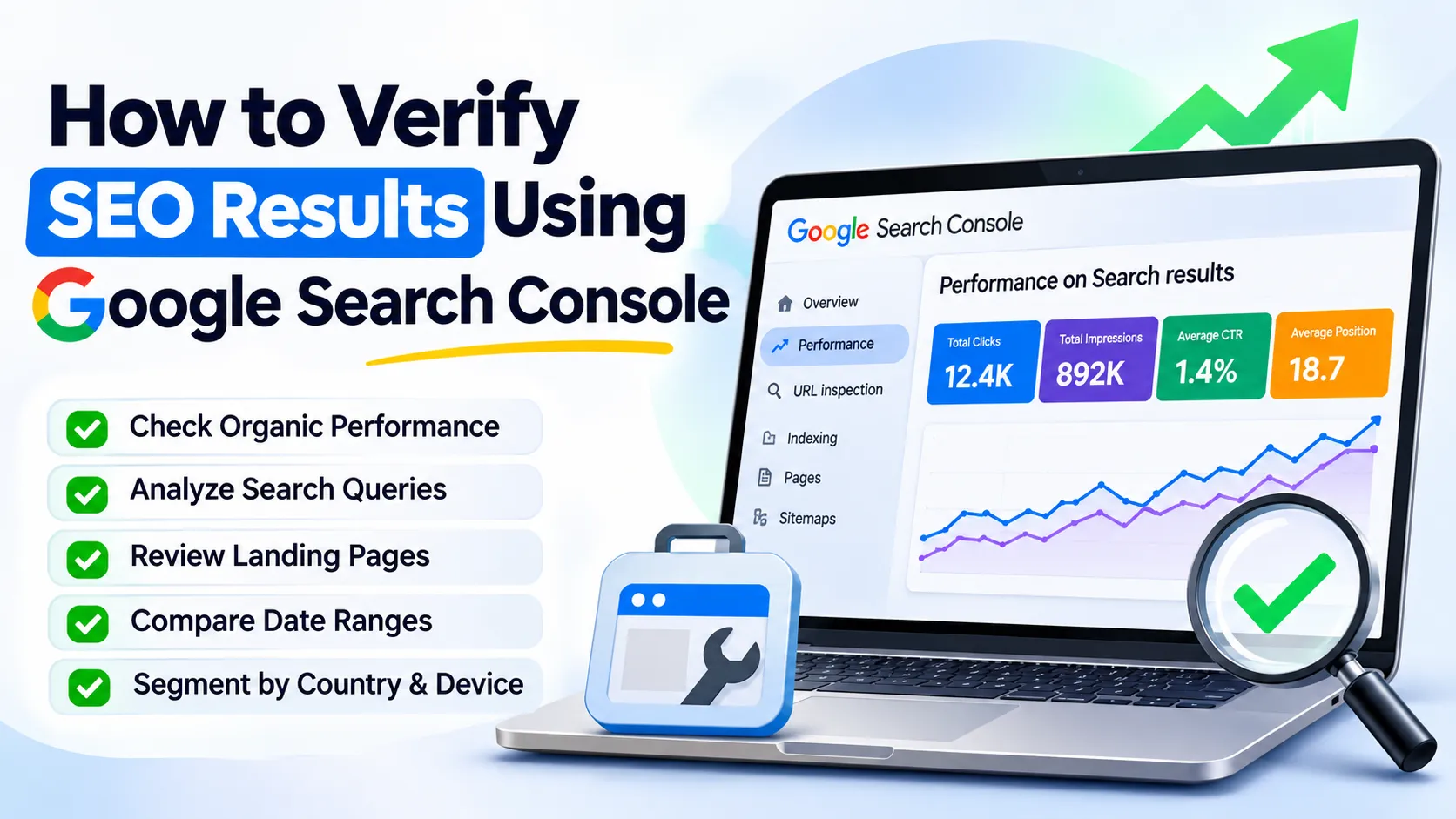
Google Search Console is one of the most valuable free tools for auditing organic search visibility. It provides Google Search performance data directly associated with your verified website property.
Step 1: Open the Performance Report
Sign in to Google Search Console and select the correct website property. Go to Performance > Search results. You can review four important metrics:
Metric | What It Measures |
Total Clicks | Clicks from Google Search results |
Total Impressions | How often eligible results appeared |
Average CTR | Clicks divided by impressions |
Average Position | Average top position across included impressions |
These metrics are useful, but they should be interpreted together.
Step 2: Identify Valuable Search Queries
Open the Queries tab. Look for searches relevant to your products, services, and target customers. For example, a digital marketing company might monitor searches related to SEO consulting, website development, and paid advertising services. Evaluate whether the website is gaining exposure for queries with appropriate search intent.
Step 3: Analyze Important Landing Pages
Switch to the Pages tab. Identify which URLs attract organic clicks and impressions. Pay particular attention to commercially important pages.
A successful informational article can support brand awareness and future conversions, but its traffic should not be confused with direct lead generation.
Step 4: Compare Reporting Periods
Use the Date filter to compare equivalent periods. Investigate major increases and decreases rather than reporting only the positive changes.
Step 5: Segment the Data
Where relevant, examine performance by country, device, and search appearance. Google Search Console provides query and page-level performance insights, although privacy filtering and reporting limits mean not every individual search query is necessarily visible. For more details, consult the official Google Search Console Performance documentation.
How to Audit SEO Reports Using Google Analytics 4
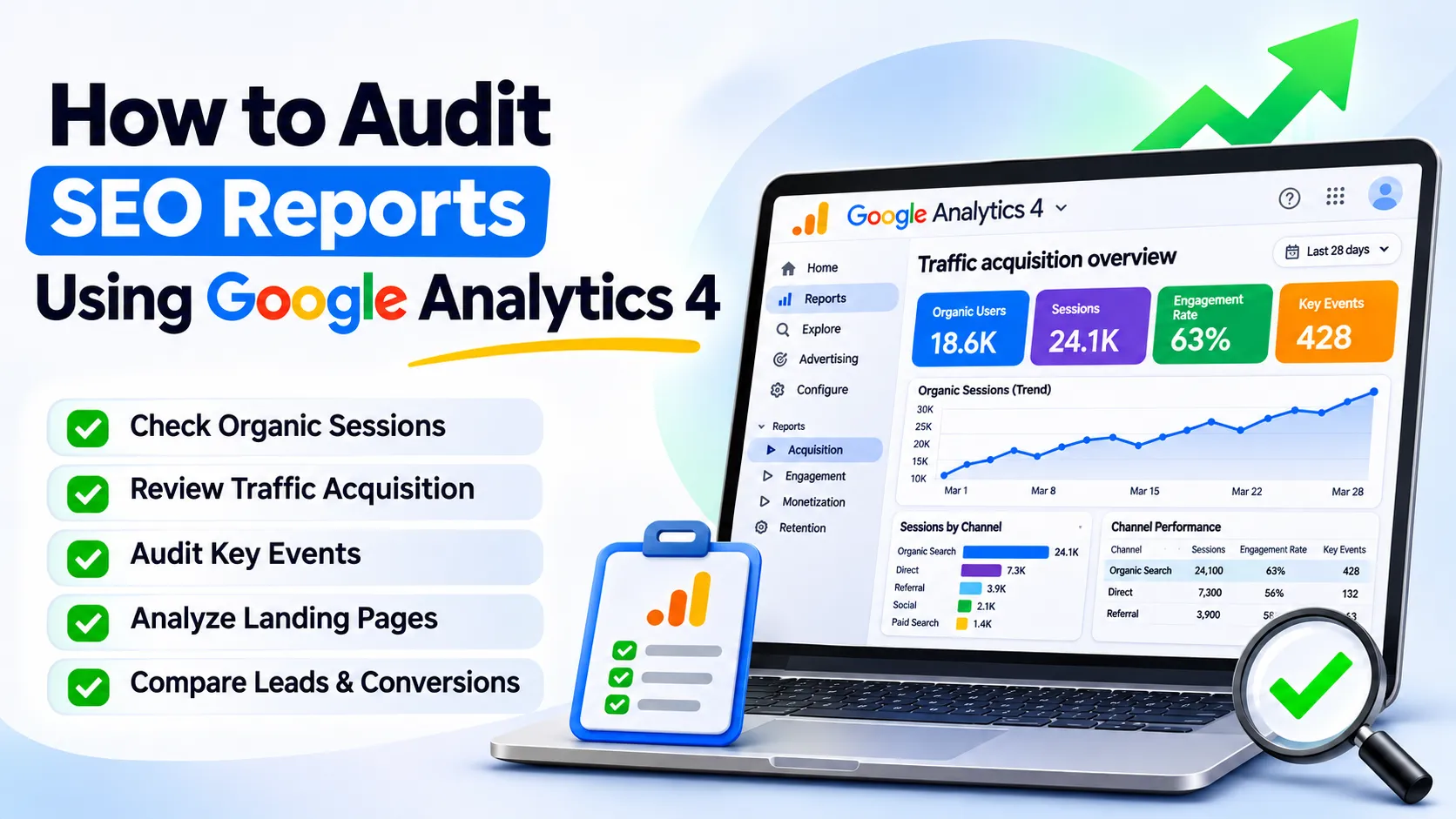
Google Analytics 4 helps explain what visitors do after reaching a website. Search Console focuses on Google Search visibility and clicks, while GA4 helps measure website sessions, engagement, and business interactions. The two tools serve different purposes, so their numbers will not always match.
Check Organic Search Sessions
Open GA4. Navigate to Reports > Acquisition > Traffic acquisition. Select or filter the Organic Search channel. Review traffic trends and investigate the pages attracting organic visitors.
Review Engagement Quality
Look beyond total session counts. Useful indicators include:
- Engaged sessions.
- Engagement rate.
- Landing-page performance.
- Relevant key events.
- Lead-generation outcomes.
None of these should be interpreted in isolation.
Verify Key Events
Navigate to Admin > Data display > Events. Review the event definitions and key-event settings. Confirm that important events measure successful actions rather than merely attempts to perform those actions.
For example, a successfully submitted contact form is typically a more meaningful lead-generation event than clicking the submit button.
Match Analytics With Real Business Records
Compare tracked leads with data from your CRM, contact forms, telephone systems, and sales team. Some differences are expected because of consent settings, attribution, spam filtering, duplicate events, and tracking limitations.
However, large unexplained differences should be investigated. For technical guidance, refer to Google’s documentation on GA4 traffic acquisition and key-event configuration.
Fake SEO Reports vs Genuine SEO Performance: A Practical Comparison
The following example is hypothetical and illustrates how the same marketing performance can be presented differently.
Misleading Reporting Claim | More Meaningful Verification |
50 keywords rank on page one | How many attract relevant clicks? |
Organic impressions increased 200% | Did qualified search traffic improve? |
Website traffic doubled | Which pages and channels drove growth? |
300 conversions generated | How many were verified enquiries? |
Domain authority increased | Did organic visibility and quality backlinks improve? |
200 backlinks acquired | Are they relevant and legitimate? |
Website reached Google position one | For which query, location, device, and period? |
Leads increased by 80% | How many came from organic search? |
A strong monthly SEO report should answer the questions in the second column.
Which SEO Metrics Actually Matter for Business Growth?
The most useful SEO metrics depend on business goals. For a local service business, qualified phone calls and consultation requests may matter most.
For an e-commerce store, organic revenue, transactions, and profitability may be more important. For a publisher, relevant readership, engagement, and monetization performance may be central.
Five Core Metrics Worth Monitoring
- Relevant non-branded organic clicks
These help demonstrate visibility among people searching for products, services, or information without necessarily knowing your brand.
- Organic landing-page performance
This reveals which pages attract search visitors and whether commercially important pages are improving.
- Qualified leads from organic search
Lead volume is valuable when those enquiries match your target customers.
- Organic search revenue or sales contribution
For businesses with suitable tracking, connecting search traffic to customer outcomes provides a clearer view of performance.
- Long-term search visibility
Consistent monitoring helps distinguish temporary fluctuations from meaningful progress.
Revenue attribution should be interpreted carefully, especially when customers interact with multiple channels before purchasing.
How to Calculate SEO Return on Investment
SEO ROI can help evaluate whether organic search investment is commercially worthwhile.
A simplified formula is:
SEO ROI (%) = [(SEO-Attributed Profit − SEO Investment) ÷ SEO Investment] × 100
For example, suppose a business invests $2,000 in SEO and estimates that SEO-attributed sales generated $5,000 in contribution profit after relevant variable costs.
The simplified calculation would be:
SEO ROI = [($5,000 − $2,000) ÷ $2,000] × 100
SEO ROI = 150%
This is a hypothetical calculation, not a Tekcurio client result. Accurate SEO ROI evaluation requires reliable cost data, reasonable attribution assumptions, and an appropriate reporting period.
For lead-generation companies, estimated lead value or customer lifetime value may be useful when direct revenue tracking is unavailable.
A Practical SEO Reporting Checklist for Business Owners
Use this checklist during monthly or quarterly reporting reviews.
SEO Audit Question | Where to Verify |
Is organic search traffic increasing? | GA4 |
Are relevant Google Search clicks growing? | Search Console |
Are non-branded queries improving? | Search Console |
Which landing pages generate visibility? | Search Console |
Are key events correctly configured? | GA4 |
Are tracked leads genuine? | CRM and enquiry records |
Is growth coming from target locations? | GA4 and Search Console |
Are backlinks relevant and legitimate? | Link reports and manual review |
Are keyword rankings independently verifiable? | Search Console and rank tracking |
Are seasonal comparisons fair? | Historical analytics |
Is there a clear explanation for declining metrics? | Agency reporting |
Does the business retain appropriate account access? | Platform permissions |
What Should an Honest Monthly SEO Report Include?
A transparent SEO report should provide:
- An executive summary explaining the reporting period and business goals.
- Organic visibility, traffic, and performance trends.
- Important keyword and landing-page changes.
- Lead and conversion performance with clear definitions.
- Technical SEO improvements and unresolved issues.
- Content published or updated during the period.
- Link-building or digital PR activities, where applicable.
- Performance declines, uncertainties, and their possible causes.
- A summary of completed work and upcoming priorities.
Reporting should connect measurable outcomes with the activities performed.
What Should You Do If You Discover Misleading SEO Numbers?
Finding discrepancies does not automatically mean your agency intentionally manipulated the data. Start by investigating the evidence.
- Document the differences. Save copies of the report and compare them with the relevant analytics views.
- Ask for clarification. Request an explanation of the metrics, filters, reporting dates, and attribution methodology.
- Examine tracking configuration. Incorrect events, duplicate tags, and reporting filters may cause inaccurate numbers.
- Confirm account access. Make sure your business maintains appropriate control of its website and marketing assets.
- Consider an independent SEO audit. An independent review can help determine whether the discrepancies reflect technical mistakes, measurement limitations, or misleading presentation.
If contractual issues arise, review the agreement before making decisions about termination or asset transfers.
How Can You Choose an SEO Agency That Provides Transparent Results?
Choosing an SEO agency should involve more than checking its ranking claims or promises. A reliable provider should be able to explain its methodology, reporting process, and limitations. Before hiring, ask:
- Which business objectives will the SEO strategy support?
- How will organic search performance be measured?
- Will we have access to our own analytics accounts?
- How will branded and non-branded searches be reported?
- What qualifies as a lead or conversion?
- How will you explain rankings that decline?
- Can you provide relevant, verifiable examples of your work?
- What deliverables are included in the monthly engagement?
Avoid agencies that guarantee a particular Google ranking or promise a fixed number of sales without understanding your website, competition, and market conditions.
The best SEO partnership is built around transparency, realistic expectations, and measurable business outcomes.
How Tekcurio Approaches SEO Performance Measurement
At Tekcurio Digital Marketing Agency, we believe businesses should be able to understand the metrics behind their marketing decisions. A meaningful SEO measurement framework should connect search visibility with website performance and commercial objectives.
Depending on the business, that may involve keyword research, technical SEO reviews, content optimization, search performance analysis, conversion tracking, and regular reporting.
Rather than relying on ranking screenshots alone, businesses should examine multiple sources of evidence and understand how each metric contributes to their goals.
SEO performance is not simply about appearing higher in search results. It is about reaching relevant audiences, improving digital visibility, and creating opportunities for sustainable business growth.
Need a Clearer Picture of Your Website’s SEO Performance?
If your SEO reports look impressive but your business results tell a different story, it may be time to examine the underlying data.
Explore Tekcurio’s SEO services and learn how a more transparent, business-focused SEO strategy can support your marketing objectives.




Website Maintenance Services in Pakistan: A Complete Guide for Businesses
SUMMARIZE THIS POST WITH ChatGPT GoogleAI Perplexity Claude Jump To

Influencer Marketing Agency in Karachi: How to Choose the Right Partner
SUMMARIZE THIS POST WITH ChatGPT GoogleAI Perplexity Claude Jump To

Website Development Services Karachi: How to Choose the Right Web Developer
SUMMARIZE THIS POST WITH ChatGPT GoogleAI Perplexity Claude Jump To

Content Marketing Agency in Pakistan: How the Right Strategy Helps Businesses Grow
SUMMARIZE THIS POST WITH ChatGPT GoogleAI Perplexity Claude Jump To