Call Us Now:
+92 300 9842234
Side Info Heading
Side Info Text
Gallery Heading
Follow Us

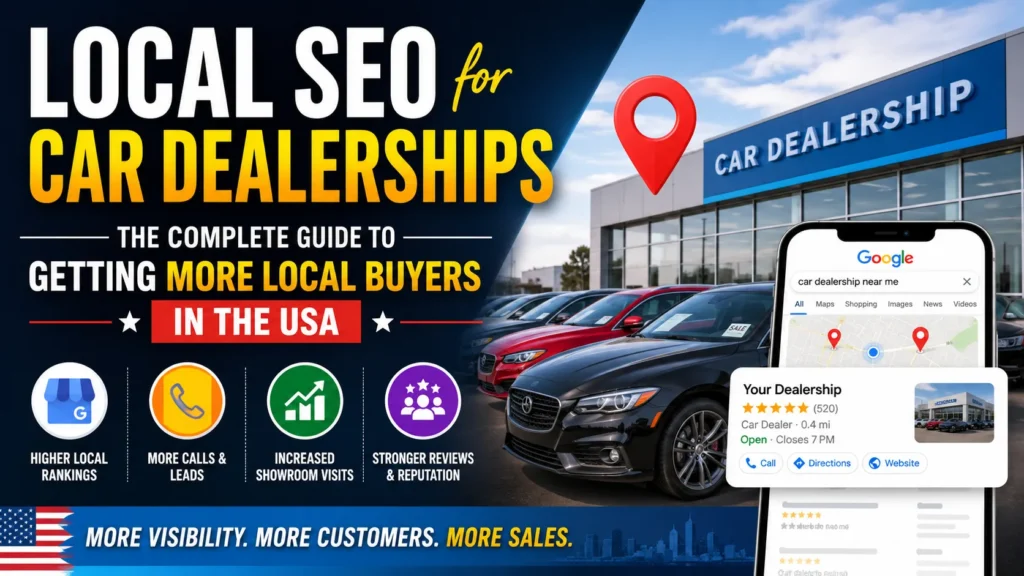
Most car buyers begin their search online before visiting a dealership. They compare nearby dealerships, browse inventory, read reviews, and explore financing options through Google. That’s why local SEO for car dealerships is essential.
It helps your dealership appear in Google Search, Google Maps, and other local search results when potential customers are ready to buy or book a service.
Unlike traditional advertising, SEO for car dealerships targets people with strong buying intent in your local market, making it one of the most cost-effective ways to generate qualified leads, showroom visits, and phone calls. In this guide, you’ll learn proven local SEO strategies, Google’s key ranking factors, and practical techniques to grow your dealership’s online visibility.
If you’re looking for professional assistance, Tekcurio Digital Marketing Agency provides data-driven local SEO solutions to help car dealerships across the USA attract more local customers and increase sales.
What Is Local SEO for Car Dealerships?
Local SEO for car dealerships is a digital marketing strategy designed to improve a dealership’s visibility in location-based search results. Its primary goal is to help nearby customers find your dealership when they search for new cars, used vehicles, financing, maintenance services, trade-ins, or other automotive solutions.
Unlike traditional SEO, which often targets a national audience, local SEO focuses on attracting customers within your service area. Search engines use location signals, business information, website relevance, and customer engagement to determine which dealerships appear in local search results.
For example, if someone in Phoenix searches for “Honda dealership near me,” Google attempts to show the most relevant nearby dealerships. If your dealership has a well-optimized online presence, accurate business information, positive customer reviews, and helpful local content, your chances of appearing in those search results increase significantly.
Local SEO also supports long-term business growth because it connects your dealership with customers who are already close to making a purchase. Instead of competing for broad automotive keywords with national websites, you compete for highly targeted searches that often lead directly to showroom visits and sales.
Why Is Local SEO Important for Car Dealerships?
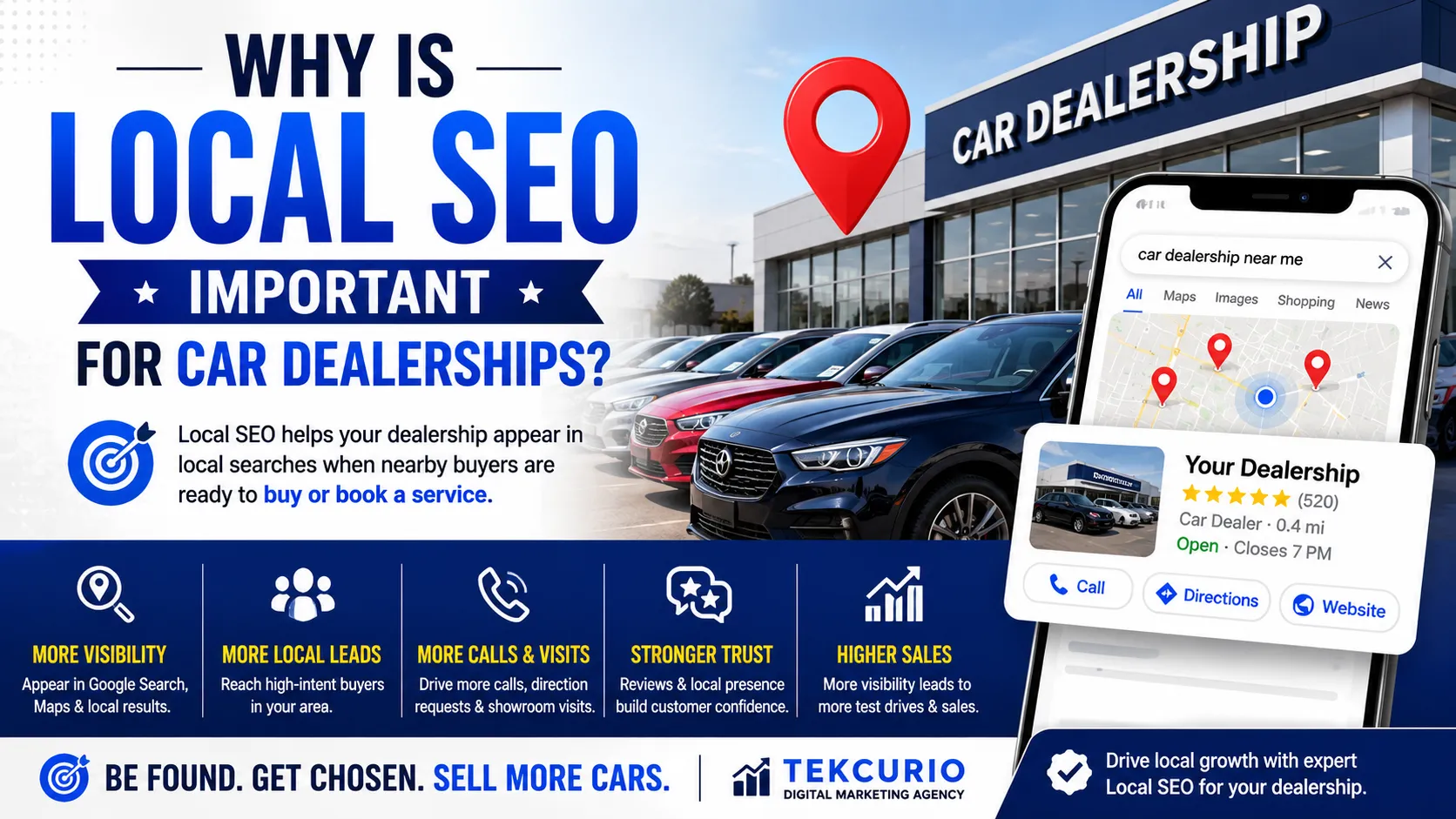
Buying a vehicle is a significant financial decision, and most buyers spend time researching dealerships before making contact. They compare inventory, pricing, financing options, customer reviews, and dealership reputation. If your dealership is difficult to find online, many potential customers may never consider visiting your showroom.
Local SEO helps solve this challenge by improving your visibility at the exact moment people are searching for vehicles in your area.
Some of the biggest advantages include:
- Higher visibility in Google Maps and local search results.
- More qualified website visitors who are actively looking for nearby dealerships.
- Increased phone calls, direction requests, and showroom visits.
- Stronger online credibility through positive customer reviews.
- Better long-term marketing ROI compared to relying solely on paid advertising.
- Increased opportunities to promote financing, service, parts, and trade-in programs.
For dealerships operating in competitive cities across the USA, strong local visibility can become a major competitive advantage. Even if two dealerships sell similar vehicles, the one with stronger local SEO often receives more customer inquiries simply because it appears first in search results.
How Does Google Rank Local Car Dealerships?
Google uses hundreds of ranking signals for search results, but local search is largely influenced by three primary factors: Relevance, Distance, and Prominence. Understanding these factors helps dealerships build a stronger optimization strategy.
Relevance
Relevance refers to how closely your dealership matches what a user is searching for. Google analyzes your website, Google Business Profile, business categories, service pages, inventory descriptions, and other online information to determine whether your dealership offers what the searcher needs.
For example, if someone searches for “certified pre-owned Toyota dealership,” Google looks for dealerships that clearly indicate they sell certified pre-owned Toyota vehicles. The more detailed and accurate your information is, the easier it becomes for Google to understand your business.
Distance
Distance measures how close your dealership is to the person performing the search. While you cannot change your physical location, you can strengthen local relevance by maintaining accurate business information across every online platform. Google wants to show nearby businesses that can realistically serve the customer.
Prominence
Prominence measures how well-known and trusted your dealership appears online. Google evaluates factors such as:
- Customer reviews
- Overall review ratings
- Website authority
- Local backlinks
- Business citations
- Online mentions
- Brand reputation
- Website quality
A dealership with hundreds of positive reviews, consistent business information, and strong community recognition is generally more likely to rank higher than one with little online presence.
Comparison of Google’s Local Ranking Factors
Ranking Factor | Why It Matters for Car Dealerships | How to Improve It |
Relevance | Helps Google understand your services and inventory | Optimize website pages, vehicle listings, and Google Business Profile |
Distance | Connects nearby customers with your dealership | Maintain accurate location and service-area information |
Prominence | Builds trust and authority | Earn reviews, local backlinks, media mentions, and customer engagement |
What Makes Local SEO Different from Traditional SEO?
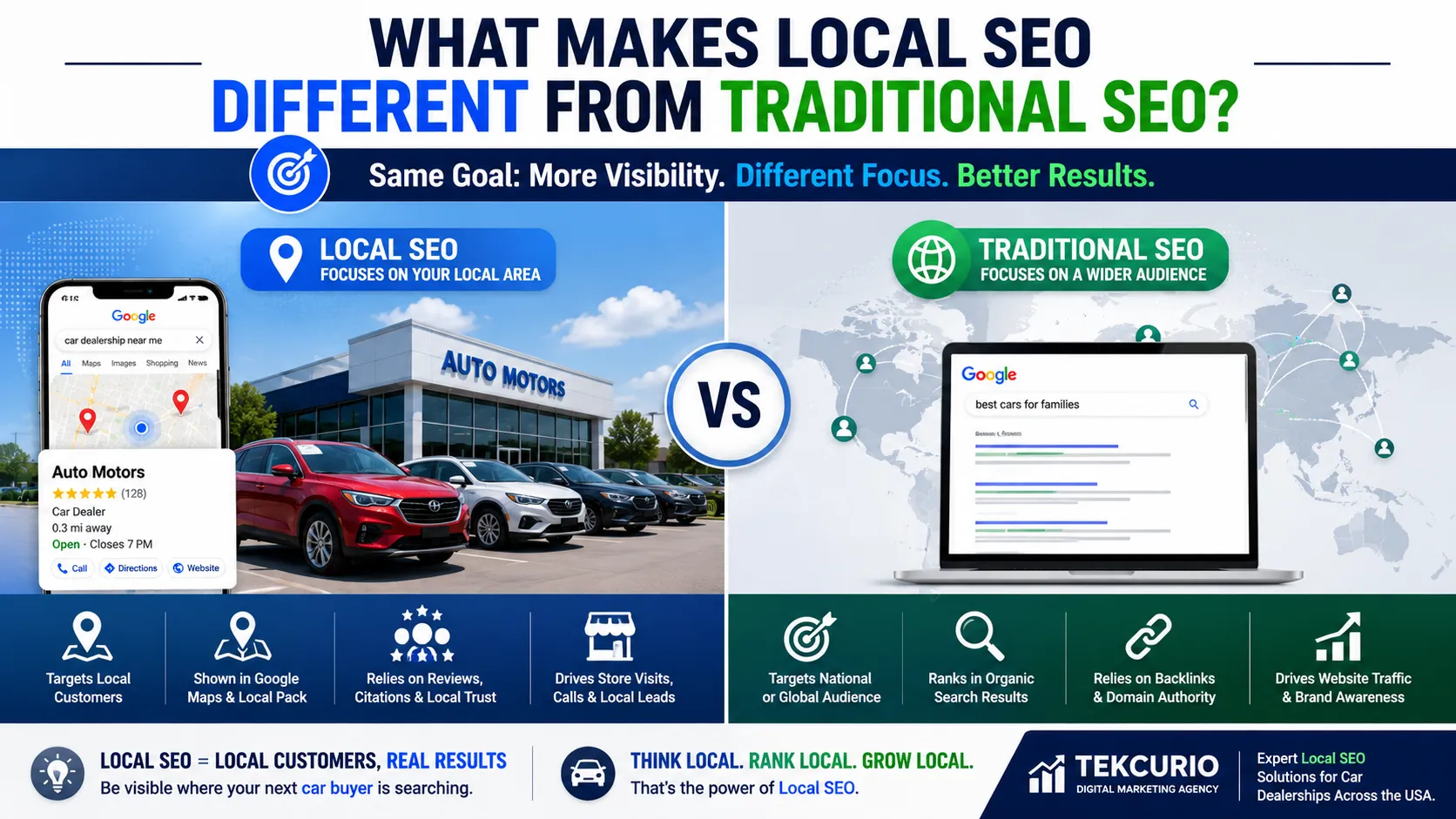
Although both strategies aim to improve search visibility, their objectives are different.
Traditional SEO often targets broad informational keywords that attract visitors from anywhere in the country. Local SEO, however, focuses on users within a specific geographic area who are more likely to become customers.
For a dealership, ranking nationally for “best SUV” may bring visitors from states where you do not operate. Ranking locally for “SUV dealership in Denver” attracts customers who can actually visit your showroom.
This location-focused approach makes local SEO far more valuable for automotive businesses serving specific cities, counties, or regions.
Local SEO also relies more heavily on Google Business Profile optimization, customer reviews, map rankings, and local citations than traditional SEO. These additional trust signals help Google determine which dealerships deserve greater visibility within local search results.
Why Does Search Intent Matter in SEO for Car Dealerships?
Successful SEO is not just about ranking for keywords. It is about satisfying the user’s intent. Someone searching for “used car financing near me” expects financing information from nearby dealerships, not a general article about auto loans.
Similarly, a search for “Jeep dealer in Austin” signals strong purchase intent. The user is likely comparing dealerships before visiting one.
Understanding search intent allows dealerships to create content that directly answers customer questions while guiding them toward scheduling a test drive, requesting financing, or contacting the sales team. When your website consistently satisfies user intent, search engines recognize that value and reward your pages with stronger visibility over time.
Why Is Google Business Profile the Foundation of Local SEO?
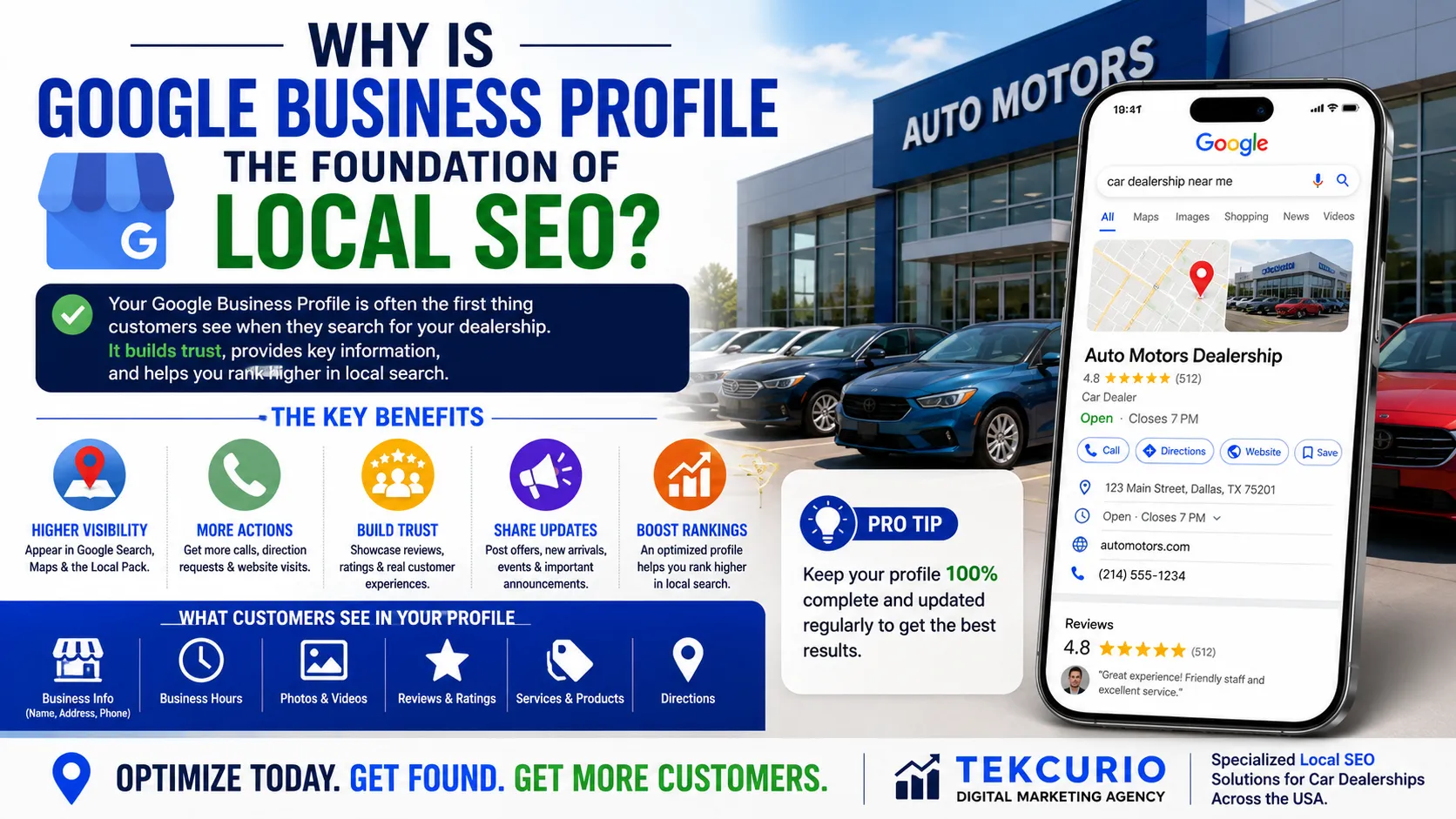
Before visiting a dealership’s website, many customers interact with its Google Business Profile. This listing often appears in Google Maps and local search results, making it one of the most influential elements of local SEO.
A complete and regularly updated profile helps Google understand your dealership while providing customers with essential information such as operating hours, contact details, directions, photos, services, and customer reviews.
An optimized Google Business Profile also increases the likelihood of appearing in Google’s Local Pack, which is the prominent group of business listings displayed for many local searches.
Because this profile serves as a digital storefront, dealerships should keep every detail accurate and updated. Even small inconsistencies can reduce customer trust and impact local rankings.
How Should You Optimize Your Car Dealership Website for Local SEO?
Your website is the foundation of your entire local SEO strategy. While your Google Business Profile helps customers discover your dealership, your website provides the detailed information that builds confidence and encourages visitors to take action. Google also uses your website to determine whether your dealership deserves higher rankings for local searches.
A professionally optimized dealership website should clearly explain what vehicles you sell, the services you provide, where you operate, and why customers should choose your dealership over nearby competitors. Every important page should answer a customer’s questions while helping search engines understand your business.
Instead of creating pages only for search engines, focus on designing pages that genuinely help buyers. Helpful content keeps visitors engaged longer, improves trust, and increases the likelihood of generating inquiries or showroom visits.
What Makes a Local Landing Page Effective?
Many dealerships serve multiple cities or regions. Creating dedicated location pages allows you to target customers searching within each specific area.
A strong local landing page should be unique rather than copied from another city page. It should explain how your dealership serves customers in that location while providing useful local information. For example, if your dealership serves Dallas, Fort Worth, and Arlington, each city should have its own detailed landing page.
The content should discuss nearby services, local driving conditions, customer testimonials from that area, and the inventory or promotions available to residents. Google rewards unique and valuable location pages because they better satisfy local search intent.
Why Is On-Page SEO Important for Car Dealerships?
On-page SEO helps search engines understand the purpose of every page on your website. It also improves the experience for visitors by organizing information logically and making it easier to navigate.
Each important page should include a clear title, descriptive headings, well-written content, optimized images, and internal links to related pages. Instead of repeating keywords unnaturally, use language that sounds natural while covering the topic comprehensively.
For example, a page about used SUVs should explain available models, financing options, warranties, inspection processes, and customer benefits instead of simply repeating “used SUV dealership” multiple times.
Google increasingly rewards pages that demonstrate expertise and provide complete answers rather than pages focused only on keyword density.
How Important Are Customer Reviews for Local Rankings?
Customer reviews are among the strongest trust signals in local SEO. They influence both Google’s ranking algorithms and the purchasing decisions of potential buyers.
When customers compare dealerships, reviews often become the deciding factor. Positive experiences shared by real buyers reassure new customers that your dealership provides reliable service, transparent pricing, and professional support. Reviews also provide fresh user-generated content that helps Google better understand your dealership’s reputation.
Instead of asking for reviews only occasionally, dealerships should develop a consistent review strategy throughout the customer journey. Sales teams, service advisors, and customer support representatives can politely request feedback after a successful interaction.
Equally important is responding to reviews professionally. Thank customers for positive comments and address negative experiences respectfully by offering practical solutions. Active engagement demonstrates that your dealership values customer satisfaction.
Why Are Local Citations Essential?
A local citation is any online mention of your dealership’s business information, including its name, address, and phone number (often called NAP information). Search engines compare these citations across multiple trusted websites to verify that your dealership is legitimate and operates where it claims to operate.
If one directory lists an old phone number while another uses a different business name, Google may become less confident in your business information. Even small inconsistencies can weaken local rankings. Maintaining identical business information across all major directories helps strengthen trust and supports higher local visibility.
Some dealerships overlook citation management after changing addresses, phone numbers, or business names. Performing regular citation audits ensures your information remains accurate everywhere customers may discover your business.
Should Every Dealership Have Individual Service Pages?
Yes. Service pages help dealerships rank for searches beyond vehicle sales. Many customers search for automotive services such as oil changes, brake repairs, tire replacements, financing assistance, trade-in evaluations, or certified pre-owned inspections before they search for a new vehicle.
Creating dedicated pages for these services allows your dealership to attract customers at different stages of the buying journey. For example, someone searching for “Toyota brake service in Houston” may eventually purchase their next vehicle from the same dealership if they have a positive service experience.
Each service page should explain the process, customer benefits, scheduling options, and reasons to choose your dealership rather than using generic manufacturer descriptions.
How Does Mobile Optimization Affect Local SEO?
Mobile devices now account for a large share of automotive searches. Many buyers search while commuting, visiting competing dealerships, or comparing inventory from their smartphones.
If your website loads slowly or is difficult to navigate on mobile devices, visitors often leave before exploring your inventory or contacting your sales team. A mobile-friendly dealership website should provide a seamless browsing experience across every screen size.
Visitors should be able to search inventory, view vehicle photos, schedule appointments, request financing, and call your dealership without unnecessary effort.
Google also uses mobile-first indexing, meaning it primarily evaluates the mobile version of your website when determining rankings. Improving mobile usability benefits both search performance and customer satisfaction.
Why Does Website Speed Matter?
Website speed affects user experience, conversions, and SEO performance. Car buyers expect inventory pages, financing calculators, and vehicle images to load quickly. Slow-loading websites increase bounce rates because visitors often leave before interacting with your content.
Several factors influence website speed, including image optimization, hosting quality, unnecessary scripts, and server performance. Regular performance testing helps identify opportunities to improve loading times. A faster website not only creates a better customer experience but also sends positive quality signals to search engines.
How Can Content Marketing Help SEO for Car Dealerships?
Content marketing allows dealerships to answer customer questions before they visit the showroom. Instead of publishing articles solely for search rankings, focus on solving real problems that buyers face throughout their purchasing journey. Helpful educational content builds trust while increasing your website’s authority.
Examples include financing guides, maintenance advice, seasonal driving tips, electric vehicle comparisons, trade-in recommendations, and buying checklists.
When customers consistently find useful information on your website, they become more likely to view your dealership as a trusted source of automotive expertise. High-quality content also generates backlinks, social shares, and repeat visitors, all of which support long-term SEO growth.
How Can Local Content Improve Search Visibility?
Local content demonstrates your dealership’s connection to the communities you serve. Rather than publishing only general automotive articles, create content that reflects local interests, weather conditions, driving habits, and community events.
For example, dealerships located in northern states may publish winter driving preparation guides, while dealerships in coastal regions may focus on hurricane vehicle preparedness. Community involvement also creates valuable content opportunities.
Sponsoring local events, supporting charities, participating in school programs, or hosting vehicle safety workshops provides authentic stories that strengthen both local reputation and search visibility. Google values businesses that demonstrate genuine community engagement because these signals reinforce local authority.
Why Are Internal Links Important?
Internal links help both users and search engines navigate your website. When related pages connect naturally, visitors can continue exploring inventory, financing information, service offerings, and dealership resources without returning to the main menu.
Search engines also use internal links to understand the relationship between pages and distribute authority throughout your website.
For example, a blog about buying a family SUV can naturally link to your SUV inventory page, financing page, and trade-in information. Well-planned internal linking improves user experience while strengthening SEO performance.
How Does Technical SEO Support Local Rankings?
Technical SEO ensures that search engines can efficiently crawl, index, and understand your dealership website. Although visitors rarely notice technical improvements directly, they significantly influence long-term search performance.
A technically optimized dealership website should include secure HTTPS encryption, structured data, clean URLs, XML sitemaps, optimized images, and proper indexing controls.
Structured data is especially valuable because it helps search engines understand details such as dealership information, reviews, vehicle inventory, business hours, pricing, and frequently asked questions.
As Google increasingly relies on structured information to generate AI-powered search experiences, technical optimization becomes even more important.
Technical SEO Checklist for Car Dealership Websites
SEO Element | Why It Matters | Recommended Best Practice |
HTTPS Security | Builds trust and protects users | Secure every page with SSL |
Mobile Optimization | Supports Google’s mobile-first indexing | Responsive design across all devices |
Website Speed | Improves user experience and rankings | Compress images and optimize code |
Structured Data | Helps search engines understand content | Implement LocalBusiness, Vehicle, FAQ, and Review schema |
XML Sitemap | Improves crawling efficiency | Keep sitemap updated automatically |
Internal Linking | Strengthens page relationships | Link relevant pages naturally throughout the website |
How Can Local Backlinks Improve Your Dealership’s Rankings?
Backlinks remain one of Google’s strongest ranking signals because they help search engines determine whether a website is trustworthy and authoritative. For local dealerships, backlinks from reputable businesses and organizations within the community are often more valuable than links from unrelated websites.
A quality backlink acts like a recommendation. When respected local organizations link to your dealership, Google gains additional confidence that your business is legitimate and relevant within your service area.
Instead of trying to acquire a large number of links, dealerships should focus on earning backlinks naturally through valuable partnerships and community involvement. Local backlink opportunities include sponsorships, business associations, automotive events, local newspapers, nonprofit organizations, community blogs, and regional business directories.
Participating in charity events, supporting youth sports teams, or collaborating with local organizations often results in authentic mentions that strengthen both your online reputation and local SEO. Backlinks should always come from credible and relevant sources. Low-quality or spammy links may provide little value and can sometimes harm long-term SEO performance.
Why Is Google Business Profile Activity Important After Optimization?
Many dealerships optimize their Google Business Profile once and then leave it untouched for months. However, Google favors businesses that actively maintain their profiles because consistent activity signals that the business is operating and engaging with customers.
Keeping your profile updated demonstrates reliability while providing customers with accurate information before they visit your dealership.
Regular updates may include announcing seasonal promotions, introducing newly arrived inventory, sharing dealership events, highlighting financing offers, posting customer success stories, or uploading recent showroom photographs.
Customers also appreciate seeing current business hours, holiday schedules, and recent images before planning a visit. An active profile improves customer experience while reinforcing local relevance.
How Does AI Search Change Local SEO for Car Dealerships?
Search is evolving rapidly as AI-powered search engines and Google’s AI Overviews provide direct answers to users instead of simply listing websites. This shift means dealership websites should focus on becoming trusted information sources rather than only targeting rankings.
AI systems prefer content that is:
- Well organized
- Factually accurate
- Easy to understand
- Comprehensive
- Supported by real expertise
Instead of writing content around isolated keywords, dealerships should answer complete customer questions.
For example, rather than creating a page that repeatedly targets “car financing,” develop a resource explaining how financing works, what documents buyers need, common loan terms, credit score considerations, and available financing options. Content that completely answers user questions has a greater chance of being referenced by AI-powered search experiences.
How Can Dealerships Optimize for GEO, AEO, and AIO?
Modern search optimization extends beyond traditional SEO.
Generative Engine Optimization (GEO) focuses on making content easy for AI systems to understand and reference. This involves providing clear explanations, accurate information, logical headings, and comprehensive topical coverage.
Answer Engine Optimization (AEO) emphasizes answering specific customer questions directly. Many users now search conversationally, asking questions such as “Which SUV is best for families?” or “How long does dealership financing approval take?” Pages that provide concise, accurate answers are more likely to appear in featured snippets and AI-generated responses.
AI Optimization (AIO) ensures that website content is structured so artificial intelligence systems can easily interpret important information. Clear headings, descriptive paragraphs, structured data, and organized page layouts all contribute to stronger AI visibility.
Although these concepts sound technical, they ultimately align with Google’s long-standing goal of rewarding websites that provide the most helpful information.
What Are the Most Common Local SEO Mistakes?
Many dealerships invest in digital marketing but unintentionally weaken their search visibility by overlooking basic optimization practices. One common mistake is creating duplicate location pages with only the city name changed. Google prefers unique pages that provide meaningful local information instead of repetitive content.
Another frequent issue is neglecting customer reviews. Reviews influence both rankings and consumer trust, so failing to request or respond to feedback can reduce visibility over time.
Some dealerships also rely heavily on manufacturer-provided content. While manufacturer descriptions are useful, copying them word for word creates duplicate content that offers little unique value.
Outdated business information presents another challenge. Changes to addresses, phone numbers, operating hours, or website URLs should always be updated across every online directory to maintain consistency.
Technical issues such as slow loading speeds, broken links, poor mobile usability, and missing structured data can also prevent otherwise strong websites from reaching their full ranking potential. Avoiding these common mistakes creates a stronger foundation for long-term SEO success.
How Can You Measure Local SEO Success?
Successful SEO should always be measured using meaningful business metrics rather than rankings alone. Improved rankings are valuable, but the real objective is generating qualified customers who contact your dealership or visit your showroom.
Useful performance indicators include organic website traffic, Google Business Profile interactions, phone calls, direction requests, contact form submissions, service bookings, financing inquiries, and vehicle sales generated through organic search.
Google Search Console and Google Analytics provide valuable insights into search visibility, user behavior, and website performance. Monitoring these reports regularly helps dealerships identify new opportunities while quickly addressing potential problems.
SEO is an ongoing process rather than a one-time project. Regular performance reviews allow dealerships to refine their strategies as customer behavior and search algorithms continue evolving.
Frequently Asked Questions
How long does local SEO take to produce results?
Most dealerships begin noticing improvements within three to six months, although highly competitive markets may require additional time. Consistent optimization generally produces stronger long-term results than short-term tactics.
Is local SEO better than paid advertising?
Both strategies serve different purposes. Paid advertising delivers immediate visibility, while local SEO builds sustainable organic traffic that continues generating leads over time. Many successful dealerships use both approaches together.
Can independent dealerships compete with large automotive groups?
Yes. Independent dealerships often perform exceptionally well in local search by focusing on customer service, local reputation, authentic reviews, and community involvement rather than trying to compete nationally.
How often should dealership websites publish new content?
Publishing two to four high-quality articles each month is sufficient for most dealerships. Consistency and usefulness are more important than publishing large amounts of low-quality content.
Does local SEO help service departments too?
Absolutely. Service-related searches such as oil changes, brake repairs, tire replacements, inspections, and maintenance are highly localized. Optimizing these pages helps attract customers who may later purchase vehicles from the same dealership.
Conclusion
Local SEO for car dealerships is one of the most effective ways to attract nearby buyers, increase online visibility, and drive more showroom visits. By optimizing your Google Business Profile, website, reviews, and local presence, your dealership can generate qualified leads and stay ahead of local competitors.
If you’re ready to grow your dealership with proven SEO for car dealerships, Tekcurio Digital Marketing Agency offers customized local SEO solutions for dealerships across the USA. Book an appointment today to discuss your dealership’s goals and discover how our expert SEO services can help you attract more local customers and increase vehicle sales.



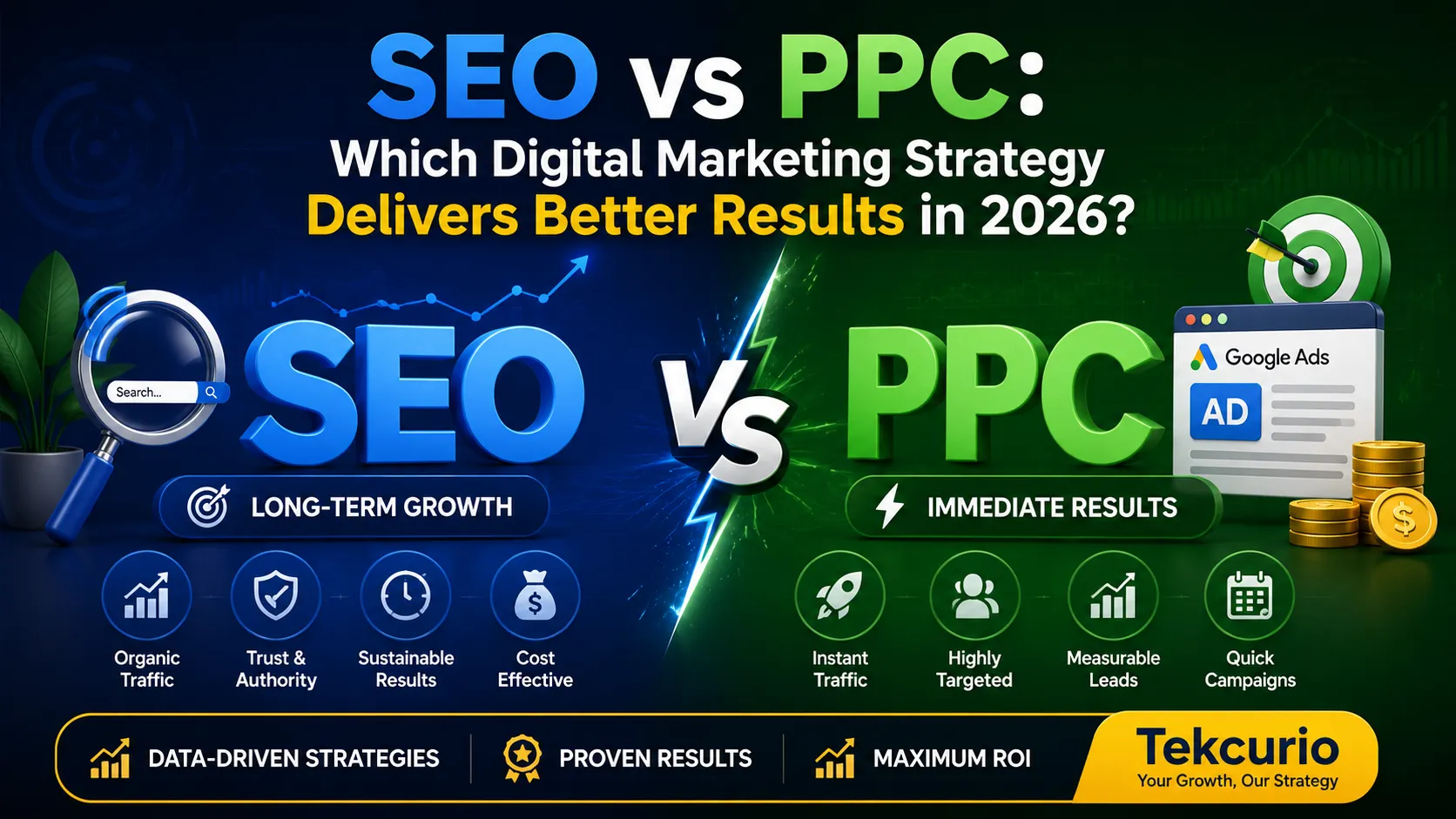
SEO vs PPC: Which Digital Marketing Strategy Delivers Better Results in 2026?
Jump To SEO vs PPC: Which Digital Marketing Strategy Delivers

Small Business Social Media Marketing Agency: A Complete Guide for Businesses That Want Real Growth in the USA
Jump To Small Business Social Media Marketing Agency: A Complete
Google Ads Management Agency in the USA: Maximize ROI & Grow Your Business Faster
Jump To Google Ads Management Agency in the USA: Maximize
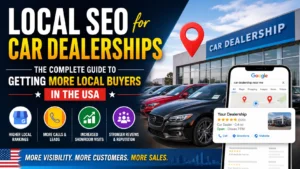
Local SEO for Car Dealerships: The Complete Guide to Getting More Local Buyers in the USA
Jump To Local SEO for Car Dealerships: The Complete Guide